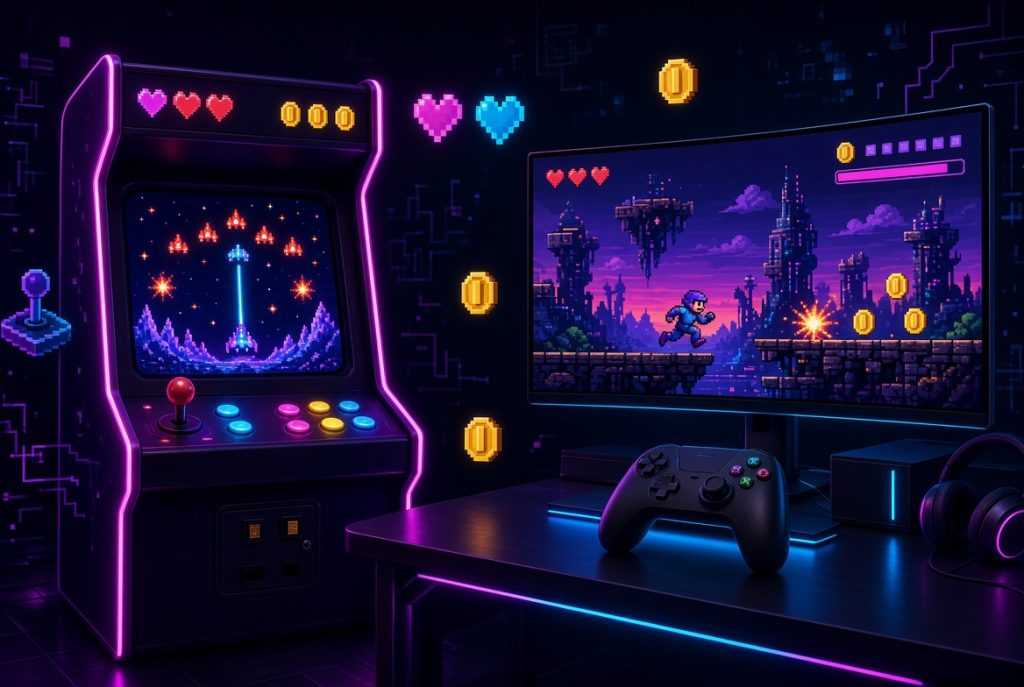
Walk into any modern mobile game and you’ll notice something familiar lurking beneath the polished graphics. That satisfying “just one more try” feeling? It’s not new. It’s the same pull that kept quarters flowing into cabinets decades ago, now dressed up in slick animations and cloud saves.
Indie developers and mobile studios have quietly rebuilt their entire design philosophy around arcade fundamentals: tight feedback loops, instant readability, and risk that feels just a little too tempting to walk away from. What used to be dismissed as “retro nostalgia” has become the economic backbone of an entire industry.
This shift matters because it changes what “modern” actually means in game design. Complexity isn’t the goal anymore—clarity is.
Why Arcade Physics Never Really Left Gaming
Classic arcade cabinets were essentially physics toys before they were stories. Pinball tables relied on momentum and friction. Claw machines turned mechanical uncertainty into pure entertainment. There was no lore to absorb, just movement and timing that felt good in your hands.
That philosophy never actually disappeared. Indie developers today still lead with mechanics first, narrative second. A dash, a jump, a well-timed dodge—these get tuned like instruments before a single line of dialogue gets written. It’s a design language built on feel, not exposition.
Drop Mechanics Show Up In Surprising New Titles
Falling-object puzzlers and physics-based runners have exploded across mobile storefronts, and most of them borrow directly from drop-and-luck arcade design. Objects tumble, bounce, and settle in ways that feel random but strangely fair—exactly the sensation that made old pachinko-style machines so compelling.
This drop mechanic isn’t confined to puzzle games anymore. It has spread into loot systems, battle pass reward reveals, and bonus rounds in mobile RPGs. Plinko crypto casinos take the same principle further still — users can watch drop-based randomness play out in real time with transparent odds and provably fair outcomes.
The broader mobile market backs this up with real numbers. Hyper-casual titles—many built entirely around simple drop or reflex mechanics—accounted for 52% of all mobile game downloads worldwide in 2023, according to mobile industry data. That’s not a niche trend. That’s a dominant design category.
Digital Casinos Borrow The Same Addictive Loop
Variable-ratio reward schedules—unpredictable wins spaced out just enough to keep players engaged—originated in arcade and casino machines long before mobile gaming existed. Today, those same reward patterns show up in loot boxes, battle passes, and daily login bonuses across mainstream titles.
This isn’t accidental. Developers know that unpredictability, paired with quick feedback, keeps sessions going. Rewarded video ads, often tied to bonus spins or extra lives, delivered nearly three times the value of standard interstitial ads in 2023, with completion rates around 85%, based on mobile monetization research. The reward loop isn’t just fun—it’s financially essential to how these games sustain themselves.
What This Reveals About Player Psychology Today
None of this is really about nostalgia. It’s about recognizing that human attention responds predictably to short, clear, rewarding loops—whether that loop lives in a 1985 arcade cabinet or a 2026 mobile app. Simplicity scales. Complexity, ironically, often gets in the way of engagement.
Physical arcades understand this too. The arcade games center market was valued at nearly $14 billion in 2025 and is projected to more than double by 2033, according to industry market analysis, with redemption-style games leading that growth because tangible, repeatable rewards still work. Modern game design didn’t invent a new formula. It just rediscovered an old one and gave it better lighting.

Heather Neves is working as a freelance content writer. She likes blogging on topics related to parenting, golf, and fitness, gaming . She graduated with honors from Columbia University with a dual degree in Accountancy and Creative Writing.