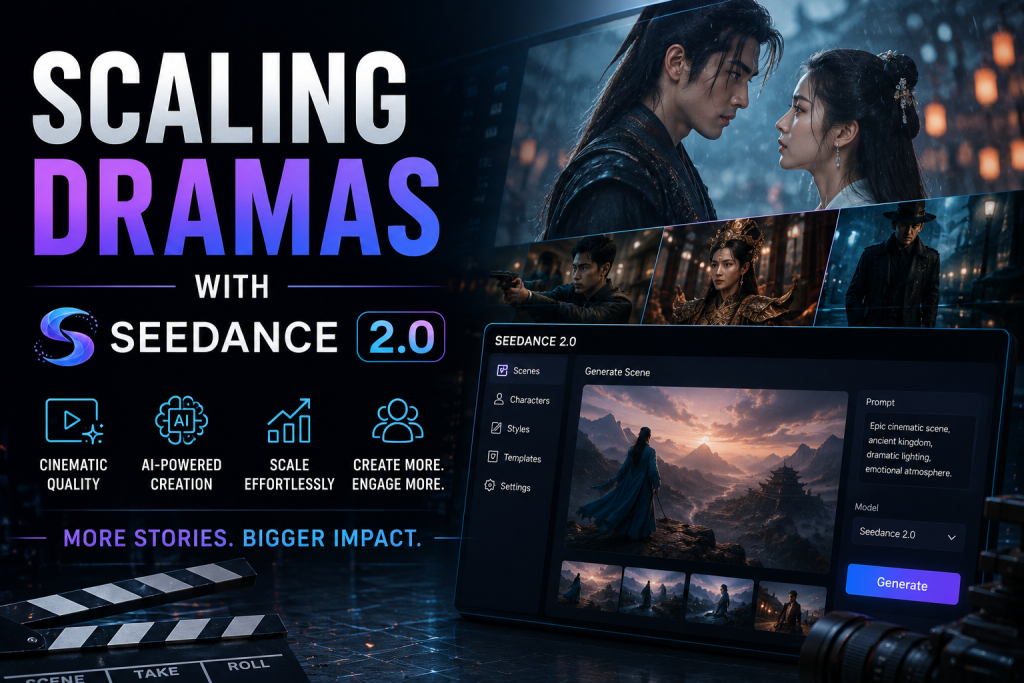
Introduction: The Short Drama Boom and Production Barriers
In 2026, the global entertainment landscape is undergoing a massive paradigm shift driven by the explosive rise of ultra-short, vertical dramas. Platforms tailored for mobile-first consumption have captured billions of hours of user attention worldwide. Audiences are hooked on high-stakes, fast-paced storytelling. However, beneath this lucrative gold rush lies a profound operational crisis: the traditional video production bottleneck.
Creating a compelling short drama series, which typically consists of 60 to 100 episodes, requires immense logistical and financial resources. Producers must continuously manage scriptwriting, talent casting, location scouting, and intensive post-production editing. In an industry governed by fast-moving platform algorithms where content freshness dictates visibility, this legacy workflow is highly unsustainable. While generative AI tools promised a quick escape from these overheads, early iterations failed due to unpredictability. Fortunately, Seedance 2.0 has emerged as an industry-grade solution, redefining the industrial scaling of narrative video content through precise cinematic control and asset consistency.
The Core Impediments of Traditional Narrative Production
To understand the transformative value of next-generation AI, creators must first diagnose the friction points that plague traditional sets and early generative video tools.
1. Character Inconsistency Issues
The foundation of any narrative, no matter how brief, is character permanence. Audiences must emotionally invest in a protagonist’s journey, recognizing their features across various scenes. Early text-to-video generative models completely failed here. Because these primitive networks relied on unconstrained diffusion processes, generating consecutive shots using the same prompt resulted in severe identity drift. A character could transform completely between scenes, rendering the footage entirely useless for continuous storytelling.
2. Random and Uncontrollable Camera Movements
Commercial filmmaking relies heavily on intentional camera language to build tension and drive plot progression. Directors use precise pans, tilts, and tracking moves to guide the viewer’s eye. Early AI video generation operated as a random lottery; entering a camera directive often caused bizarre spatial warping or unnatural background artifacts. Without predictable machine-driven cinematography, assembling a professional-looking scene-by-scene storyboard was virtually impossible.
3. Exorbitant Financial and Temporal Risks
Traditional short drama production carries massive financial vulnerabilities. Moving a full crew to physical locations, paying day-rates to professional talent, and managing unpredictable real-world environments can drain a studio’s budget rapidly. If a storyline fails to hook the audience within the first few episodes, the upfront capital is entirely lost. This prevents creators from running rapid content experiments to find true winners.
How Seedance 2.0 Resolves the Narrative Workflow Conundrum
The creative sector did not need another abstract art generator; it demanded a robust, deterministic, and controllable digital production pipeline. By re-engineering structural conditioning layers within advanced diffusion models, Seedance 2.0 directly answers the calls of professional video creators.
1. Advanced Identity-Preserving Engine
The defining technological achievement of this platform is its high-fidelity identity preservation. Instead of forcing creators to guess complex prompt combinations to keep a face steady, the system permits users to upload just a few reference images of a character. The neural network locks these distinctive facial topologies into a stable “Digital Actor Asset.”
When rendering new scenes, this asset remains perfectly isolated from changing background lighting or environments. Whether your script requires the character to walk through a rainy alleyway or stand in a bright office, their facial geometry and expressions stay flawlessly identical across every frame. This eliminates identity drift and allows studios to build valuable, proprietary digital character IPs without booking real-world actors.
2. Granular Cinematic Camera Controls
To eliminate the frustrating unpredictability of traditional AI video generation, the platform integrates a sophisticated virtual camera trajectory controller. Production teams can command the viewport with exact kinematic accuracy. Through simple parameter inputs, users can establish multi-axis motions:
- Continuous tracking shots with zero background distortion.
- Smooth, cinematic pans that mimic premium mechanical fluid-head tripods.
- Precise dramatic push-ins designed to highlight intense character emotions.
By delivering absolute authority over the visual frame, the tool ensures that every second of output aligns perfectly with the director’s narrative goals.
A Standardized SOP for High-Volume AI Production
To maximize output while keeping computational costs low, top-tier global studios utilize a highly structured standard operating procedure with this advanced video generator.
Step 1: Pre-Building the Character Vault
Before generating scenes, the creative team establishes the digital cast. High-resolution reference angles for the protagonist and key supporting roles are uploaded to the asset vault. This pre-production step guarantees that whenever a character is summoned by a script, their visual representation remains uniform.
Step 2: Structured Script-to-Prompt Modularization
Traditional scripts are translated into clear, modular prompt structures. Instead of typing poetic paragraphs, engineers use a systematic syntax: [Character ID] + [Environment/Lighting] + [Action/Expression] + [Camera Command]. This structural discipline maximizes first-run success rates, cutting compute waste significantly.
Step 3: High-Frequency Hook Testing
In the short video space, the initial three seconds determine user retention. Because the generation cost with this software is a tiny fraction of a physical shoot, producers can easily create multiple distinct opening hooks for a single episode. Once initial audience metrics identify the highest-retention variant, the rest of the narrative arc is scaled seamlessly in that creative direction.
Conclusion: Emancipating Creators Through AI Innovation
The future of digital storytelling belongs to teams capable of iterating narratives at the speed of thought. The traditional barriers to filmmaking—prohibitive financial budgets, geographical constraints, and long post-production timelines—are being permanently dismantled.
By employing Seedance 2.0 as the foundation of your production studio, you bypass operational bottlenecks and gain the ability to produce premium, character-consistent short dramas for global audiences at scale. Embracing these advanced, deterministic tools is the definitive path to dominating the modern digital content marketplace.