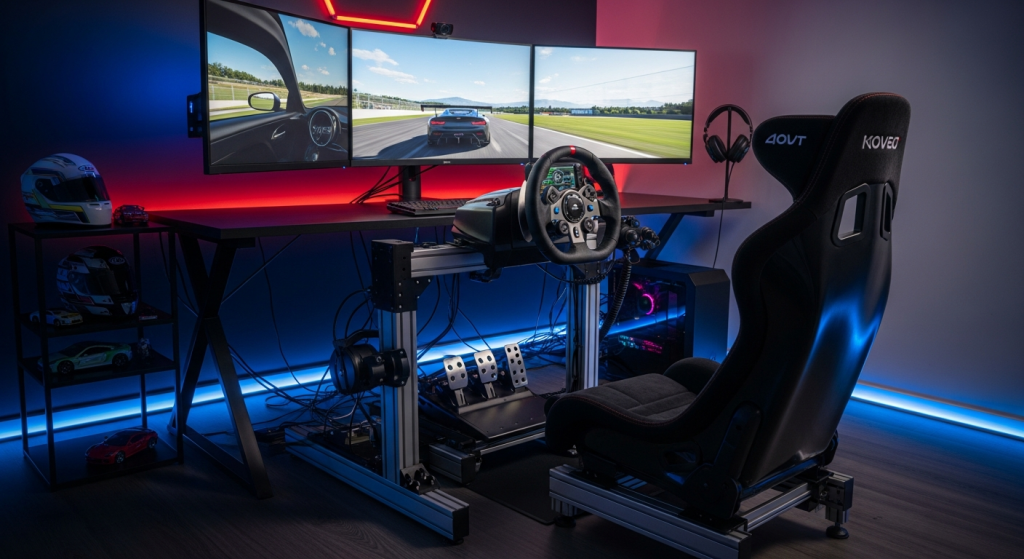
Key Highlights
Here are the key takeaways about sim racing rig compatibility:
-
The core of compatibility lies in matching the mounting patterns of your wheel base and pedals to the pre-drilled holes on your sim racing rig, ensuring a realistic driving experience.
-
A robust build quality is essential for a sim racing rig to handle the high torque from direct drive wheel bases and the force from load cell pedals during intense racing sessions.
-
Australia’s sim racing market sets high standards, with brands like Trak Racer ensuring wide compatibility with gear from major manufacturers like Simucube and Fanatec.
-
Universal rig frames, often made from aluminum profiles, offer the best adaptability, making it easier to mix and match sim racing gear.
-
The sim racing community is a great resource for checking compatibility and finding solutions for unique setups.
-
Adjustability in your rig’s wheel deck and pedal plate is crucial for comfort, performance, and achieving a realistic racing experience.
Introduction
Welcome to sim racing! A well-matched setup—rig, wheel base, and pedals—is crucial for full immersion. This guide will help you choose the right gear so you can start racing sooner.
Understanding Sim Racing Rig Compatibility

Compatibility in a sim racing rig means your wheel base and pedals securely attach to your rig, with matching mounting holes and a sturdy frame. This ensures stability and immersion—an incompatible setup can cause flex, instability, or damage. To ensure you have reliable customer support, check the manufacturer’s product page to confirm your gear is supported.
What Makes a Sim Racing Rig Compatible with Wheel Bases and Pedals?
True compatibility is more than matching brands—it relies on physical design and structural integrity. The key is the mounting pattern: your rig’s pre-drilled holes must align with your wheel and pedals for a secure fit, setting a gold standard for performance and ensuring you have the right seat for the best experience.
Build quality is crucial, especially for direct drive wheels and load cell pedals, which need a sturdy rig that resists flex under force feedback or heavy braking.
A compatible sim racing rig securely supports your gear and allows precise adjustment of wheel and pedal positions for comfort and control. Always check the manufacturer’s website for supported brands and models.
Overview of Key Compatibility Standards in Australia
The Australian sim racing market is now mature, with local standards ensuring high compatibility. While there’s no official “sim racing law,” most rigs support a wide range of hardware, making setup and upgrades simple. You can also connect with others through Simucube’s Discord community to share tips and experiences, including the latest Simucube Tuner software updates.
Brands like Trak Racer offer universal rigs featuring:
-
Pre-drilled mounting patterns: Compatible with major wheelbases and pedals, utilizing lightbridge technology for seamless connectivity.
-
Structural rigidity: Handles direct drive wheels and load cell pedals, often constructed from aluminium profiles.
-
Modular design: Aluminum profiles allow easy adjustments and upgrades
These standards ensure most rigs work with your current or future gear. When choosing a rig, look for pre-drilled mounting options to maximize compatibility.
Essential Components of a Sim Racing Rig
A sim racing rig is a setup designed for immersive driving. Its main components are the wheelbase, pedals, and frame.
The wheelbase provides force feedback to simulate car movements. Pedals control acceleration and braking, with premium models offering realistic resistance. The frame ensures stability and ergonomic positioning. Let’s take a closer look at each part.
Wheel Bases: Types, Features, and Mounting Considerations
The wheelbase is the core of your sim racing setup, delivering force feedback that connects you to the virtual car through the Simucube Link Platform. Serious racers favor direct drive wheelbases for precise, detailed feedback across the entire range by linking the steering wheel directly to the motor.
Modern direct drive systems offer improved motor design with exceptional torque accuracy and smooth performance, providing more realistic feedback. Investing in a quality wheelbase means better feedback every drive.
Mounting is essential—powerful wheelbases need sturdy mounts to avoid flex. Consider:
-
Mounting Pattern: Make sure your rig is pre-drilled for your wheelbase brand (e.g., front-mount for Simucube Quick Release Wheelside Kit, bottom-mount for Fanatec) to ensure maximum precision.
-
Rigidity: Your rig must handle your wheelbase’s torque; entry-level rigs may flex with stronger motors.
-
Adjustability: Look for height and angle adjustments for comfort.
Pedals: Main Variations and Mounting Options
Pedals connect you to your car’s throttle and brakes, making them crucial for control and immersion. The main difference: standard potentiometer pedals track movement, while advanced load cell pedals measure pressure for a more realistic brake feel and higher force feedback detail, similar to what you would experience with Indy cars.
Mounting varies—some pedals mount flat, others need brackets or side mounts. Choose a rig that matches your pedals for the best fit.
Before buying, check:
-
Pedal Plate Compatibility: Make sure your rig has pre-drilled holes for your pedals.
-
Adapter Needs: Some high-end pedals may require adapter plates if holes don’t align.
-
Adjustability: Look for rigs with adjustable angles, height, and spacing for comfort and performance.
Factors Influencing Compatibility with Wheel Bases
Ensuring your wheelbase is compatible with your sim racing rig is essential for optimal performance. The new Simucube Link Hub Quick Release technology, along with modern direct drive wheelbases, produces strong forces, so a sturdy rig is necessary for precise force feedback. Secure mounting is critical.
Key factors include mounting points and overall rig strength. Let’s examine mounting patterns, adjustability, and how different brands address compatibility.
Mounting Points, Patterns, and Adjustable Fittings
Accurate mounting points are crucial for an optimal sim racing experience. Most rigs use standardized patterns like 8020 aluminum profiles, offering flexible setups for easy customization to fit different wheelbases, pedals, and wheel rims. These compatible systems provide a stable base for smooth driving.
Adjustable fittings make it easy to customize for various gear. Using products like Simucube or Simucube Link devices and load cell pedals underscores the need for precise force feedback and precise force effects with solid build quality. This adaptability boosts performance during races, helping sim racers achieve greater precision and cut lap times.
Factors Influencing Compatibility with Pedal Sets
Ensuring your pedals are compatible with your sim racing rig is key to top performance, especially during the most intense racing sessions. Unstable or misaligned pedals hurt consistency, particularly with load cell brakes. A compatible pedal plate with a new control box provides a stable base for precise control.
Compatibility depends on pedal plate adjustability and available adapters for non-standard setups. These features ensure a secure, comfortable platform—letting you brake later and accelerate harder with confidence.
Pedal Plate Adjustability and Placement Flexibility
An adjustable pedal plate is crucial for any sim racing rig, especially when combined with button boxes and bucket seats. Unlike fixed mounts, true adjustability lets you fine-tune pedal height, angle, and position for ergonomic comfort.
Proper placement boosts comfort, reduces fatigue, and enables precise inputs—improving both performance and immersion, making options like the Fanatec ClubSport GT Cockpit even more appealing. It also supports better posture and field of view, with some rigs allowing inverted pedals for a more realistic GT experience.
Benefits of an adjustable pedal plate:
-
Ergonomic Comfort: Matches pedals to your body, reducing strain.
-
Wider Compatibility: Fits various pedal sets, including unique sizes.
-
Performance Tuning: Enables optimal placement for advanced techniques like heel-and-toe shifting.
Common Adapter Solutions for Unique Pedal Setups
If your new pedals don’t fit your rig’s pre-drilled holes, adapter plates are the solution. Both sim racing brands and third-party companies offer plates that match various mounting patterns.
Adapters are especially useful for unique or high-end pedals with non-standard layouts, or when using older rigs. These metal plates feature multiple hole patterns for secure mounting.
Common adapter options:
-
Official Brand Adapters: Plates made by pedal manufacturers for their products.
-
Third-Party Plates: Universal adapters from sim racing specialists.
-
DIY Solutions: Community-shared 3D-printed or custom designs.
Mixing and Matching Wheel Bases and Pedals
Modern sim racing lets you mix gear from different brands, so you’re not locked into one ecosystem. Choose your preferred wheel base and pedals for a customized setup.
Before combining components, ensure your rig supports both and your PC recognizes them. With proper planning, building the hybrid setup is simple.
Pros and Cons of Using Different Brands Together
Yes, you can mix and match sim racing wheelbases and pedals from different brands on a sim racing rig. This allows you to make the right choice for your preferred sim racing wheelbase and load cell pedals for a custom setup.
Pros:
-
Full customization with any brand’s components
-
Can be more cost-effective than bundled sets
Cons:
-
Each device may need separate software, making setup more complex
-
Compatibility issues can be harder to troubleshoot, with less official support
Choosing a Universal Sim Racing Rig Frame for Versatility
For maximum versatility, choose a universal sim rig frame made from durable aluminum profiles with T-slot designs for easy hardware mounting and unlimited adjustability.
The main benefit is modularity—upgrading your wheel base or pedals is simple; just slide the mounts along the profiles. This flexibility also improves ergonomics and field of view. Most specialized online retailers offer these rigs.
When buying a universal sim rig frame, consider:
-
Profile Thickness: Choose sturdy profiles (80/40 or larger) to prevent flex.
-
Included Hardware: Make sure it includes enough T-nuts and bolts.
-
Expandability: Look for support for accessories like shifter mounts or monitor stands.
Compatibility Across Entry-Level, Mid-Range, and Professional Rigs
Compatibility isn’t universal—it depends on your sim racing rig’s tier. Entry-level rigs prioritize different features than pro setups, which affects support for wheel bases and pedals.
Knowing these differences helps you make smarter purchases. Entry-level rigs are great for beginners but may limit future upgrades. We’ll compare entry-level compatibility with the flexibility of pro setups.
Entry-Level Sim Racing Rigs with High-End Hardware
Entry-level sim racing rigs can sometimes accommodate high-end hardware like direct drive wheelbases or load cell pedals, but there are trade-offs. These rigs often lack the rigidity to securely hold a racing seat and handle strong forces during long practice sessions, leading to flex, reduced force feedback, and less immersion. Heavy braking may bend or shift the pedal plate, causing inconsistent inputs.
If you use high-end gear on an entry-level rig, reinforcement may be necessary. However, it’s usually better to invest in a mid-range or professional rig built for such equipment.
Professional Sim Racing Rigs for Ultimate Flexibility
Professional sim rigs deliver top-tier compatibility and performance with a consistent wheelbase. Made from thick aluminum or heavy-duty steel, they offer unmatched rigidity—eliminating flex with powerful direct drive motors and heavy pedals.
These highly modular rigs support accessories like motion platforms, shifter mounts, and multi-monitor stands. Their durability and flexibility make them the best long-term choice for sim racers.
Top options include:
-
Aluminum Profile Rigs: 8020-style frames with universal compatibility and adjustability.
-
Trak Racer: Pre-drilled for various wheelbases and pedals.
-
Custom-built Rigs: Tailored designs for perfect fit and compatibility.
Conclusion
To get the best sim racing experience, ensure your rig, wheel base, and good software compatible pedals are compatible. Check mounting points, adjustable fittings, and brand compatibility. The right setup—whether for beginners or pros—boosts performance and immersion. Explore options and online guides to find what fits your needs and elevate your sim racing experience.

Hi! I’m Bryan, and I’m a passionate & expert writer with more than five years of experience. I have written about various topics such as product descriptions, travel, cryptocurrencies, and online gaming in my writing journey.