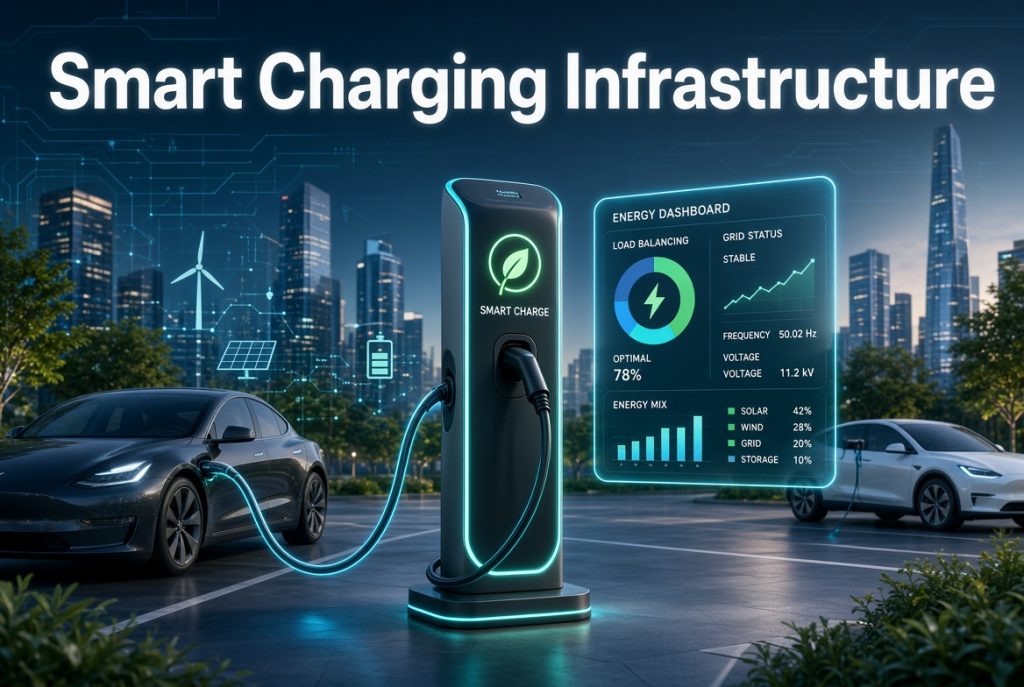
The acceleration of industrial electrification of fleets is altering the manner in which distribution centers, warehouses, and manufacturing sites handle energy. Electric forklifts are currently beneficial in terms of operation and environmentally, and large-scale charging can have great demands on facility power grids. Smart charging infrastructure is a solution to this difficulty, as it ties fleet operations and energy management systems together, enabling companies to align the timing of charging, track electricity use, and ensure reliable operations. With a typically updated forklift fleet management system, charging would be an inseparable component of wider plant energy planning but not a solitary upkeep undertaking.
Smart Load Management Eliminates Peak Energy
One of the most important capabilities of smart charging is load management. The requirement of electricity can change drastically over the course of a working day, and concurrent charging could drive a facility to costly peak demand. Smart charging systems are capable of prioritizing vehicles based on their operational urgency and allocating available electrical capacity among chargers. The system can not only dynamically adjust the rates of charging, but it does not have to charge every vehicle at maximum power right away. Such a strategy aids in avoiding unnecessary peaks of demand and having the most vital vehicles at hand when they are needed by production or warehouse processes.
Charging Around Operational Requirements
The major factor in applying smart charging has to be fleet productivity. The unavailability of a forklift due to insufficient charge on its battery can cause inconvenience to material handling and cause expensive delays. Smart systems thus integrate information on energy with data on operation. The vehicles that are put on intensive shifts can be given precedence, whereas forklifts under consideration to start working later at night can charge up at less demanding times. The historical data of utilization may also indicate recurrent patterns, and with that, the managers may be able to develop more precise charging strategies. This means that energy optimization can coexist with, and does not disrupt, daily logistics.
Utilizing Renewable Energy More Efficiently
Smart charging may also enhance the worth of renewable energy that is installed in an industrial environment. The case of solar generation, in particular, generally changes during the daytime. Intelligent coordination is necessary to prevent exporting more solar electricity to the grid whilst forklifts have the upper hand charging with electricity elsewhere. Some form of charging workload can be timed to occur at times of increased renewable output, with operational needs and equipment constraints. By matching electricity use to the availability of cleaner electricity, facilities will be able to reduce your carbon footprint and may also enhance the payback of investments in renewable energy.
Battery health and charging optimization
Energy efficiency must not be bought at the cost of battery life. Overhigh-power charging, improper charging cycles, and bad battery maintenance may raise the cost of degradation and replacement. Smart infrastructure is able to track charging behavior and data related to the battery to aid more suitable charging practices. Managers will be able to spot abnormalities in charging patterns, deteriorated batteries, or significantly more energy-consuming vehicles than similar ones. Integrating charging intelligence with preventive maintenance is thus a more all-encompassing approach to fleet efficiency that will save energy and sudden equipment breakdowns.
Online security, capacity, and assimilation
With charging infrastructure being linked to enterprise networks, cybersecurity gains importance. Systems used in fleets, charging service, building-management systems, and energy-management software should communicate with one another with the necessary degree of security and proper access control. Scalability is also the factor that businesses should consider when choosing infrastructure. A ten-forklift solution might not serve well a future fleet of fifty or one hundred machines. Open integrations, consistent data standards, centralized monitoring, and modular charging capacity can assist organizations to grow electrified without entirely redesigning their energy infrastructure.
Constructing a more energy-ready fleet
Smart charging infrastructure cannot be seen as just a replacement of current forklift charging stations but rather a structural linkage between the productivity of the fleet vehicle and the management of the facility’s energy. Through the combination of data on vehicle, charger controls, grid capacity, renewable generation, and operational schedules, businesses can make the process of charging more predictable and efficient. Improved energy usage, decreased peak power, enhanced battery control, and enhanced sustainability results can be better outcomes. There is a growing need to tie charging facilities to smart fleet and power-management systems as industrial facilities progressively switch to electrified fleets, which will enable resilient, cost-effective, and environmentally friendly operations.