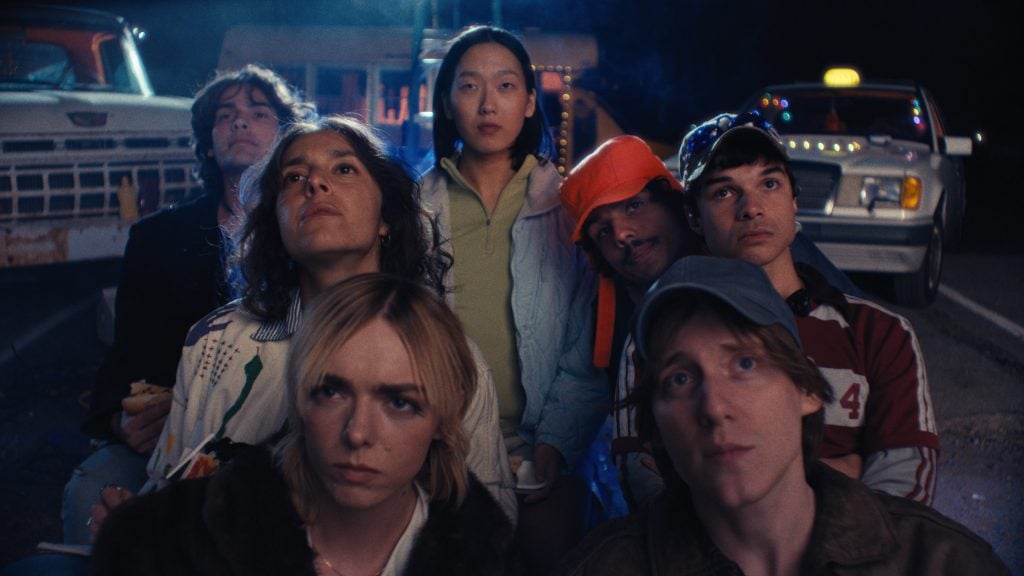
Sparks is the kind of coming-of-age film that begins with a strange idea and slowly reveals that the idea itself isn’t really the point. The story centers on a group of teenagers in Sparks, Nevada, who call themselves the Crop—an aimless but tightly bonded circle of friends drifting through long desert days and even longer nights. Their lives revolve around the usual rituals of adolescence: wandering around town, talking about nothing and everything, and trying to imagine a future that still feels far away. What keeps their imagination alive is a local urban legend. Somewhere outside the city, they believe, a reservoir may actually be a portal through time.
At first, the legend feels like the kind of story teenagers tell to make life feel a little more exciting. It’s something to joke about, something to dare each other to investigate. The possibility that it might be real adds just enough mystery to their otherwise repetitive routines. But everything changes when Cleo arrives in town. Played with quiet intensity by Elsie Fisher, Cleo isn’t interested in the reservoir as a fun myth or a group adventure. She believes in it. More than that, she arrives with a cinematic obsession: after discovering a cigarette vending machine that inexplicably produces a book on Jean-Luc Godard, Cleo has already morphed into a cinephile, and the notion of time travel becomes intertwined with her romantic fantasies of 1960s Paris—a place where, in her mind, she might meet Godard himself.
That oddly specific goal gives the story its emotional center. For Cleo, the reservoir isn’t a curiosity—it’s an escape route. Her obsessive enthusiasm unsettles the rest of the Crop because it forces them to take the legend seriously for the first time. What had once been a casual fantasy suddenly feels charged with possibility. The idea that life could be different, that somewhere beyond their dusty Nevada surroundings, there might be a better, more vibrant version of existence, begins to take hold. Her cinematic longing adds an extra layer of wonder, blending the real with the imagined in a way that feels whimsical yet deeply human.
Where Sparks works best is in its patient portrayal of teenage inertia. These characters aren’t rebellious stereotypes or larger-than-life personalities. They are kids caught in that strange limbo between childhood and adulthood, unsure of who they are or what they want. The film treats that uncertainty with empathy. Their long conversations, quiet wandering, and half-formed dreams feel natural rather than exaggerated. It captures a familiar truth about adolescence: sometimes it feels like your real life hasn’t started yet, like you’re simply waiting for something to finally change.
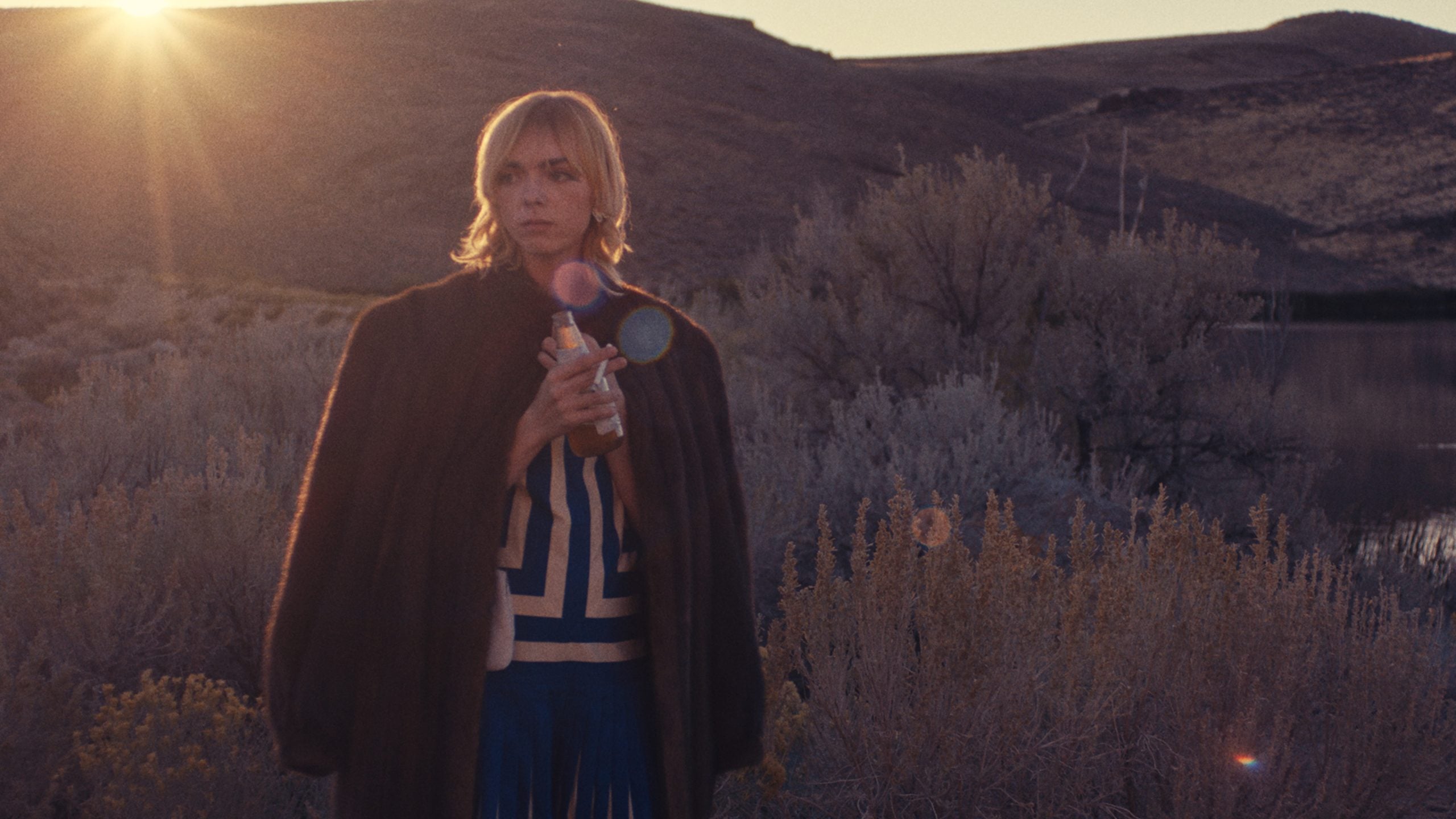
Elsie Fisher’s performance as Cleo is the film’s anchor. She avoids turning the character into a quirky outsider who swoops in to fix everyone’s lives. Instead, Cleo feels deeply internal and driven by a longing she doesn’t fully explain. Fisher plays her as someone who has already decided the present isn’t enough. Her fascination with 1960s Paris and Godard—a world she has only glimpsed through books and films—reveals the film’s deeper idea about nostalgia. It isn’t just about longing for the past. It’s about believing that somewhere, sometime, life might feel more meaningful than it does right now.
The film also benefits from its setting. The Nevada desert provides a haunting backdrop, full of wide skies, empty roads, and quiet stretches of water that seem to invite mystery. The reservoir itself becomes a powerful symbol, not because the film tries to explain it, but because it refuses to. Whether it’s truly a time portal or simply a myth doesn’t matter nearly as much as what it represents to the characters. It’s a reflection of their hopes, their boredom, and their desire for something beyond the boundaries of their town.
Sparks ultimately isn’t a science-fiction film in the traditional sense. It doesn’t build toward elaborate explanations or dramatic revelations. Instead, it lingers in uncertainty, using the idea of time travel—and Cleo’s Godard-inspired fantasy—as a way to explore the emotional restlessness of youth. The film suggests that growing up often means realizing that the magical escape routes we imagine probably don’t exist. But for a brief period in life, believing they might can make everything feel possible.
By the time Sparks ends, its mystery remains unresolved. Yet that ambiguity feels intentional. What the film leaves behind isn’t a puzzle to solve, but a feeling—the bittersweet recognition of what it means to be young, inspired by movies, legends, and dreams, and convinced that somewhere else, in another time or place, life might finally make sense.
Sparks held its World Premiere as part of the Narrative Spotlight section of the 2026 SXSW TV & Film Festival.
Director: Fergus Campbell
Screenwriter: Fergus Campbell
Rated: NR
Runtime: 76m
What the film leaves behind isn’t a puzzle to solve, but a feeling—the bittersweet recognition of what it means to be young, inspired by movies, legends, and dreams, and convinced that somewhere else, in another time or place, life might finally make sense.

Codie Allen is a passionate trans and queer film critic and entertainment writer based in Orlando, FL. A Rotten Tomatoes-approved critic, Dorian Awards member, and CACF member, they also contribute to The Curb and InSession Film. When they’re not writing about films, you can find them sipping way too much tea and listening to Taylor Swift.