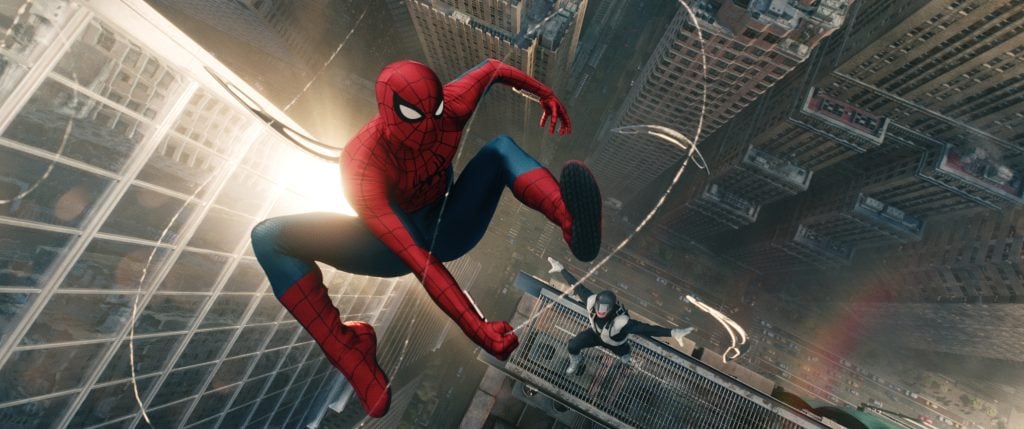
Anyone who spent hours swinging through New York in Insomniac Games’ Marvel’s Spider-Man series may have experienced a strange feeling while watching Spider-Man: Brand New Day.
Some of Tom Holland’s movements look remarkably familiar.
A fan-created side-by-side video places several moments from the Marvel Studios movie next to footage from Insomniac’s PlayStation games. The comparison includes Spider-Man launching himself from a rooftop, flipping through the air, using his webs to overpower groups of enemies and falling alongside a collapsing structure.
The similarities are difficult to dismiss as coincidence. They also support what Holland and director Destin Daniel Cretton have already said about the film’s approach to Spider-Man’s action.
The Insomniac games were a major source of inspiration for the stunt team behind Brand New Day.
The Side-By-Side Video Highlights Several Familiar Moves
The comparison begins with one of the film’s earliest swinging sequences.
Spider-Man propels himself from a New York rooftop, launching his body high above the street before completing an acrobatic flip and attaching another web to continue his movement through the city.
The moment closely resembles the point-launch and traversal animations found throughout Insomniac’s games. Players can use nearby surfaces to pull Spider-Man forward, building speed before sending him into a flip or extended swing.
That style of movement gives Spider-Man more momentum than a conventional leap from a rooftop. He does not simply jump and wait for the next web line to catch him. Every surface becomes something he can use to redirect or accelerate his body.
Other comparisons focus on the movie’s combat.
Holland’s Spider-Man uses his webs to pull enemies off balance, throw opponents through the air and move quickly between several attackers. His physical strikes are combined with webbing rather than treated as separate abilities.
Those combinations resemble the finishing moves used by Peter Parker and Miles Morales in the games. Insomniac’s Spider-Men frequently launch enemies into the air, pull themselves toward targets and use web lines to turn ordinary punches and kicks into more elaborate takedowns.
The comparison also places a major falling sequence from the movie beside similar set pieces from the games. Spider-Man dives toward the ground while pieces of a damaged structure fall around him, forcing him to navigate debris while attempting to prevent a larger disaster.
The exact circumstances are different, but the visual language is unmistakably similar.
Destin Daniel Cretton Confirmed The Games Inspired The Stunt Team
The resemblance is not simply something fans noticed after the movie arrived in theaters.
Cretton has openly discussed using Insomniac’s games as a reference while developing the film’s action sequences.
The director admitted that he is not a dedicated gamer himself. Instead of pretending to possess a deep familiarity with the PlayStation series, he surrounded himself with stunt performers and action designers who regularly played the games.
Members of the team captured footage of moves they liked and brought those examples into the creative process. The filmmakers then discussed whether those actions could be recreated practically or adapted for the movie.
“Can we pull this move off?”
That question appears to have guided much of the action design.
The goal was not to reproduce gameplay animation frame by frame. A move that looks convincing when controlled through a video game does not automatically work when performed by a stunt double, captured by a physical camera and combined with visual effects.
The team instead treated the games as a library of possibilities.
Insomniac had already spent years considering how Spider-Man might move through a three-dimensional version of New York when he is not restricted by traditional filmmaking methods. The developers created thousands of transitions, combat animations and traversal techniques designed to make players feel continuously in control of the character.
Cretton’s stunt team could study those ideas and then determine which ones could be translated into live action without making Holland’s Spider-Man feel weightless or completely computer-generated.
Tom Holland Also Used The Games As A Reference
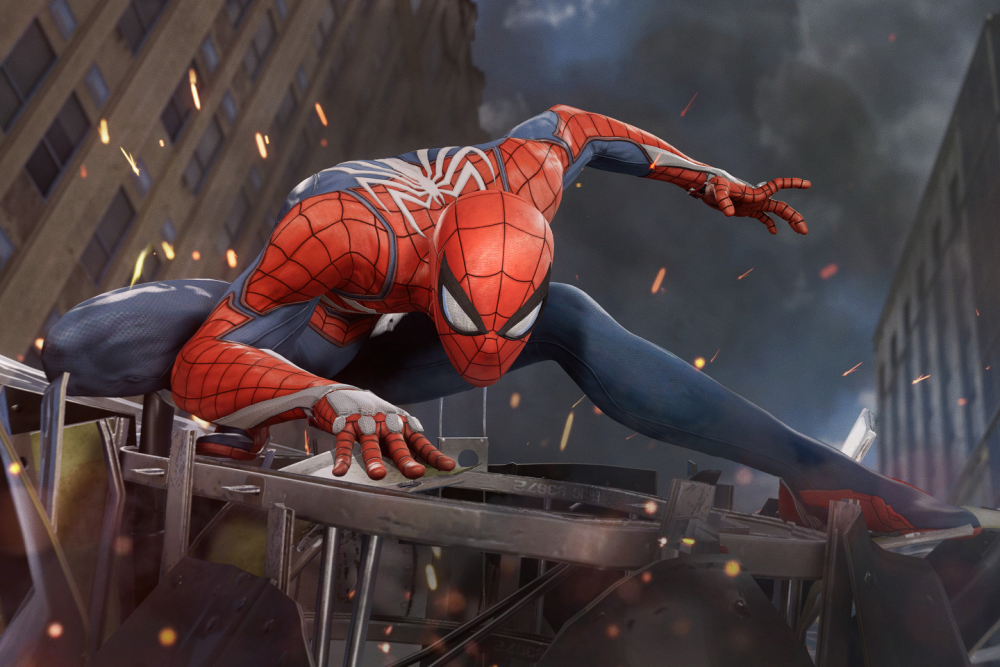
Holland has confirmed that the finishing moves in Brand New Day were influenced by Insomniac’s action design.
The actor is familiar with the games beyond their value as production references. While promoting the movie, Holland revealed that he had played one of the titles the night before its premiere because he was too excited to sleep.
His continued interest makes sense. The games offer one of the most complete modern interpretations of what it would feel like to move and fight as Spider-Man.
They also provide Holland with something earlier live-action actors did not have.
Tobey Maguire and Andrew Garfield could draw from comic-book artwork, animation and earlier movies, but neither actor had access to a video game interpretation as detailed and responsive as Insomniac’s version.
The PlayStation games allow Spider-Man to perform hundreds of small actions. He can recover from a fall, redirect himself around a building, run along a wall, throw an enemy into the air or connect several movements without stopping.
Those details can help an actor and stunt team think beyond the familiar collection of poses audiences already associate with the character.
The Influence Is About Movement, Not Shared Continuity
The comparisons do not mean that Holland’s Spider-Man and Insomniac’s Peter Parker exist in the same continuity.
They are separate interpretations of the Marvel character with different histories, supporting casts and versions of New York.
Insomniac’s Peter is already an experienced adult hero when the first game begins. He has been Spider-Man for approximately eight years, has an established relationship with the New York Police Department and has already encountered many of his most famous villains.
Holland’s Peter began as a teenager who was recruited by Tony Stark. His early adventures were shaped by the Avengers, advanced Stark technology and the larger MCU before Spider-Man: No Way Home removed those safety nets.
The games are therefore influencing how the movie’s Spider-Man moves rather than rewriting who he is.
That distinction matters because visual similarities can quickly become the foundation for unsupported crossover theories. Nothing in the comparison establishes that the PlayStation universe is becoming part of the MCU or that Insomniac’s Peter is preparing to appear in a live-action project.
The connection is creative rather than narrative.
Insomniac Changed What Audiences Expect From Spider-Man Action
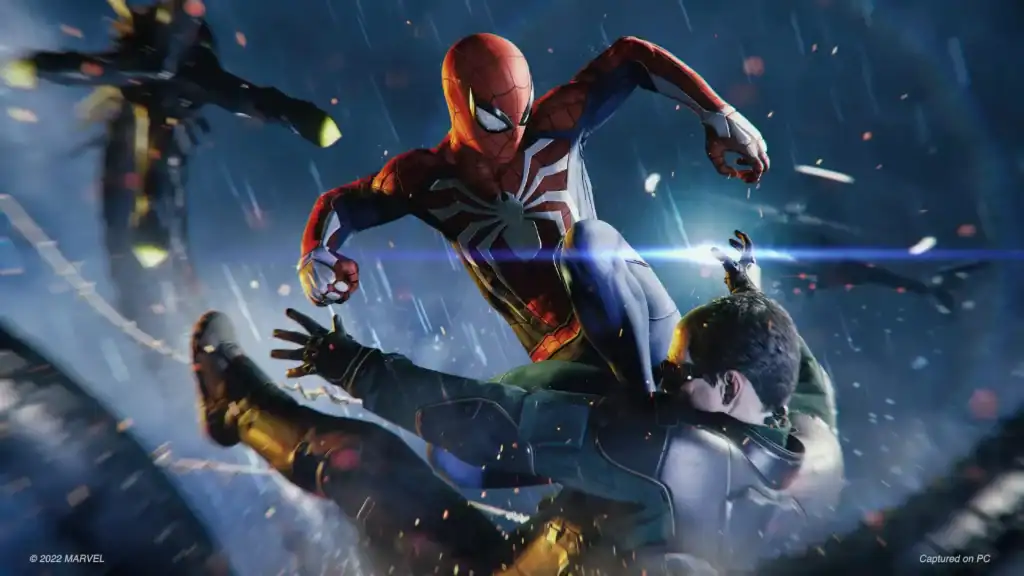
Insomniac’s first Marvel’s Spider-Man game arrived in 2018 and immediately became an important modern interpretation of the character.
The series continued with Marvel’s Spider-Man: Miles Morales and Marvel’s Spider-Man 2, expanding the playable version of New York while developing different movement and combat styles for Peter and Miles.
The games earned praise for their stories, but their influence on Spider-Man’s physical movement may prove just as lasting.
Previous games had already experimented with open-world web-swinging. Insomniac refined that idea by giving every movement a clear sense of speed, direction and player input.
Spider-Man can swing low between cars, climb rapidly above the skyline or release a web at the top of an arc to carry his momentum forward. He can run along buildings, pull himself toward specific surfaces and use environmental objects during combat.
The result is a version of Spider-Man who rarely appears to stop moving.
That fluidity is difficult to capture in a movie. A video game player controls the camera and decides where Spider-Man travels next. A filmmaker must choose the angle, pace and destination in advance while ensuring the audience can still understand what is happening.
Brand New Day appears to have found a productive middle ground. The movie borrows the energy and creativity of the games without making its action feel like recorded gameplay.
Brand New Day Gives Holland’s Spider-Man A More Developed Fighting Style
Holland’s Spider-Man has always been physically capable, but his earlier MCU appearances frequently presented him as inexperienced.
In Spider-Man: Homecoming, Peter struggled to understand the features built into his Stark-designed suit. His fights were messy because he was still learning how to use his abilities under pressure.
Spider-Man: Far From Home showed him becoming more confident, while No Way Home placed him against villains with abilities and experience he had never encountered before.
By the time Brand New Day begins, Peter has been operating alone for several years. The world no longer remembers Peter Parker, but Spider-Man has remained active throughout New York.
His more advanced fighting style reflects that missing period.
He has learned how to use his webbing aggressively, move between several enemies and turn the surrounding environment into part of an attack. His movements no longer look like those of a teenager improvising his way through every confrontation.
The Insomniac influence helps communicate that experience without requiring Peter to explain how much he has trained.
Audiences can see the difference through the way he carries himself.
Video Games Can Offer More Than Easter Eggs To Movies
Hollywood’s relationship with video games has traditionally centered on adaptation.
Studios turn popular games into movies or television shows, often attempting to recreate recognizable characters, locations and stories for audiences who may never have held a controller.
The influence seen in Brand New Day works differently.
Insomniac’s games are not the original source of Spider-Man. They are adaptations of the same Marvel comics that inspired the movies. However, the games developed their own solutions to questions that every Spider-Man project must answer.
How does he move through New York without becoming visually repetitive? How does he fight ordinary criminals without relying only on punches? How can his webbing become part of every action rather than a tool reserved for swinging?
The game developers answered those questions through interactive design. The filmmakers could then study the results and adapt the strongest ideas for another medium.
That creates a more interesting exchange than hiding a game controller in the background or inserting a costume solely as an Easter egg.
The influence becomes part of the filmmaking itself.
The Movie Still Needed To Make The Moves Feel Physical
Using a game as inspiration creates its own risks.
Video game characters can survive extreme falls, change direction in midair and perform movements that would be impossible for a real human body. Players accept those actions because they are part of the game’s controls and visual style.
A live-action movie can quickly lose its sense of reality when a digital character moves without believable weight.
Cretton’s challenge was preserving the creativity of Insomniac’s Spider-Man while making Holland’s version feel physically present in the scene.
The movie’s new suit helps with that goal. Its fabric visibly folds and shifts as Peter moves, reminding viewers that there is a person beneath the mask rather than a perfectly smooth digital model.
The filmmakers also combined visual effects with stunt work whenever possible. Even when a complete action could not be performed practically, beginning or ending the movement with a real performer helps create a stronger sense of continuity.
The most effective moments do not look like the movie suddenly switched to a cutscene. They look like Holland’s Spider-Man has learned new ways to use the powers he already possessed.
The Games Also Fit Brand New Day’s Back-To-Basics Direction
The influence extends beyond individual finishing moves.
Insomniac’s games understand that Spider-Man’s appeal comes from balancing large-scale action with the ordinary pressures of Peter Parker’s life.
Peter can save the city from a supervillain and still worry about employment, relationships, rent and whether he is disappointing the people closest to him.
Brand New Day returns Holland’s character to a similar balance following the ending of No Way Home.
He lives alone, listens for crimes and makes his own equipment without relying on Stark Industries. New York once again feels like his responsibility rather than one location within a much larger Avengers mission.
That does not make the movie an adaptation of Insomniac’s story. The film introduces its own conflicts and continues the MCU’s version of Peter’s life.
However, the games provide a useful example of how a modern Spider-Man story can feel large without losing its connection to the streets below.
The Comparison Shows Inspiration Rather Than Imitation
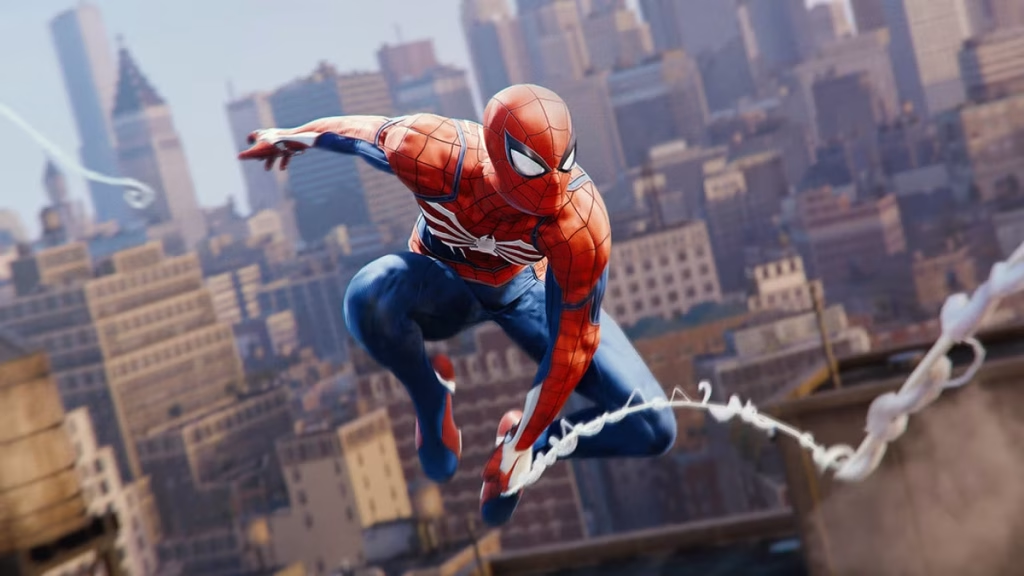
The side-by-side footage is convincing because it reveals how specific movements crossed from one medium into another.
The rooftop launch, midair flips, web-assisted takedowns and collapsing-building dive all carry the recognizable rhythm of Insomniac’s games.
That does not diminish the work of the movie’s stunt performers or action designers.
Influence is not the same as copying. Every Spider-Man adaptation builds on decades of comic art, animation, movies and games. The strongest versions recognize which earlier ideas captured the character particularly well and then find a new way to use them.
Insomniac created one of the most convincing physical interpretations of Spider-Man ever placed on a screen. Ignoring that achievement would have been a missed opportunity.
Cretton and his team instead allowed experienced gamers within the production to bring forward the moves that excited them. Holland then helped translate those ideas into the performance of a Peter Parker who has become faster, stronger and more confident since audiences last saw him.
The result is a movie that feels influenced by the games without becoming trapped inside them.
Insomniac’s Spider-Man Has Left A Lasting Mark On The Character
The fan comparison confirms something larger than a collection of similar action shots.
Insomniac’s series has become part of the visual vocabulary surrounding Spider-Man.
Future movies, animated projects and games will inevitably be compared with the studio’s approach to web-swinging and combat. The games gave audiences a chance to control Spider-Man’s movement directly, creating expectations that passive entertainment must now find ways to match.
Spider-Man: Brand New Day appears to understand that change.
Holland’s Spider-Man does not move exactly like the PlayStation version, nor should he. He remains a distinct character shaped by his own experiences in the MCU.
However, the movie embraces the speed, momentum and web-based creativity that made Insomniac’s action so satisfying.
The influence was already visible in theaters. Placing the scenes beside the games simply makes it impossible to miss.

DC Fanboy! Superman is the greatest comic book character of all time. Favorite movies are Man of Steel, Goonies, Back To the Future