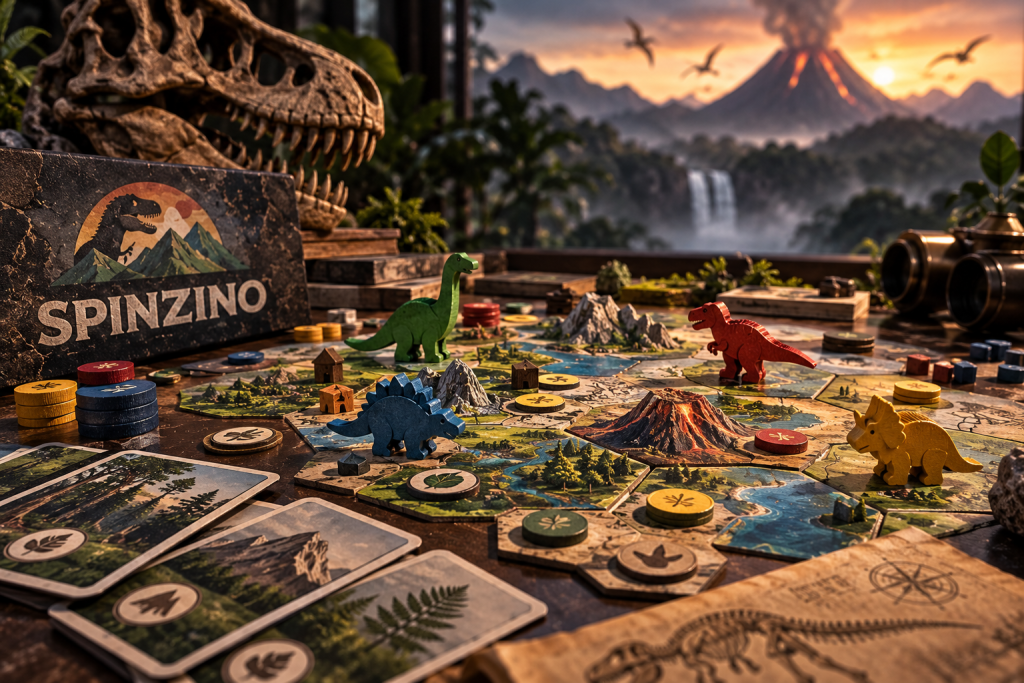
A Dinosaur Race With More Than Luck
Let’s be real — dinosaur-themed board games are everywhere because, hey, dinosaurs are cool and easy to get excited about. But the ones that really stick with you? They’re the ones that slap a fun theme onto some genuinely smart decisions. That’s exactly what Spinzino is going for. It’s got you racing little dinosaur movers toward a central Nest, but winning isn’t just about who can roll the highest number or move the farthest every turn. Nah — it’s way more about when you use your dino’s special trick, how much chaos you’re willing to invite, and whether saving that awesome ability for later might actually be the move that seals the deal.
It’s built for two to four players, and a typical game chills in that 25-to-40-minute sweet spot — long enough to feel satisfying, short enough that you’ll totally want to play again right after.
How Movement Works
So here’s how you actually get around the board: you spin this wheel divided into chunks, each slice giving you a certain number of spaces to move plus a little event icon — think Lava, Jungle, Egg, or Meteor. Some spins just shove you forward; others might throw a wrench in your plans (like losing an egg or getting sent backward).
That’s where the fun tension kicks in. Sure, you might land on a spin that says, “Hey, move 5 spaces!” But is that actually the best use of that spin right now? Maybe the space you’d land on is covered in Lava (bad news for your eggs), or maybe you’re so far ahead that burning a high-movement spin feels wasteful. Sometimes, taking that smaller, safer move is the smarter play — especially if you’ve got a chance to spin again and really need to avoid disaster.
And yeah, that “extra spin” option? Tempting as hell when you’re behind, but it’s a gamble. More movement could catapult you into the lead… or it could slap you with a double Meteor and wreck your whole game. It’s all about reading the board and asking yourself: “Is this risk worth it right now?”
The Four Dinosaurs Have Different Roles
This is where Spinsino stops being just a luck fest and starts feeling like a real brain burner. The four dinosaurs aren’t just reskins — they each bring a totally different flavor to the table, and picking the right one for the moment is often more important than just grabbing the “strongest” sounding dino.
- Rex is your powerhouse. When you need to just book it forward a few extra spaces, he’s your guy.
- Raptor is all about second chances. Crummy first spin? Raptor lets you re-spin — super handy when you’re stuck in a rut or need to dodge a bad space.
- Trike is your control freak. He’s great at messing with those event icons (like neutralizing Lava or Meteor), which saves your bacon when the board’s trying to screw you over.
- Bronto plays the long game. He doesn’t give you raw speed, but he’s fantastic for jockeying for position — especially when you’re neck-and-neck with another player heading into the final stretch toward the Nest.
The key? Don’t just auto-pick the dino with the flashiest ability. Take ten seconds to glance at the board: Who’s close to the Nest? Are eggs under threat? Is that Meteor space looking ominous? Your answer changes which dino deserves the spotlight this turn.
Why Timing Matters
On Spinzino, a key lesson is that using a powerful dinosaur too early may not always be the best choice.
Okay, picture this: You’ve got Raptor ready to go — that re-spin ability feels like a cheat code. So why not slap him down the second you get a meh spin? Well… if the board’s wide open and you’re just cruising toward the Nest with zero threats nearby, burning Raptor early might be overkill. You’ve basically used a precious reset button when you didn’t really need it.
But fast-forward a few turns: You’re trailing by one space, the player ahead is about to scoop the last egg they need, and that space has a Lava icon sitting on it. Suddenly, Raptor’s re-spin isn’t just nice — it’s the difference between winning and watching someone else claim victory while you nervously bite your nails. Same goes for Trike’s defensive tricks. Cancelling a useless Meteor when you’ve got nothing to lose? Meh. Saving it to protect your final egg run? Chef’s kiss.
It’s not about having the best abilities — it’s about deploying them at the exact moment they’ll hurt your opponents the most or save your own bacon.
Managing Risk on the Board
Look, the wheel’s got randomness — you can’t escape that. But smart players don’t just cross their fingers and hope. They look at where everyone’s sitting, what dangers loom ahead, and ask: “How much wiggle room do I actually have?”
Maybe your first spin lands you on a safe Jungle space with no downsides. Awesome — take it and move on. But other times? You see a path that could gain you three spaces… but it’s littered with Egg threats or a sneaky Meteor. Do you play it safe and take the sure-but-slower route? Or do you eye that risky spin, knowing it could either rocket you ahead or leave you regretting your life choices?
That tension — playing it cool versus swinging for the fences — is where the real strategy lives. Yeah, being cautious keeps you out of trouble… but sometimes, the calculated risk is what turns a close loss into a sweet, sweet win.
The Importance of Eggs
Here’s something that trips up new players: This isn’t just a straight dash to the Finish line. Eggs are part of the goal. You start with three eggs chilling in the Valley zone, and to win, you’ve gotta get all three of them to the central Nest along with getting your dinosaur there first.
So suddenly, that “fastest” path isn’t so fast if it means marching your dino straight through a Meteor shower that’ll crack your eggs. Sometimes, looping around to grab a safe egg pickup or avoid a danger zone is the play — even if it adds a few seconds to your trek. Your dino’s speed means nothing if you show up egg-less at the Nest.
Different Ways to Play
The box gives you a few flavors to keep things fresh. The standard game (two to four players, full rules) is where the bluffing, blocking, and “I’ll steal your egg next turn!” drama really shines.
Short on time? The Fast Spin mode trims things down for a quicker bite — same core game, just streamlined so you can squeeze in a round during lunch.
And if you’re flying solo? The Meteor Clock mode turns it into a race against time — you’re not battling friends, but trying to nail your moves before a doom-meter fills up. It’s wild how the same spinning-wheel-and-dino setup can feel totally different just by tweaking the win conditions.
Strategy Over Simple Speed
Here’s the truth nobody tells you when they see the cute dinosaur pieces: Winning Spinzino isn’t about who can move the most spaces on every single turn. It’s about watching the board like a hawk, knowing what each dino actually does in practice, and having the patience to wait for that perfect moment to unleash your ability.
Maybe you hold onto Rex’s burst speed for three turns because you know the final sprint to the Nest is where it’ll matter most. Maybe you save Trike’s shield for when someone’s about to knock your last egg into the lava. That’s not passive — that’s playing the long game while everyone else is busy spinning their wheels.
That blend of luck (hey, the wheel’s still gonna spin), timing, board awareness, and self-control? That’s what makes Spinzino feel less like rolling dice and more like out-thinking your friends. You’re not just reacting to each spin — you’re thinking two or three turns ahead, plotting how your little plastic dinos can work together to get you to that Nest first, eggs intact, with a grin on your face.
And honestly? That’s why it stays on the shelf — not just because dinosaurs are awesome, but because it makes you feel like a sneaky genius when you pull off that perfectly timed Raptor re-spin to steal victory from the jaws of defeat.

Ashley Rosa is a freelance writer and blogger. As writing is her passion that why she loves to write articles related to the latest trends in technology and sometimes on health-tech as well. She is crazy about chocolates. You can find her at twitter: @ashrosa2.