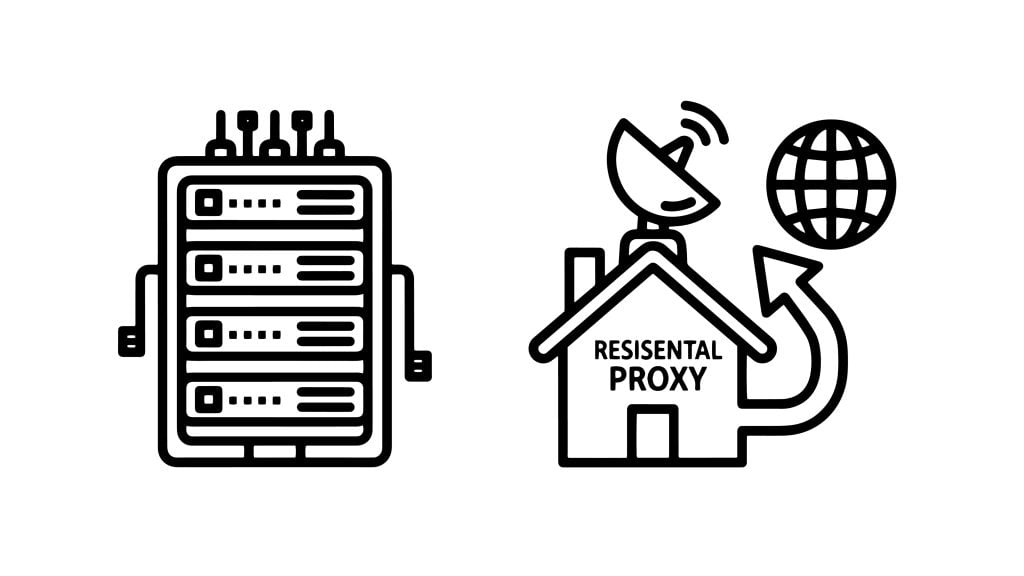
The shift toward unmetered proxy infrastructure is fundamentally changing the economics of web scraping, multi-accounting, and automated data collection. Moving away from restrictive pay-per-gigabyte models eliminates the constant anxiety over bandwidth consumption, allowing data engineers and growth marketers to scale their pipelines without a proportional spike in overhead.
However, unlimited bandwidth only solves half the equation. If you choose the wrong underlying network architecture-specifically, picking static over rotating or vice versa – your target server’s anti-bot system will still identify your automated footprint. The result? Immediate rate limits, CAPTCHA walls, or permanent IP blacklisting.
To maximize the return on investment (ROI) of an unmetered plan, you must align your proxy architecture with your technical workflow. Here is an architectural deep dive into when to deploy static versus rotating residential networks.
The Mechanics of Static Residential Proxies (ISP Proxies)
A static residential proxy assigns you a fixed IP address that remains assigned to your port for long periods, often lasting months. These IPs originate from real consumer Internet Service Providers (ISPs) like AT&T, Comcast, or Verizon, but they are hosted directly within data center network infrastructures. This unique architecture delivers a powerful hybrid advantage: the high trust score of a residential broadband user combined with the lightning-fast 1 Gbps to 10 Gbps speeds and low latency of a data center backbone.
Because there is only a single network “hop” between your automation script and the target website, static proxies provide highly stable connections.
High-Value Use Cases
- Persistent Session Multi-Accounting: Social media algorithms on platforms like Instagram, TikTok, and LinkedIn actively monitor session consistency. If an account suddenly switches IP ranges mid-session, it flags a potential account takeover, triggering security checkpoints or shadowbans.
- E-Commerce Storefront Management: Managing multiple seller accounts on platforms like Amazon or eBay requires ironclad isolation. Utilizing dedicated static IPs ensures your store footprints are never linked together by platform audits.
- Whitelisted Enterprise Pipelines: Accessing secure financial portals or localized ad networks requires passing strict IP whitelisting rules that dynamic pools simply cannot accommodate.
The Unmetered Advantage for Static: Running media-heavy automation—such as continuous HD video uploads to social channels or streaming localized content for quality assurance—rapidly consumes data. Utilizing a residential proxy with unlimited bandwidth allows you to maintain these data-intensive, continuous sessions 24/7 without monitoring a data usage dashboard.
The Mechanics of Rotating Residential Proxies (Dynamic Pools)
Rotating residential proxies operate on an entirely stateless premise. Instead of anchoring your connection to a fixed identity, a rotating gateway proxy server acts as an intermediary. Every time your script issues a new HTTP request, the gateway pulls a completely fresh IP address from a massive pool of millions of real, peer-to-peer consumer devices (desktop computers, mobile devices, and home routers).
This continuous shuffling creates a highly fragmented digital identity, making it nearly impossible for anti-bot defenses like Cloudflare, Akamai, or Datadome to map out a structural pattern or apply blanket rate limits.
High-Value Use Cases
- Large-Scale Web Scraping: Pulling public product data, real estate listings, or flight prices requires making hundreds of thousands of parallel requests. Distributing this load across a massive, rotating peer pool allows you to extract data completely unimpeded.
- Search Engine Optimization (SEO) Monitoring: Scraping localized search engine results pages (SERPs) requires rotating through precise regional IPs to gather accurate data without running into Google’s CAPTCHA blocks.
- Price Intelligence & Stock Monitoring: High-frequency polling to detect retail price adjustments requires making rapid, concurrent requests that would burn out a single static IP within seconds.
The Unmetered Advantage for Rotating: Historically, developers had to artificially throttle their multi-threaded scrapers, turn off image rendering, and limit parallel connections to save money on metered plans. With unmetered bandwidth, that technical bottleneck disappears. You can spin up hundreds of parallel scraping threads at maximum velocity, compressing data extraction timelines from days into hours.
Navigating the “Silent Failure” Trap
One of the most common structural mistakes developers make when deploying rotating proxies is mismatching the session type to a multi-step workflow. If you attempt to execute a login process, add an item to a shopping cart, and complete a checkout flow using per-request rotation, the session token will break instantly. The e-commerce site views every step as a completely different user from a different city, causing a silent failure mid-flow.
For multi-step workflows that still require broad pool rotation, you must implement sticky sessions (time-based rotation). This mode allows you to keep the same IP for a defined window (such as 10 to 30 minutes) before the gateway switches you to a new endpoint.
Structural Comparison
| Performance Metric | Static Residential Proxies | Rotating Residential Proxies |
| IP Persistence | Unchanging (Fixed identity) | Changes per request or fixed time interval |
| Network Latency | Ultra-low (Direct data center routing) | Variable (Extra hop through gateway proxy) |
| Connection Speed | Up to 10 Gbps dedicated links | Dependent on peer node home broadband speeds |
| Primary Risk | Target bans if single IP is overused | Session breaks if rotation is misconfigured |
| Best Suited For | Account maintenance, logins, stability | Mass data extraction, stateless scraping |
Building a Hybrid Strategy
For advanced, enterprise-grade automated systems, the ultimate solution is rarely binary. The most resilient data operations leverage a hybrid proxy topology:
- Use static residential proxies to handle authentication phases, account creation, and session-token generation where identity continuity is non-negotiable.
- Hand off the heavy lifting—such as crawling millions of unauthenticated public product pages—to rotating residential proxy pools where volume and anonymity are required.
Unlimited bandwidth is an incredibly powerful operational upgrade, but it must be paired with precise network planning. By aligning your architectural layout with your technical workloads, you can scale your automated infrastructure safely, reliably, and without unexpected financial friction.

Sandra Larson is a writer with the personal blog at ElizabethanAuthor and an academic coach for students. Her main sphere of professional interest is the connection between AI and modern study techniques. Sandra believes that digital tools are a way to a better future in the education system.