


Anyone who is a fan of the Hunger Games books or movies is very familiar with Haymitch Abernathy. Audiences have known him as the sarcastic and often intoxicated mentor who helps Katniss Everdeen and Peeta Mellark survive the Hunger Games, but The Hunger Games: Sunrise on the Reaping takes us back to a time when he was an entirely different person. Set 24 years before the events of the original film, Francis Lawrence’s latest entry follows a sixteen-year-old Haymitch as he is thrown into the Second Quarter Quell, the 50th Hunger Games. It is a story about a teenager who believes things can change, even when the people in power have built an entire system around making sure they never do. Emotionally devastating and packed with some of the franchise’s most impressive spectacle, this is one of the darkest chapters in the series, even if its crowded story gets in the way of its strongest ideas.
A Younger Haymitch and the Second Quarter Quell
Living in District 12 with his widowed mother and younger brother Sid, Haymitch (Joseph Zada) helps support his family by working for a bootlegger. He is also in a relationship with Lenore Dove Baird (Whitney Peak), a member of the Covey, and seems to have a future he is genuinely excited about. That changes on his sixteenth birthday, when the reaping for the Second Quarter Quell takes place. As part of the anniversary rules, each district must send four tributes to the Capitol instead of the usual two. After an incident occurs during the reaping, Haymitch intervenes to protect Lenore Dove and is selected. He joins fellow District 12 tributes Maysilee Donner (McKenna Grace), Wyatt Callow (Ben Wang), and Louella McCoy (Molly McCann), all of whom are sent to compete in a Games designed to be even more deadly than the ones that came before.

Joseph Zada and an Impressive Supporting Cast
Zada is perfectly cast as Haymitch. There is a charm and optimism to his performance that makes it easy to understand why people would gravitate toward this younger version of the character. He is quick-witted and a little reckless, but there is also a sense of genuine kindness to him that makes his transformation into the Haymitch audiences already know all the more painful. We know this kid will eventually become a broken person. Zada does a terrific job of showing that personality without simply imitating Woody Harrelson. You can recognize the character in the way he carries himself and responds to the people around him, but this is still his own interpretation. The film needs us to believe that this teenager could eventually become the man we meet in the original movies, and Zada gives us plenty of reasons to buy into that connection.
The supporting cast is just as important to making the story work, and everyone is perfectly cast. McKenna Grace brings a strong presence to Maysilee, giving her a relationship with Haymitch that becomes one of the film’s emotional anchors. Ben Wang is likable as Wyatt, although the character is not given quite enough material to make the most of his role. Molly McCann also makes an impression as Louella. The returning characters and younger versions of familiar faces give the film plenty of personality. Elle Fanning is nearly the best thing in the entire movie as Effie Trinket. She captures the character’s recognizable enthusiasm and theatrical mannerisms while giving us a version of Effie who has not yet become the person audiences remember from the original films. Every time she appears, there is an infectious energy to her performance that makes it difficult not to smile. Kieran Culkin is equally entertaining as Caesar Flickerman, bringing an almost ridiculous amount of charisma to a character whose self-centeredness is part of what makes him so amusing. He is the sort of character you find yourself looking forward to seeing again as soon as he leaves the screen.
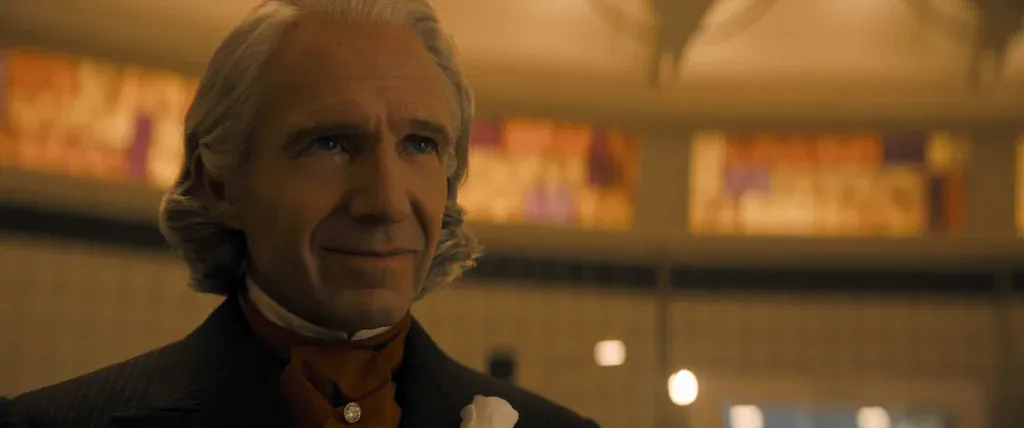
Jesse Plemons also makes a compelling impression as a younger Plutarch Heavensbee, here working as a cameraman for the Games. His position gives the film another perspective on the spectacle, particularly as he becomes involved in the covert efforts to undermine it. Glenn Close is a lot more openly campy as Drusilla Sickle, but that approach works for a character who seems to take genuine pleasure in the cruelty surrounding her. Ralph Fiennes brings a chilling authority to President Snow, and even when he is off screen, his presence is felt throughout. Meanwhile, Maya Hawke, Kelvin Harrison Jr., and Lili Taylor add welcome appearances as familiar victors Wiress, Beetee, and Mags. Across the ensemble, the actors make these characters their own while still respecting the performances that introduced them to audiences.
The Capitol’s Control of the Narrative

One of the most impressive aspects of Sunrise on the Reaping is how much it understands the Hunger Games as a system of propaganda. The arena is certainly the main attraction, but the film is just as interested in everything happening around it: the interviews, the broadcasts, the editing, and the way the Capitol decides which parts of the Games the public gets to see. Haymitch can challenge the rules and put his life on the line trying to undermine the system, but none of that necessarily matters if the people watching at home are never allowed to know what actually happened. The Capitol can take an act of resistance and turn it into a story about selfishness, cowardice, or luck. It has control over the cameras, the footage, and ultimately the version of events that becomes accepted as truth.
That idea gives the film some of its most compelling material. The Hunger Games have always been a form of entertainment designed to reinforce the Capitol’s power, but this installment spends more time examining how that entertainment is manufactured. The difference between what happens in the arena and what viewers are told happened is particularly important to Haymitch’s story. Even when he manages to resist, the Capitol has the ability to erase his intentions and reshape his actions into something that serves its own interests. It is a frightening extension of the series’ ideas about authoritarian control, particularly because it shows that controlling information can be just as effective as controlling people through violence. The film also makes a strong case for collective resistance, with Haymitch’s efforts depending on people willing to take risks and help one another, even when the chances of success are incredibly slim.
A Deadly Arena and a Heartbreaking Journey
The Games themselves deliver plenty of spectacle. The poisonous arena has a striking psychedelic aesthetic, with its use of purple, green, and yellow giving it a look unlike anything else in the franchise. The colorful presentation creates an especially unsettling contrast with the violence taking place inside it. There is a relentless quality to the action once the tributes enter the arena, and Lawrence knows how to stage these sequences so that the danger remains clear even when the scale of the production grows considerably. The various threats, including the toxic pollen and the waterbird and squirrel mutts, make the environment feel unpredictable. It is also one of the more visually memorable arenas in the series, with its strange colors and deadly mechanisms giving the Games a distinct identity.

For all that spectacle, this is arguably the darkest Hunger Games movie yet. It is not necessarily the most graphic or brutal entry, and some viewers may expect the violence to go further given the circumstances of the Second Quarter Quell. The emotional impact, however, is difficult to shake. Watching Haymitch begin the story as a hopeful teenager and gradually lose nearly everything that gave him a reason to remain hopeful is heartbreaking. The ending makes his eventual personality in the original films feel less like a character quirk and more like the result of years of grief and disillusionment.
Connections to the Hunger Games Franchise
The film’s connection to the rest of the franchise is another major strength. As a follow-up to The Hunger Games: The Ballad of Songbirds & Snakes and a prequel to the original film, it brings several threads together while giving familiar characters and institutions more history. There is a real sense of how much has been lost between this version of Panem and the one audiences first encountered. It also makes the original films more affecting in retrospect, particularly when considering what Haymitch has experienced before Katniss and Peeta ever arrive in the Capitol. The story eventually circles back to the characters and events that started the franchise, giving this installment a satisfying place within the larger series.
Where the Film Falls Short
There are, however, moments when the film struggles under the weight of everything it wants to include. The cast is enormous, and while most of the actors make a strong impression, several characters are not given enough time to develop beyond their basic function in the story. Wyatt is a particularly noticeable example, since the film introduces him as an oddsmaker and gives him a connection to Haymitch’s group without fully exploring what makes him interesting. The number of alliances, victors, Capitol figures, and tributes also makes some stretches feel crowded. A few relationships could have used more breathing room, especially when the emotional stakes depend on the audience becoming attached to people who are not always given much time on screen. At times, the movie feels a little bloated, and its length does not always translate into meaningful development.
Final Thoughts
Even with those issues, The Hunger Games: Sunrise on the Reaping is a powerful addition to the franchise. Francis Lawrence delivers the scale and action audiences expect, but the film’s most affecting moments come from its understanding of how a government can take someone’s suffering, turn it into entertainment, and then rewrite the story for its own benefit. Haymitch’s tragedy is that he begins with the belief that he can make a difference, only to discover how thoroughly the system can punish anyone who tries. By the time the movie reaches its conclusion, the cynical man from the original films feels like someone we have come to understand in an entirely different way. It is a heartbreaking journey, and one that brings the franchise full circle. If this is how the Hunger Games end, this is a perfect conclusion to a franchise we have come to know and love.
The Hunger Games: Sunrise on the Reaping is a powerful addition to the franchise. Francis Lawrence delivers the scale and action audiences expect, but the film's most affecting moments come from its understanding of how a government can take someone's suffering, turn it into entertainment, and then rewrite the story for its own benefit.
-
GVN Rating

Roberto Tyler Ortiz is a movie and TV enthusiast with a love for literally any film. He is a writer for LoudAndClearReviews, and when he isn’t writing for them, he’s sharing his personal reviews and thoughts on Twitter, Instagram, and Letterboxd. As a member of the Austin Film Critics Association, Roberto is always ready to chat about the latest releases, dive deep into film discussions, or discover something new.