

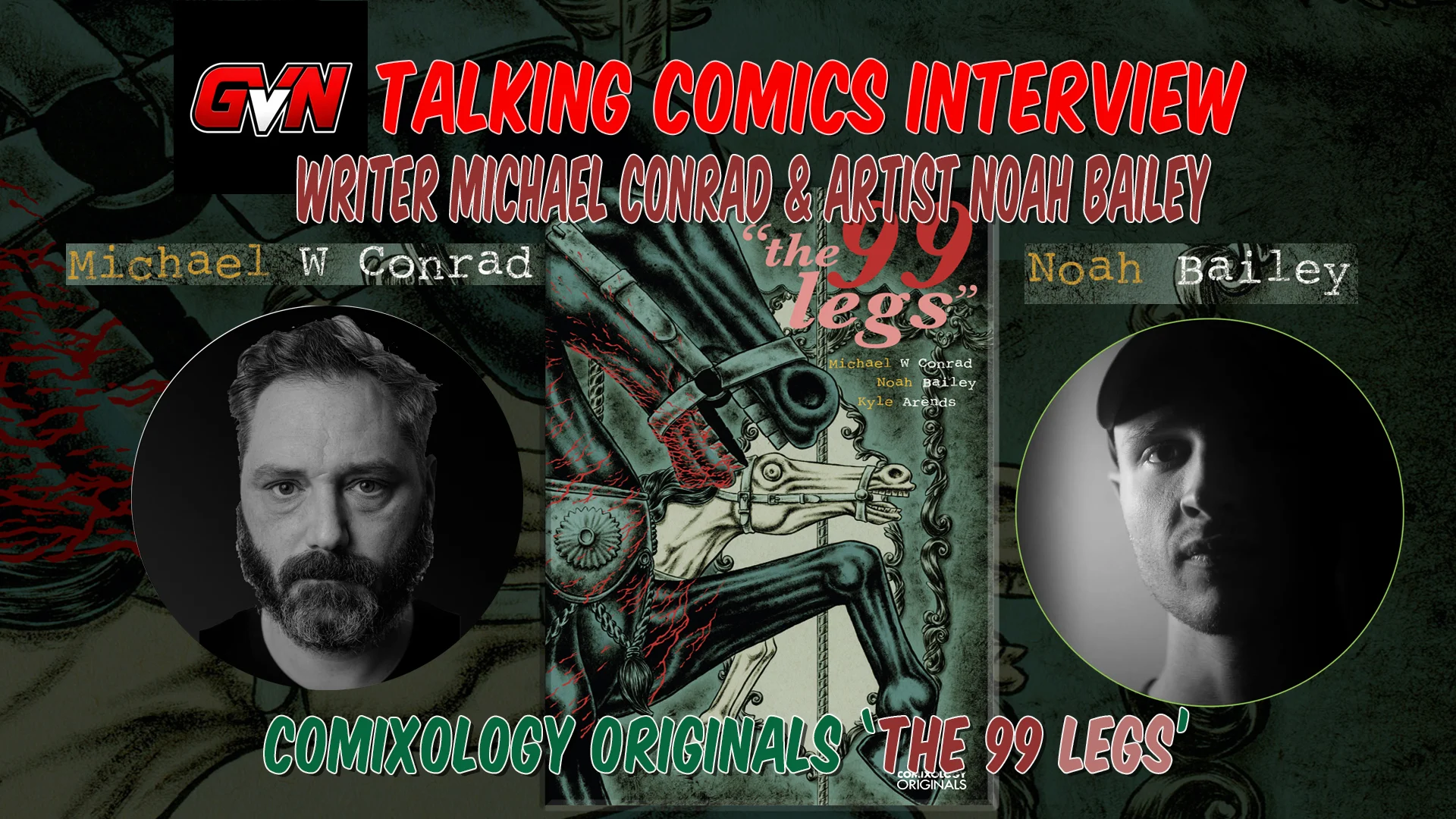
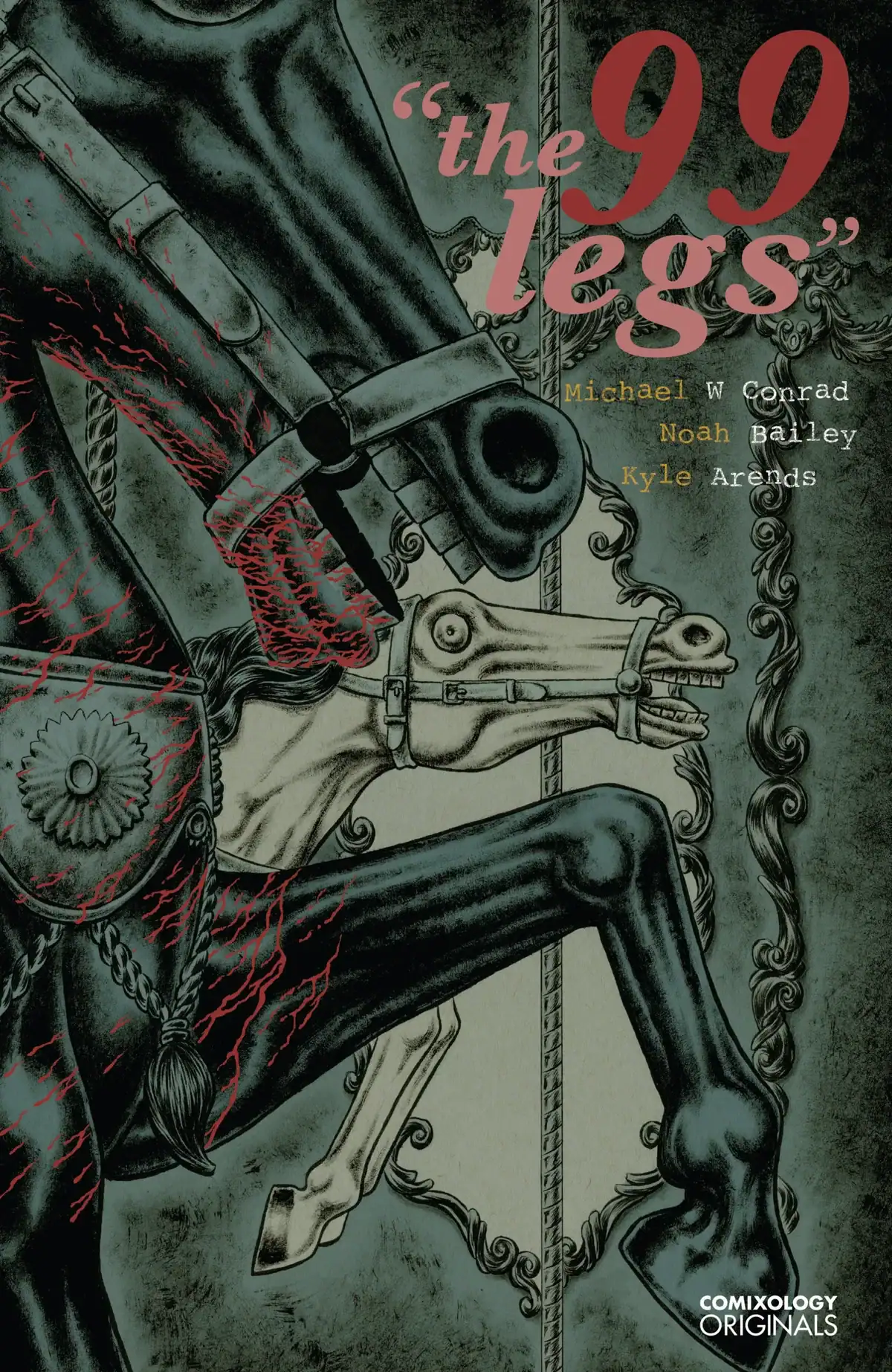
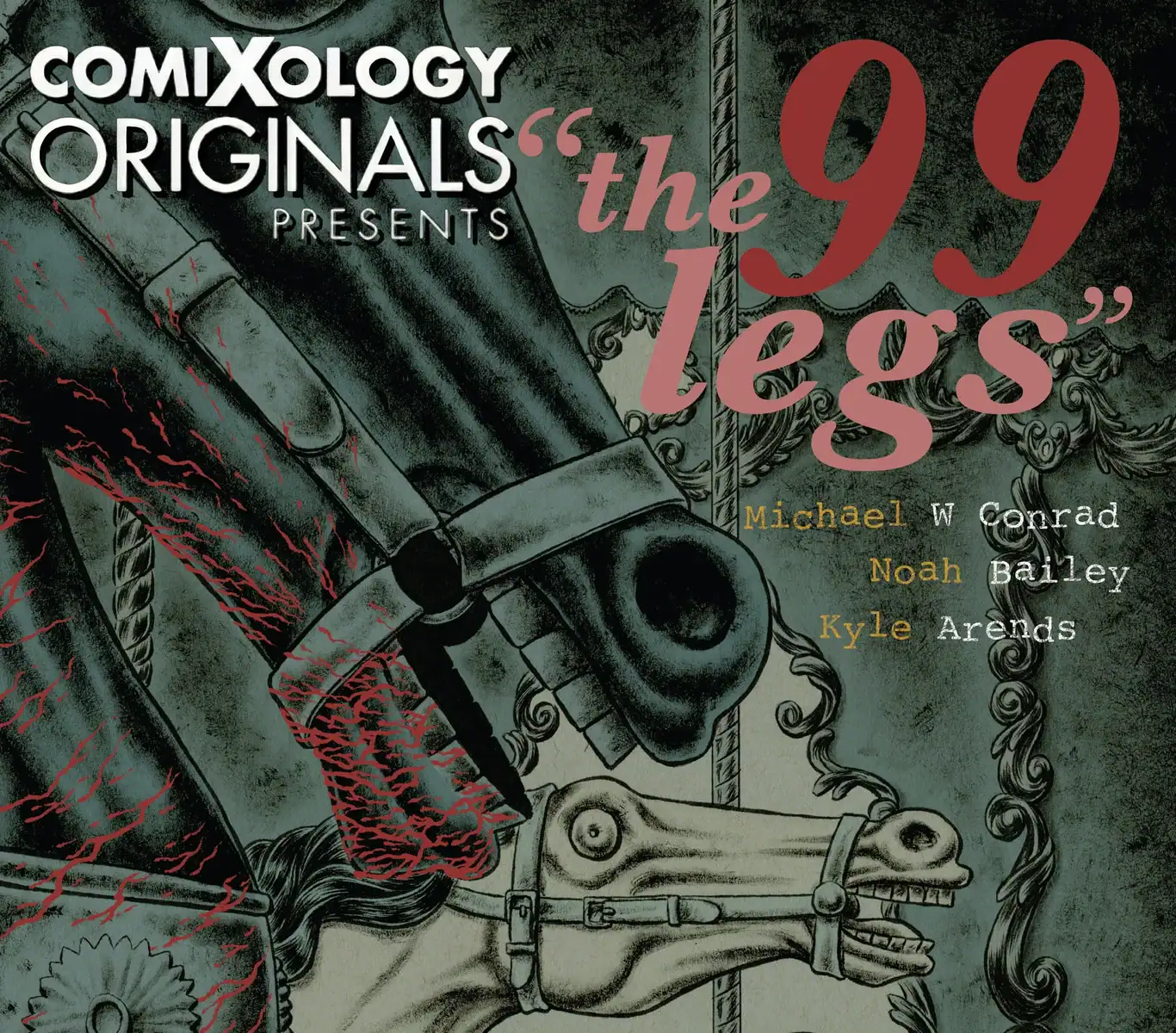
Few genres blend style and suspense quite like Giallo, and few modern creators are as eager to push horror storytelling into bold new territory as writer Michael Conrad and artist Noah Bailey. With The 99 Legs, the duo delivers a chilling mystery inspired by the cult Italian horror tradition, following a crime fiction writer whose fascination with murder becomes terrifyingly real when they stumble into an active string of killings.
With psychological tension, striking visuals, and a mystery that blurs the line between fiction and reality, The 99 Legs promises a fresh, haunting experience for horror fans. Ahead of its digital debut on November 17 via Comixology Originals and its forthcoming print release from Mad Cave Studios, we caught up with Michael Conrad and Noah Bailey to discuss cinematic influences, building suspense on the comic page, and bringing this unsettling tale to life.
Giallo Films Inspiration
GVN: Thanks for sharing a part of your day with us, guys. Let’s plunge right into your exciting horror-based graphic novel: The 99 Legs. This story draws inspiration from classic Italian Giallo films, a genre known for its striking visuals, psychological tension, and elaborate mysteries. What were some of the key hallmarks of Giallo that you wanted to bring into the comic medium, and how did each of you adopt those influences to fit your respective storytelling styles?
MC: Giallo typically centers on a killer, and an unlikely investigative team. The stories often feature a first-person perspective via the killer, and a bizarre twist or rationale behind the killer’s modus operandi. Visually there are a number of other components, but for the story these were the key elements I wanted to include in our take.
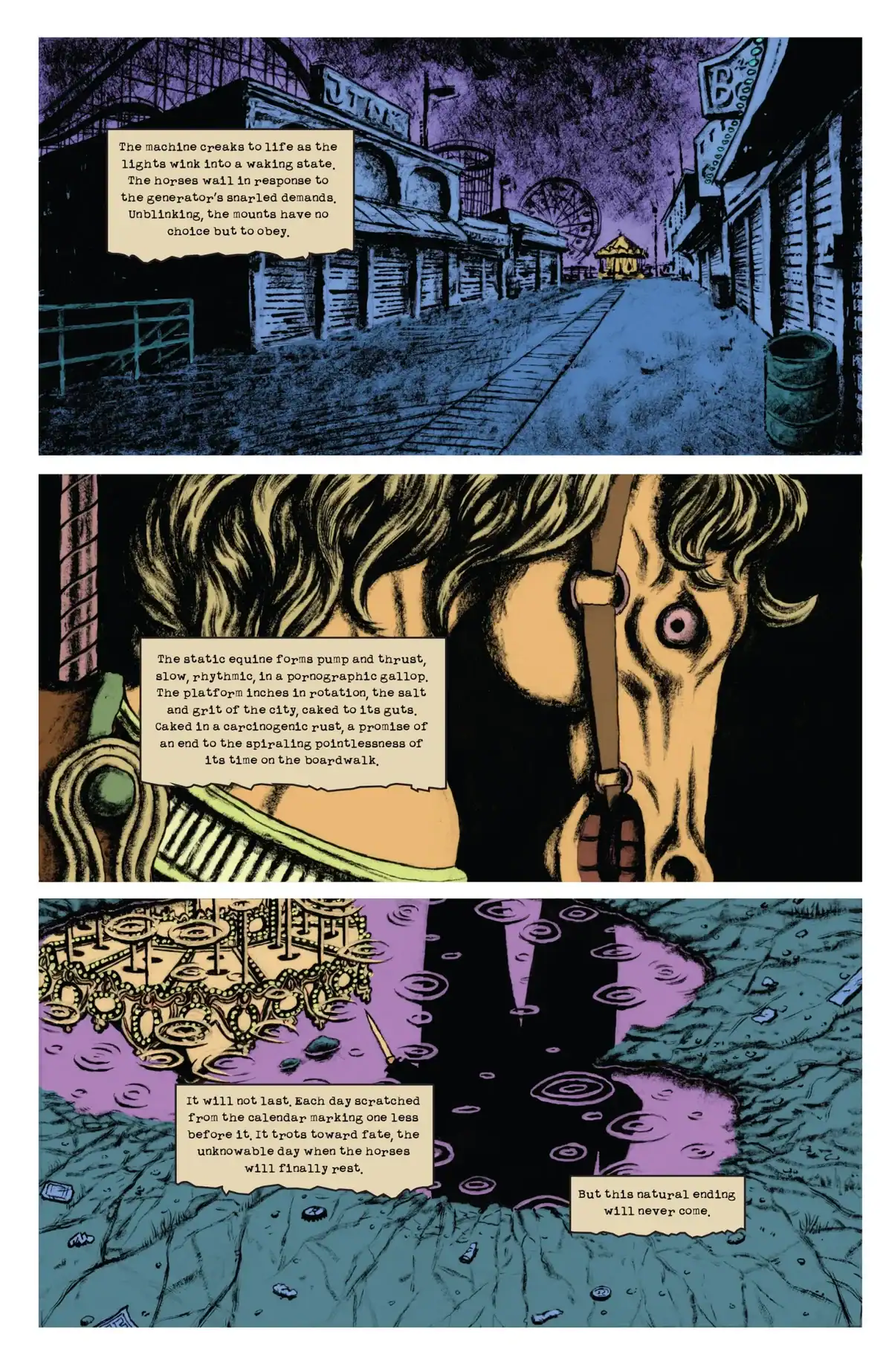
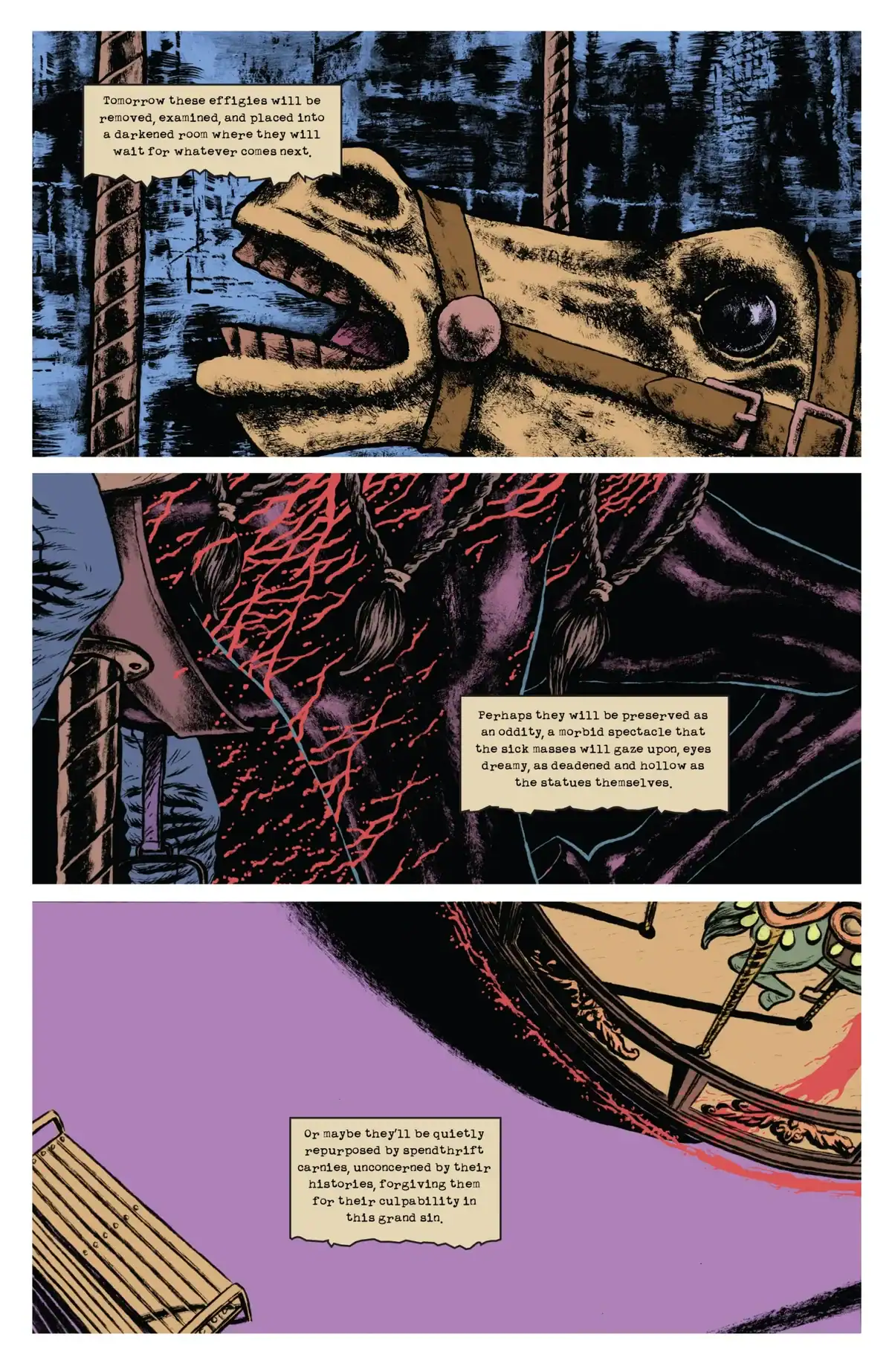
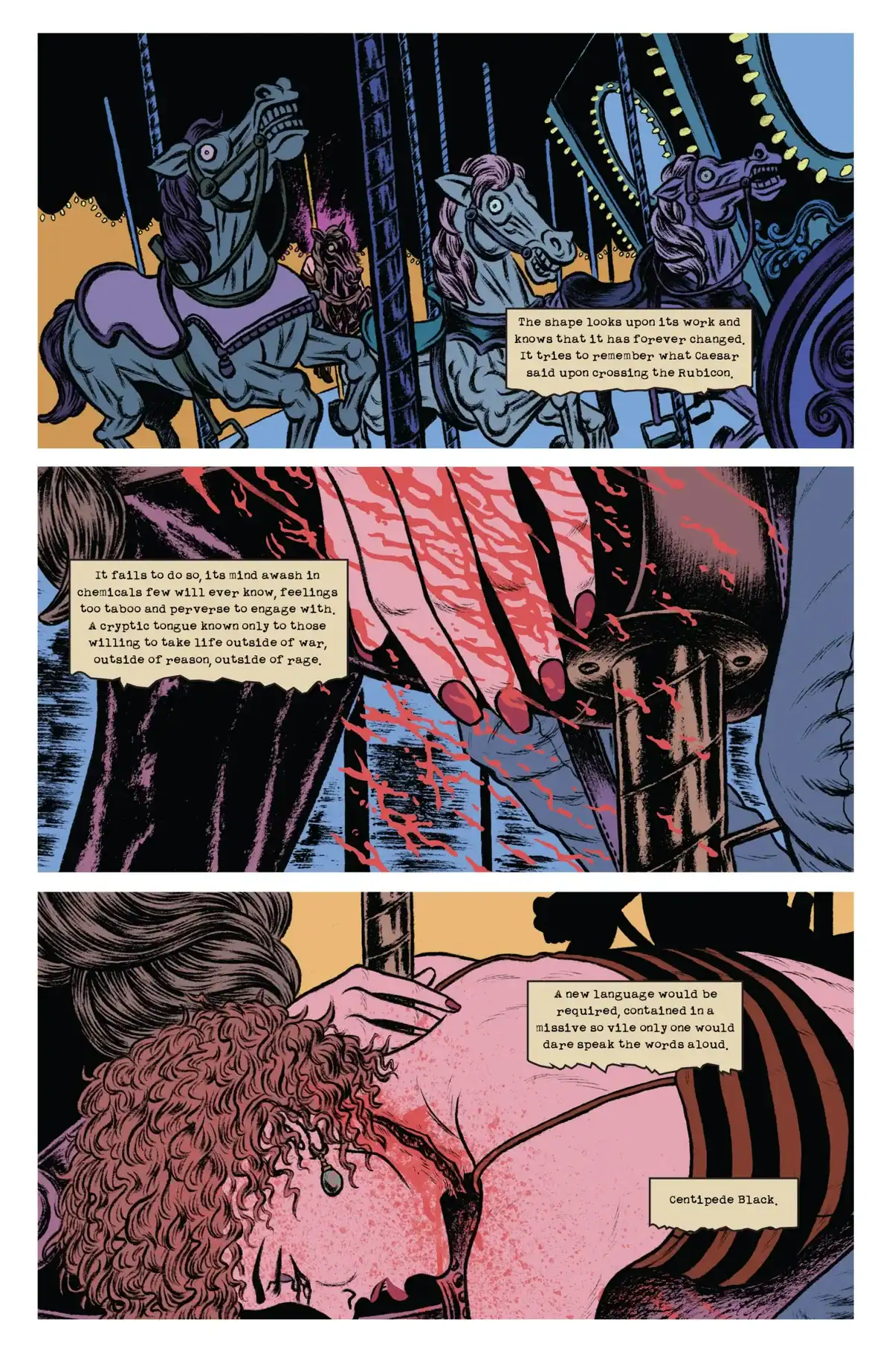
NB: I had a really fun time being inspired by the lighting, design and color of Giallo. I wasn’t strictly thinking “Giallo” throughout the entire process, but certainly those elements have really just become a part of my storytelling in general over the years. This is just the purest form of their expression in my work, I’d say!
“I want to know what evil looks like”
GVN: At the heart of the story is a crime fiction writer who suddenly finds himself tangled up in a very real murder investigation. What fascinated you about exploring the blurry line between fictional crime stories and real-world violence?
MC: I spend a good deal of time (as many do) escaping into true crime stories. I don’t know if this is a coping strategy or something, like if I face the darkness I might be able to make sense of it or something? I’m sure many true crime media consumers ask themselves similar questions.
Regardless of motivations there’s always the nagging and less comfortable question of, if consuming this kind of thing is a form of exploitation of those who have really suffered, and if in doing so we create an incentivization for those who perpetrate such acts. A number of killers have cited celebrity as a bonus or even a desired outcome of their actions. Again looking at ourselves, are we engaging with some perverse curiosity when we engage with this media, or are we testing our stomachs, or are we trying to reckon with the inescapable truth that some people are capable of unthinkable acts?
Narrative horror asks the same questions in a more overt form. You’ll rarely hear a true crime podcaster address such topics, but in fiction it becomes almost a necessity to do so. What’s more, we’re even allowed to say “I want to know what evil looks like” in a way that is far less morally dubious, an ethical engagement with that side of ourselves.
So yeah, true crime played an influence, as uncomfortable as that may be to admit.
The Anxieties on Display
GVN: Michael, horror fans know your work often examines fear on both a personal and societal level. What themes or anxieties are you most excited for readers to uncover as the mystery of “The 99 Legs” unfolds?
MC: Oddly with The 99 Legs the anxieties on display are far less about death or pain and more about the life of a writer. While the main character in the story is not me at all, he does encompass some fears I have about myself as a creator. He feels like his life is falling apart, he can’t connect with readers in a meaningful way, his relationships suffer due to his insecurities and poor coping strategies, he’s angry because of the thing he once loved.
Every writer became a storyteller because someone once told them they were good at it, just like every decent basketball player spent extra time drilling on the court because something told them it was a skill worth honing. The thing is, once you start doing these things on a bigger level you find the Dunning-Kruger effect is very real and critics will let you know that. Healthy folks get humble and continue to hone their craft, while others spiral out and often quit. The main character of this story is one of those guys, a piece of that lives in me, and probably lives in any reader out there who has spent time chasing impossible dreams.
This isn’t to totally ignore the fact that The 99 Legs features a killer who is completely disengaged from empathy, and seems to kill the very people who have highlighted the main characters’ anxieties. To me this is equally scary, to see your wicked little wishes actually take place feels like a nightmare to me.
Artistic Challenges
GVN: Noah, Giallo cinema is famous for its bold color palettes, dramatic lighting, and unforgettable imagery. How did those visual influences shape the look of “The 99 Legs,” and were there any specific artistic challenges in translating Michael’s script onto the comic page?
NB: There were definitely challenges! But, I really enjoy the problem solving involved in adapting a script to drawings. There’s quite a bit going on in some panels, and also quite a lot of words, so a major challenge was effectively communicating the actions of the characters while also allowing enough room for Michael’s beautiful writing. The use of the Giallo genre allowed me the freedom to color crazily and get dirty and scratchy. The shadows are really a blast to consider. After designing these environments and placing these characters in them, thinking about different ways to light a scene is just overwhelmingly enjoyable–and Giallo is famous for incredible lighting and wild angles. So fun!
Working Together
GVN: One of the joys of a great horror mystery is balancing suspense with revelation. How did you work together to control the pacing, plant clues, and keep readers guessing… without giving away too much too soon?
MC: It’s funny, and maybe a flaw for me to feel this way, but most mysteries in stories feel like a manipulation, like, you just withheld information that would be apparent if I wasn’t willfully deceived. With this story the revelation is revealed in a way that is hopefully qualified by its outlandish nature. It’s perhaps known all along, but requires the characters and the reader to buy into something that feels inconceivable. We did plant clues all along the way visually, but reason will likely prevent many from being able to get there before the story does. Perhaps a second reading will offer them some treats in the form of what’s seen in the panels.
NB: Man, it’s difficult to follow Michael’s answers sometimes. Hahahaha. I think he put it really well. But, one of my favorite things about Giallo in particular, that sets it aside from other classic murder mystery genres, is that sometimes the reveal of the killer is so absurd I’m pretty sure they just made things as convoluted as possible and offered so many red-herrings for the sake of intrigue, and decided on the actual identity of the killer when they showed up to set that day. Hahaha. Which is such a fun thing and the result is sometimes a narratively schizophrenic, kind of dream-logic mess. And I’m saying this as a compliment. I love it.
“… A Cool Book”
GVN: Comixology Originals has become a home for innovative digital-first comics. Did knowing that “The 99 Legs” would debut digitally influence how you approached the storytelling, page layouts, or reader experience in any way?
MC: Nah, not really. We just make comics and know that the platform is programmed in a way that allows for pretty much anything we can come up with be it for print or digital presentation. For us the big goal was to make a cool book, we knew if we could accomplish that we would be safe.
NB: It had no influence on me, because I am a selfish baby when it comes to my artwork, and I just want to do whatever excites me most at any given moment. I know that if the work is really good, any issues with compatibility will be forgiven and people will be like “Whoa, look at that!” Hahahaha. So, hopefully it’s really good!
The Fan’s Takeaway
GVN: Thank you again, Michael and Noah. Finally, with horror enjoying a major resurgence across comics, film, and television, what do you think makes “The 99 Legs” stand out from other genre stories, and what do you hope readers will still be thinking about long after they reach the final page?
MC: The 99 Legs will stand out because it doesn’t care about if horror makes a resurgence or not. This is a book that didn’t ask for permission, or demand an audience, or even consider if anyone other than Noah and I would care. In this way we hope we’ve created something special, something for people who are tired of being pandered to, or told where to look, and how to feel. We did this out of a passion for comics, for storytelling that doesn’t care about our feelings, and isn’t made explicitly to be a product.
When I was young my brother went to art school and came back changed. I couldn’t figure it out, I felt a distance from him at the time. I asked him what he had learned, hoping it would give me some insight. He summed it up in a sentence, “Art exists for art’s sake.” I’ve meditated on that for a long time now. David Lynch, when asked about the meaning of his films would either refuse to respond or give a nothing answer. These have been formative for me. I don’t know what I hope for. I don’t know if I’d want to determine these things. I welcome readers to enjoy what we’ve done at their own discretion, and to make of it what they will.
NB: Once again, so wonderfully put, Michael. Hahahaha. I guess I just would like the passion to shine through in “The 99 Legs”. I want it to be felt. Maybe not as intensely as we felt it, but maybe just a lil bit. As a life-long horror fanatic, I am so thrilled that horror is so huge right now. Young people are discovering new horrors that never existed before and sharing them so boldly. This is a medium that can never die and given the right care, will always have new things to show us. I am so pleased to be a small part of this world. Thank you so much for having us!!
As horror fans eagerly await The 99 Legs, it’s clear Michael Conrad and Noah Bailey are crafting something far more than a traditional murder mystery. Inspired by the stylish suspense and psychological tension of classic Giallo cinema, the creative team has crafted a chilling narrative where fiction and reality intertwine in ever more terrifying ways.
We thank Michael and Noah for taking the time to speak with us about their inspirations, challenges, and creative process behind this haunting new graphic novel. Be sure to check out The 99 Legs when it debuts digitally through Comixology Originals on November 17, and keep an eye out for the print edition from Mad Cave Studios next year. For the latest news on comics, graphic novels, horror, and the creators bringing them to life, keep your eyes on GVN Talking Comics and keep reading.

Senior Writer at GeekVibesNation – I am a 60 something child of the 70’s who admits to being a Star Trek/Star Wars/Comic Book junkie who once dove headfirst over a cliff (Ok, it was a small hill) to try to rescue his Fantastic Four comic from a watery grave. I am married to a lovely woman who is as crazy as I am and the proud parent of a 21-year-old young man with autism. My wife and son are my real heroes.