Running a small business is a constant balancing act between ambition and resources. You are chasing growth, scraping for leads, and celebrating every new subscriber that joins your list. But there is a silent threat that can cap your growth before you even get started: Data Decay.
In the aggressive digital landscape of 2026, the inbox has become a fortress. Internet Service Providers (ISPs) have tightened their defenses, and they have zero tolerance for senders who blast messages into the void. If you are sending emails to addresses that don’t exist, you aren’t just wasting time—you are actively flagging your domain as “low quality.”
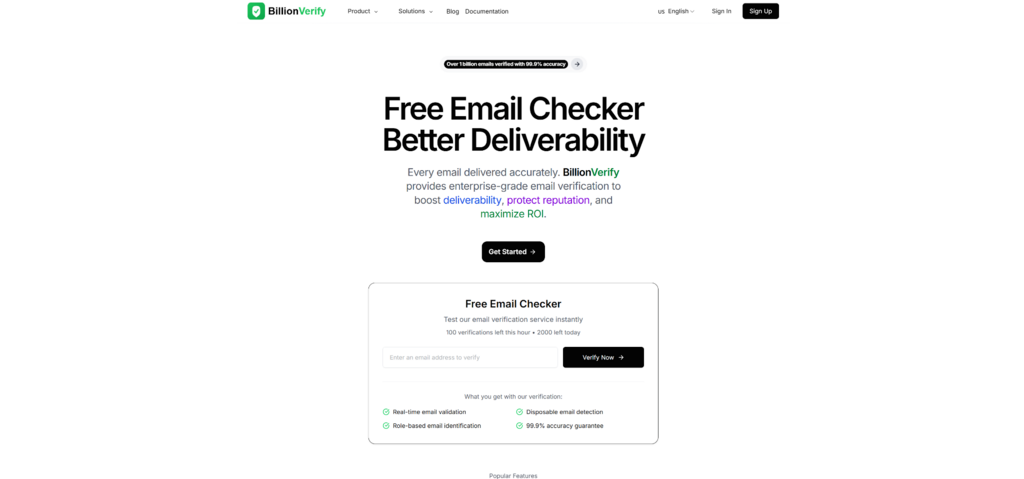
For a small business, a damaged sender reputation is devastating. It means your invoices, your newsletters, and your sales pitches end up in the Spam folder, invisible to your customers. This is why integrating a reliable Free Email Checker into your workflow is not just a technical “nice-to-have”—it is a fundamental survival mechanism for your revenue stream.
The “Invisible Wall” Blocking Your Sales
I have consulted with dozens of startups that couldn’t figure out why their open rates were stuck at 10%. They blamed their copy. They blamed their subject lines. They blamed the time of day.
In almost every case, the culprit was the list itself.
When you collect emails—whether through a trade show, a website popup, or a lead magnet—you are collecting raw, unfiltered data. My analysis of average B2B lists shows that up to 25% of emails expire or become invalid within 12 months. People change jobs, companies rebrand, and typos happen.
If you don’t use an Email Verifier to prune this dead wood, you are hitting an invisible wall. You are shouting into an empty room, and the ISPs are punishing you for it.
How Verification Actually Works: A Look Under the Hood
To the average user, an email validator looks like a simple database search. You type in an email, and it says “Yes” or “No.”
But from a technical perspective, the process is a fascinating sequence of digital diplomacy. When you run a mail checker, you are triggering a real-time negotiation with mail servers across the globe.
1. The Syntax Gatekeeper
First, the system checks the obvious. Is there an @ symbol? Are there illegal characters? This catches the “fat finger” errors—like john@gmil.com instead of gmail.com.
2. The DNS Roadmap
Next, the tool queries the Domain Name System (DNS). It asks, “Does this website actually have a mail server?” If the domain is dead (which happens often with failed startups), the email is instantly flagged as invalid.
3. The SMTP Handshake (The “Silent Knock”)
This is the most critical step to check if email exists. The verification engine connects to the specific mail server and initiates a session.
-
The Query: “I have a message for sarah@example.com.”
-
The Response: The server replies with a code (e.g., “250 OK” or “550 User Unknown”).
-
The Abort: Crucially, the tool disconnects before sending any actual data. The user never knows you checked, but you get 100% confirmation of existence.

My Experience: The “Free Tier” Strategy
In 2026, the software market has shifted. Top-tier providers now offer generous free tiers not because their product is cheap, but because they operate on a Product-Led Growth model. They know that if you trust them with 100 emails, you will trust them with 100,000.
In my testing of these free tools, I look for three specific things:
-
Accuracy: Does it catch the “Catch-All” domains?
-
Speed: Can it handle a bulk upload without freezing?
-
Security: Is my data encrypted?
I recently used a free email address validator to scrub a client’s list of 500 “cold” leads. The tool identified that 80 of them were “Disposable” (temporary addresses). By removing those 80 bad leads, we didn’t just save money; we protected the client’s domain from being blacklisted by Google.
Comparison: The Cost of “Doing It Yourself”
You might think, “I’ll just send the emails and see which ones bounce. That’s free, right?”
That is a dangerous misconception. Below is a breakdown of why manual testing is the most expensive “free” method you can choose.
|
Feature |
Method A: “Send and Pray” (Manual) |
Method B: Professional Verification (Free Tier) |
The Business Reality |
|
Verification Method |
Sending actual emails |
SMTP Handshake (No sending) |
Method A damages your reputation instantly. |
|
Time Investment |
Hours (Processing bounces) |
Minutes (Automated scan) |
Your time is worth more than manual data entry. |
|
Risk Level |
|
|
One bad campaign can ruin your domain for months. |
|
Disposable Detection |
|
|
Prevents “freebie seekers” from skewing your data. |
|
Catch-All Analysis |
|
|
Helps you segment and protect your main IP. |
|
Cost |
High (Lost revenue/reputation) |
Free (Up to limit) |
Verify email lists before you send to save money. |
 High (Blacklist danger)
 Zero (Passive check)
 Impossible
 Automatic
The “Catch-All” Trap: A Personal Observation
One specific nuance I want to highlight is the “Catch-All” server.
In my tests, I’ve noticed that many small businesses use default server settings that accept all incoming mail. A basic script will tell you these emails are “Valid.” But they are risky. If you send too many emails to a Catch-All server that doesn’t actually have a user behind it, you might eventually hit a Spam Trap.
A high-quality check email tool will flag these as “Risky” or “Unverifiable.” This is not a failure; it is a warning. It tells you: “Proceed with caution.” My advice? Don’t delete them, but don’t put them in your primary high-volume campaign. Send them a slow, plain-text drip campaign to see if they engage.
Limitations: What Technology Can’t Do
It is important to manage expectations. Even the best AI-driven verification in 2026 has limits.
-
The “Unknown” Factor: Some servers (especially government or military) are behind firewalls that block all SMTP queries. You will get an “Unknown” result. This is normal.
-
Intent vs. Existence: The tool confirms the mailbox exists. It does not confirm that the human checks it. A valid email can still be an abandoned inbox.
Conclusion: Precision is the New Growth Hack
In the early days of the internet, volume was king. In 2026, precision is king.
The most successful small businesses are not the ones with the biggest lists; they are the ones with the most engaged audiences. By using a tool to verify email data regularly, you are doing more than just cleaning a spreadsheet. You are optimizing your entire sales funnel.
You are ensuring that every ounce of effort your marketing team puts in has a chance to land. You are protecting your brand’s digital credit score. And best of all, with the high-quality free tools available today, you can start this process without spending a dime.
Don’t let bad data be the anchor that holds your business back. Cut the weight, and watch your engagement soar.

Madeline Miller love to writes articles about gaming, coding, and pop culture.