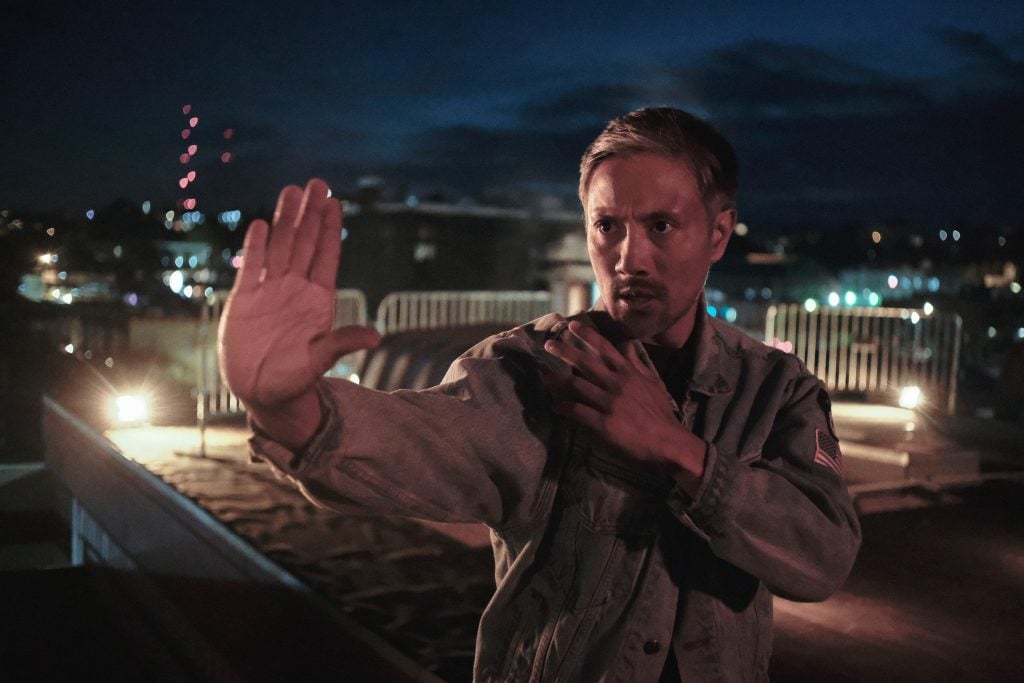
One person stands alone in an open room while a group closes in around him. The fight is quick and clean. Within moments, it’s over. No shouting, no chaos. Just control. Audiences have seen versions of this scene many times, and it has become a kind of shorthand for modern martial‑arts cinema.
What makes it unusual is what came behind it. The character at the center of the frame is based on a real person most viewers had never heard of before the movies brought his name into common use. Away from the screen, his life was quiet. He taught a traditional style, ran a modest school, and worked with a small circle of students. He lived into old age and died of illness, not legend.
One of those students would go on to become famous around the world. The teacher did not. For years, his reputation stayed mostly within a narrow martial‑arts community. That only changed when a filmmaker chose not to treat his life as a footnote, but to reshape it into something larger, less a record of what happened, and more a story about what it could represent.
The Distance Between the Record and the Screen
The films have a different version. In that version, he is a colossus. A defender of his city during foreign military occupation, a man who fights not for personal reasons but to protect the dignity of an entire people.
He defeats foreign champions in public challenges. He endures imprisonment. He refuses bribes from every faction that approaches him. None of this has a solid grounding in the documented record. The occupation happened. The man existed. The rest is the work of writers who understood exactly what kind of story they were telling.
What the Story Is Actually About
To understand why these films work, you have to ask what they are selling beyond the fight choreography. They are not really selling a biography. Most viewers do not know and do not particularly care whether the events on screen happened. What the films sell is a feeling.
Specifically, the feeling that somewhere in the past there existed a man of total moral integrity, complete physical mastery, and absolute calm under pressure. He could not be bought. He could not be humiliated. He stood for the people around him when no institution would.
That feeling is not accidental. It was engineered for a specific cultural moment. The films appeared during a period when questions of identity (what it means to belong to a particular culture, how that culture is perceived by the outside world, how dignity is reclaimed after historical wounds) were pressing and unresolved.
A legendary figure from the past offered a way to process those questions without having to argue about them directly. He simply won. Cleanly, quietly, and with his values intact.
Real Life vs. Screen Legend: A Direct Comparison
| Real Life | On Screen |
| Ran a modest teaching school | Defender of an entire city’s honor |
| Left his hometown due to political change | Portrayed as a reluctant wartime hero |
| Trained a small circle of students | Defeats hundreds of challengers publicly |
| Died quietly; little known outside his field | Icon of cultural resistance across generations |
The Template That Made It Travel
The filmmakers did not invent this structure. They borrowed it from a very old tradition. The reluctant hero who is forced by circumstances into a fight he did not seek. The man on screen never starts a conflict.
He absorbs pressure, deflects aggression, and responds only when there is no other option. When he finally does fight, it is not anger that drives him but something colder and more controlled: the refusal to be diminished. That is a story structure older than cinema, older than the novel, older than most of the cultural forms we know.
What the films added was historical specificity. By anchoring the legend in a documented period of genuine suffering. A foreign military occupation, followed by discrimination against immigrants in a distant country.
The films gave the emotional template real weight. The audience were not watching a fantasy. They were watching something that pointed to actual history, even if it significantly distorted it.
That combination of emotional truth and historical approximation is precisely what makes myth so powerful and so difficult to argue with. If you want your online games to be such a visage of enthralling storytelling and graphics, visit Slotocash today.
The Quiet Distortion of the Fighting Style Itself
There is another casualty in this process, one that receives less attention than the biographical liberties. The fighting style at the center of these films is real. It is still taught and practiced around the world.
But what appears on screen bears only a surface resemblance to what serious practitioners actually do. The real form is close, subtle, and deeply interior. It was built for practical defense at very short range, not for dramatic display.
The screen version retains the name and a few recognizable gestures, but the physics are cinematic rather than functional. Long-time practitioners tend to notice immediately. They rarely say much publicly, because the films have done more for enrollment in their schools than decades of quiet teaching ever did.
Why the Political Dimension Cannot Be Ignored
These films did not appear in a vacuum. The choice to set the central story during a wartime occupation by a foreign military power. Specifically, a conflict between China and a neighboring country was not a neutral creative decision.
It tapped directly into a reservoir of historical grievance that remains politically alive across the region. The antagonists are not just dramatically convenient villains; they represent a specific wound that has never fully healed in the countries involved. Critics in several countries noted this at the time of release, with sharply different reactions depending on which side of that history they stood on.
Later entries in the franchise shifted the setting to a different geography. A foreign city where immigrants from the same culture faced systematic discrimination. The emotional formula translated without friction. Outsider. Hostile system. Corrupt local power. Dignified, patient, ultimately unstoppable hero.
The specific historical context changed, but the underlying story remained identical. This is one of the clearest signs that the filmmakers were working from a template rather than a biography. The man fits wherever the structure needs him.
The Cost of the Legend
Something is lost when a real person becomes a symbol at this scale. The actual man, who had opinions, limitations, fears, ordinary days, and a life that included far more quiet than drama, vanishes inside the icon.
His surviving students have spoken over the years about the liberties taken. Some found it uncomfortable. Others accepted it with pragmatic grace. But the discomfort points to something real: the people who actually knew him were watching a stranger wearing his face.
This is not unique to this franchise. Cinema has always done this to its subjects. The distance between the documented person and the screen version is, in most biopics, enormous. What makes this particular case worth examining is the scale of the mythologizing.
The degree to which a private, modest life was rebuilt as a grand public narrative, and the clarity with which that rebuilding served interests far beyond storytelling. The legend was useful. It answered needs. It still does.
What We Are Really Looking For
The appeal of these stories says as much about the people watching as it does about the culture they came from. Audiences from very different places and backgrounds connected with them, often for reasons that had little to do with the specific history on screen.
What they responded to was simpler. The idea of someone who doesn’t bend. Someone who isn’t unsure about what’s right, who doesn’t hesitate at the moment when it counts, and who doesn’t lose the fight that actually matters. That kind of figure doesn’t exist in real life. It probably never has.
But the desire for someone like that clearly hasn’t gone away. The hope that such clarity and certainty could exist, even briefly, even onscreen, seems to show up everywhere, again and again.
Cinema has always been in the business of building those figures and sending them out into the world. The films around this particular grandmaster did it with unusual skill and unusual commercial success.
Whether future audiences will remember the myth or the man behind it is an open question. Almost certainly, they will remember the image: the still figure at the center of the room, the opponents circling, and the absolute certainty of what comes next.

Robert Griffith is a content and essay writer. He is collaborating with local magazines and newspapers. Robert is interested in topics such as marketing and history.