There’s a specific kind of bitterness that only exists in creative spaces. It’s the resentment of watching someone else succeed while you feel stuck, the fury of believing your talent has gone unnoticed, and the idea that being wronged somehow justifies bad behavior. The Musical, the feature debut from director Giselle Bonilla, builds its entire identity around that emotional space, a comedy fueled not by optimism but by pettiness and spite.
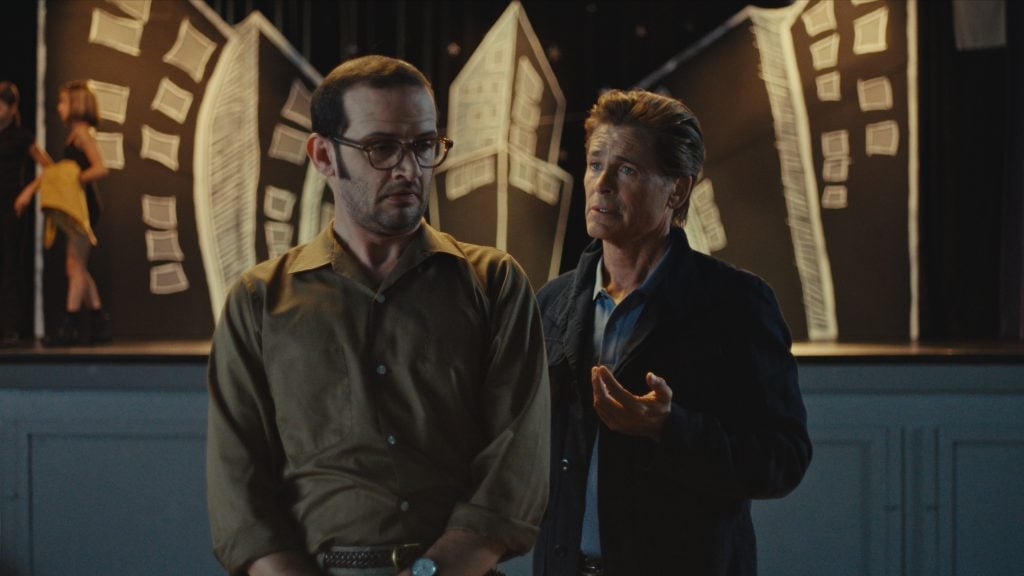
Doug (Will Brill) is a frustrated playwright who teaches theater at a middle school, clinging to the hope that his “real” career hasn’t passed him by. As the semester begins, he’s convinced he and his ex-girlfriend Abigail (Gillian Jacobs) are on the verge of reconciliation after an eight-week break. That illusion shatters almost immediately when Abigail reveals she’s begun dating Principal Brady (Rob Lowe), Doug’s professional rival, personal nemesis, and walking symbol of everything he believes has gone wrong in his life.
Brady is polished, confident, and on the verge of receiving the school’s coveted Blue Ribbon of Academic Excellence. Doug, spiraling and wounded, decides the only logical response is sabotage. If Brady’s success depends on the school looking good, Doug will ensure it doesn’t by staging the most inappropriate, politically incorrect student musical imaginable.
From there, The Musical makes its intentions clear. This is not a story of the healing power of art, or the triumph of creativity (well, considering where it’s headed, maybe it is about the triumph of creativity). It’s about what happens when bitterness takes over your brain. In that sense, the film feels like a distant cousin of Hamlet 2, another comedy built around a disgruntled theater teacher weaponizing performance as revenge. Bonilla’s film shares that DNA openly, though it never quite reaches the same balance of absurdity and insight.
Will Brill throws himself fully into Doug’s unraveling. His performance is very committed and often very funny in isolation. Doug’s desperation oozes from every interaction and the forced confidence. Brill understands the character’s delusion completely, portraying him as a man who genuinely believes he is the victim even as he becomes increasingly destructive.
The problem is not Doug’s behavior, it’s the film’s relationship to it.
For much of its runtime, The Musical positions Doug as an underdog, a misunderstood artist battling an unjust system. Yet his actions are frequently cruel, irresponsible, and self-serving in ways the film rarely interrogates. His manipulation of his students, his obsession with humiliating Brady, and his refusal to accept any accountability are largely treated as comedic fuel rather than character flaws requiring confrontation. As a result, Doug doesn’t meaningfully grow. He doesn’t learn. He simply escalates, and the film seems content to cheer him on. Now…Obviously, that could be the main point of the movie, but does it entirely work? Not really sure.
That imbalance becomes especially apparent in how Principal Brady is written. Rob Lowe is the film’s greatest asset, bringing natural charm even when the script gives him very little to work with. Brady is positioned as the antagonist, yet the film never provides a genuine reason for us to dislike him beyond Doug’s perspective. He’s smug, outgoing, and a bit corporate, but not actively cruel or malicious. The screenplay insists he’s the villain without doing the work to earn it.
To be fair, that may be intentional. The story is told almost entirely through Doug’s worldview, and resentment has a way of flattening other people into symbols. Still, intention doesn’t fully excuse execution. Without complexity on the opposing side, the conflict lacks bite.
Gillian Jacobs, meanwhile, is deeply underused. As Abigail, she functions primarily as a narrative catalyst, the object of Doug’s fixation and resentment rather than a fully realized person. Though Jacobs is clearly trying here, the character is rarely allowed interiority. She exists to motivate Doug’s spiral, not to meaningfully challenge or reflect it.
Where the film finds its strongest footing is in its setting. The middle school theater environment is ripe for satire, even if the film doesn’t lean too much into it, and The Musical occasionally nails the absurd politics of arts education with the forced enthusiasm and politics. The students themselves provide moments of genuine charm, their sincerity clashing with Doug’s adult grievances.
The turning point arrives early on when a paper airplane accidentally destroys the miniature sets Abigail has built for the planned West Side Story production. That minor disaster sparks Doug’s inspiration: an original musical titled The Heroes, a wildly inappropriate, boundary-pushing spectacle that becomes his instrument of revenge. Without giving too much away, the material is intentionally offensive.
Even with the many negatives, The Musical remains an easy watch. Bonilla’s direction keeps the energy moving, and the film’s commitment to chaos gives it momentum even when the screenplay falters. There’s an undeniable fun in watching things spiral, especially when Lowe pops in to inject life into a scene.
It’s not hard to imagine a better version of this film, one that leans harder into self-awareness and allows its protagonist to face consequences rather than applause. As it stands, The Musical is an enjoyable enough but uneven debut; a comedy with energy to spare, strong performances at its center, and a screenplay that maybe could have benefited from a rewrite or two.
Maybe it should’ve been called Spite: The Musical after all.
The Musical had its World Premiere in the U.S. Dramatic Competition section of the 2026 Sundance Film Festival.
Director: Giselle Bonilla
Writer: Alexander Heller
Rated: NR
Runtime: 84m
The Musical is an enjoyable enough but uneven debut; a comedy with energy to spare, strong performances at its center, and a screenplay that maybe could have benefited from a rewrite or two. Maybe it should’ve been called Spite: The Musical after all.
-
4.5
-
User Ratings (0 Votes)
0

Roberto Tyler Ortiz is a movie and TV enthusiast with a love for literally any film. He is a writer for LoudAndClearReviews, and when he isn’t writing for them, he’s sharing his personal reviews and thoughts on Twitter, Instagram, and Letterboxd. As a member of the Austin Film Critics Association, Roberto is always ready to chat about the latest releases, dive deep into film discussions, or discover something new.