

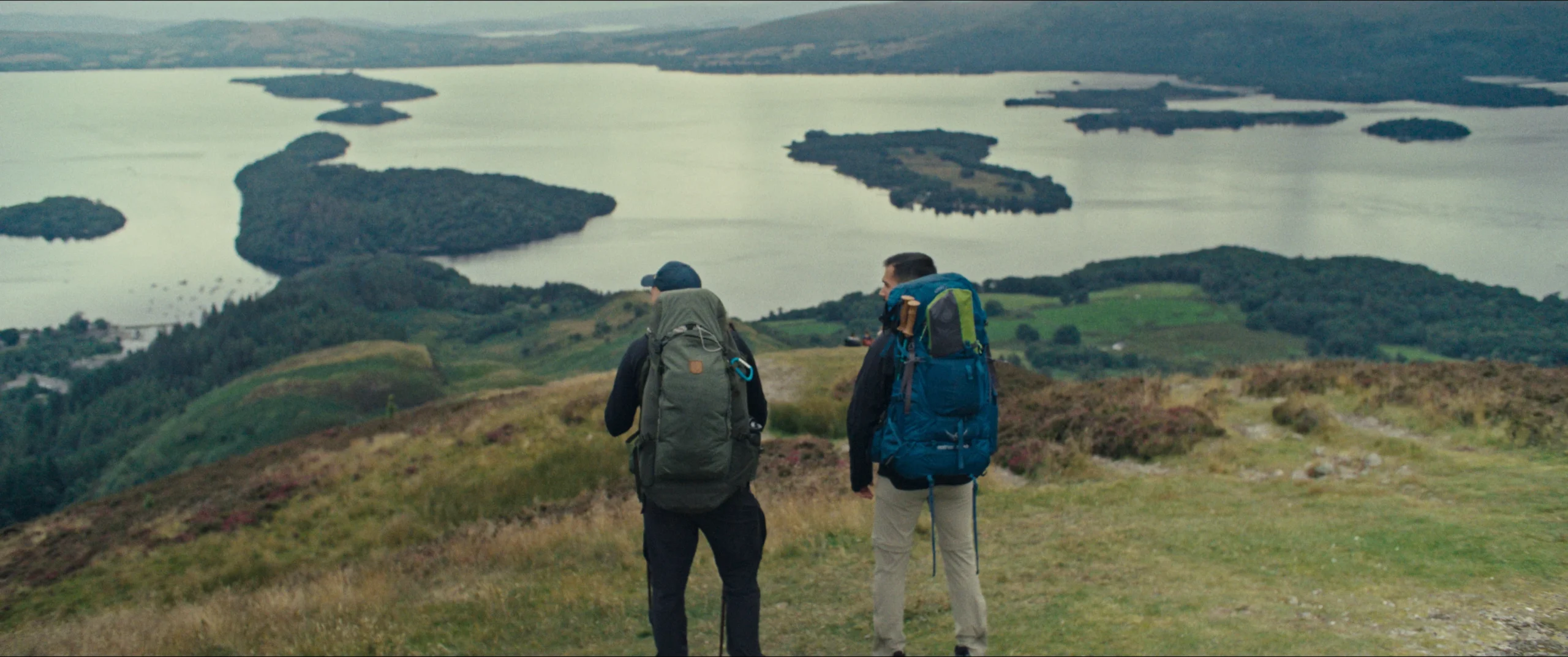
The dedication at the beginning of Bart Schrijver’s second feature, The North, is a simple message: “For my friend. I miss us.” And who among us hasn’t felt a similar longing for a person who was once such an intimate presence in our life, yet has drifted in one way or another, for one reason or another? In Schrijver’s case, the “friend” in question is an amalgamation of two people from his past – one with whom the director took a 3,000 kilometer hike (roughly 1,864 miles) through New Zealand back in 2017, and the other a childhood mate with whom the bond they shared slowly declined as they aged. As he told The Film Pupil, Schrijver felt a specific kind of grief in relation to both experiences, from allowing himself to be so focused on other preoccupations that the connections he’d once built with two people began to fracture. Perhaps Oscar Wilde had it backwards when he first uttered the phrase “life imitates art.”
Lluis (Carlos Pulido) embodies this aforementioned synthesis, one half of the hiking duo completed by Schrijver’s apparent archetype, Chris (perhaps not coincidentally played by an actor with a shared given name, Bart Harder). The two men, boasting strong exterior frames that shroud their far more fragile interiors, have not seen one another in a decade yet agree to set out on a 600 kilometer hike (372 miles) through the Scottish Highlands. “Why the years of distance?” is a question The North is less interested in exploring than the unknowns of how things will unfold now that they are back together again after such a long time apart, and its answers are clear: Much of it will take place in prolonged silence, unspoken grievances and resentments burbling beneath the surface, itching to get out but not knowing when or how to strike, not to mention whether or not the iron is hot.
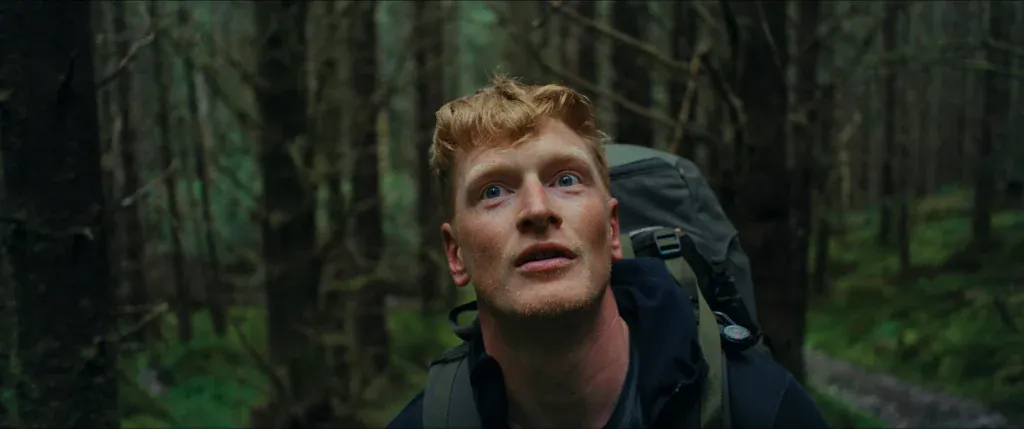
And what better place for such discovery – both individual and shared – to take place than on a hike, where meals are shared just as much as tent space and mountain air, and the world feels as endless as the space between two men who know not how to communicate through words and regularly find themselves asking the other “Are we good?” or “Are you okay?” as a means of making themselves feel more secure, not out of genuine concern for the other’s feelings. At a not-at-all brisk 132 minutes, The North takes pages out of films like the 2014 Reese Witherspoon vehicle Wild and 2015’s The Way in positioning a long walk as a pathway to introspection and healing, though two runs through this movie likely wouldn’t provide the same amount of dialogue nor voiceover than either of those two films do by themselves. It’s a trial in endurance, both narratively and literally for an audience, but Schrijver is fine with allowing his characters space to breathe and to seethe. There is a distinct difference between a picture being pedantic rather than patient, a line that The North certainly straddles, though it does ultimately land more on the side of being a considerate, thoughtful work reliant on the soul-searching its characters undergo as a byproduct of their journey up, down, and through the beautiful green hills of Scotland.
Shot by Twan Peeters (who also shot Schrijver’s first feature, Human Nature, which is also about a hike designed to serve its protagonist with opportunities for self-reflection), the images captured here often drive the film forward and serve as a balm rather than a method to meet a film’s version of a word count. “Long” is a word that plenty would use to describe The North – some might even say “overlong,” given that it operates on but a few thematic principles for two-plus hours – but no expedition, physical or mental, is short and sweet. Both Harder and Pulido are given their “big” moments to exude the rawest emotions they can muster, though like the film built around them, it is in the stretches of ostensible peace where they are doing their best work. The void into which they (and we) often wish to scream is precisely that, an empty crevice of deaf ears on which our voices fall. The wilderness they trek is anything but, and it’s through this that The North finds its ultimate purpose: The notion that the calmest places can unearth our most chaotic demons, and in time, free us of them altogether.
The wilderness they trek is anything but, and it’s through this that The North finds its ultimate purpose: The notion that the calmest places can unearth our most chaotic demons, and in time, free us of them altogether.
-
GVN Rating

Will Bjarnar is a writer, critic, and video editor based in New York City. Originally from Upstate New York, and thus a member of the Greater Western New York Film Critics Association and a long-suffering Buffalo Bills fan, Will first became interested in movies when he discovered IMDb at a young age; with its help, he became a voracious list maker, poster lover, and trailer consumer. He has since turned that passion into a professional pursuit, writing for the film and entertainment sites Next Best Picture, InSession Film, Big Picture Big Sound, Film Inquiry, and, of course, Geek Vibes Nation. He spends the later months of each year editing an annual video countdown of the year’s 25 best films. You can find more of his musings on Letterboxd (willbjarnar) and on X (@bywillbjarnar).