There is something deeply exhausting about watching two people who clearly love each other realize that love might not be enough, and it appears writer/director Joe Swanberg understands that feeling a little too well. Swanberg’s latest is a messy, uncomfortable relationship drama about two people who keep trying to figure out whether they should stay together, take a break, move on, or simply stop talking for five minutes before changing their minds again. It can be frustrating, repetitive, and very maddening, but there is something undeniably honest and relatable about the way it captures people who have no idea what they want and keep hurting each other while trying to figure it out.
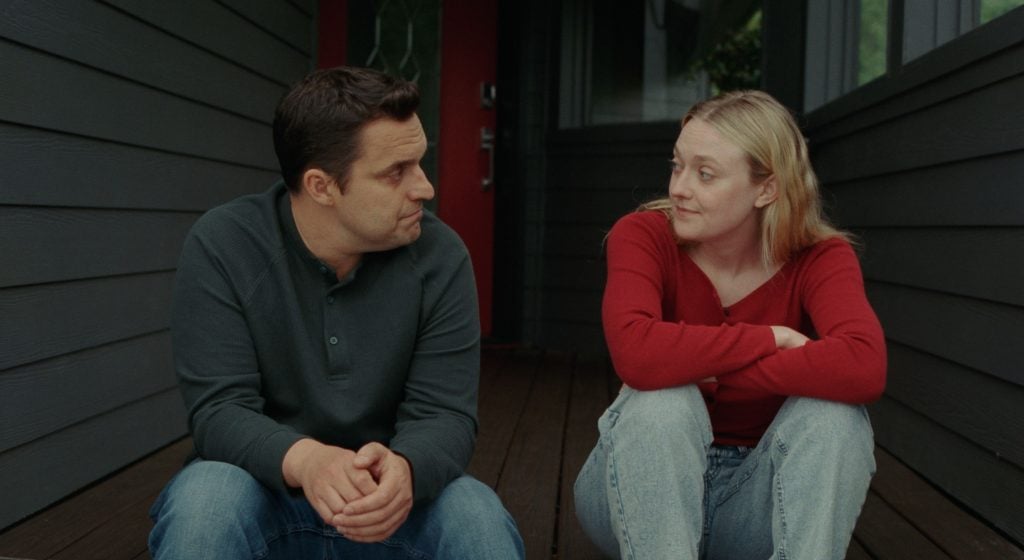
At the center is Wendy, played by Dakota Fanning, a 33-year-old woman living in Alaska who has built a comfortable life for herself but is beginning to wonder whether that life is actually the one she wants. She has been dating Jack (Jake Johnson), an older divorced man with two children, for two years. They clearly care about one another, but they are at completely different points in their lives. Jack already has a family and seems perfectly comfortable with the life he has built. Wendy isn’t sure she wants to step into that life, especially as her friends begin getting married, having children and settling down.
Fanning is excellent here. Wendy could have easily become irritating because she spends so much of the movie changing her mind, pushing people away and then pulling them back in, but Fanning gives her enough vulnerability and uncertainty that it becomes difficult to judge her too harshly. There is confidence to Wendy, but there is also a constant sense that she is trying to convince herself that she knows what she is doing. Fanning is particularly good at those quiet moments when Wendy doesn’t know how to respond to something, because you can practically see her thoughts changing in real time.
That uncertainty is also what makes the character exhausting. Wendy spends much of the movie going back and forth between what she wants and what she thinks she should want. She wants independence, then misses Jack. She reconnects with her ex boyfriend Chuck, then starts questioning that relationship. She wants space, then becomes upset when Jack gives her space. It feels incredibly human, but there were stretches where I wanted to grab both of them and tell them to just make a decision already.
Jake Johnson is just as good as Fanning. His Jack is probably one of the more interesting performances I’ve seen from him because he isn’t playing the usual charming, sarcastic version of himself. Jack is insecure, emotionally fragile and kind of a dork. He is someone who wants to appear like he has everything figured out on the surface while constantly worrying that Wendy is going to leave him. Johnson plays that insecurity without turning Jack into a pathetic character. There is something genuinely sad about watching him try to hold onto a relationship that he knows may already be slipping away.
The chemistry between Fanning and Johnson is fantastic, which makes their problems considerably more painful to watch. You believe that these two have spent years together. They have the little rhythms and annoyances that come with familiarity where you can watch them sit together without saying anything and still feel completely comfortable. Even their arguments feel like arguments between people who have had the same conversation several times before.
That realism is one of Swanberg’s biggest strengths, although it also becomes one of the film’s biggest weaknesses. The Sun Never Sets captures the repetition of relationships so accurately that the movie itself occasionally becomes repetitive. Wendy and Jack have the same conversation, separate, reconnect, argue again and repeat the process. There are stretches where the repetition feels purposeful because that is exactly what being stuck in an unhealthy relationship can feel like. Other times, it simply feels like the movie is spinning its wheels.
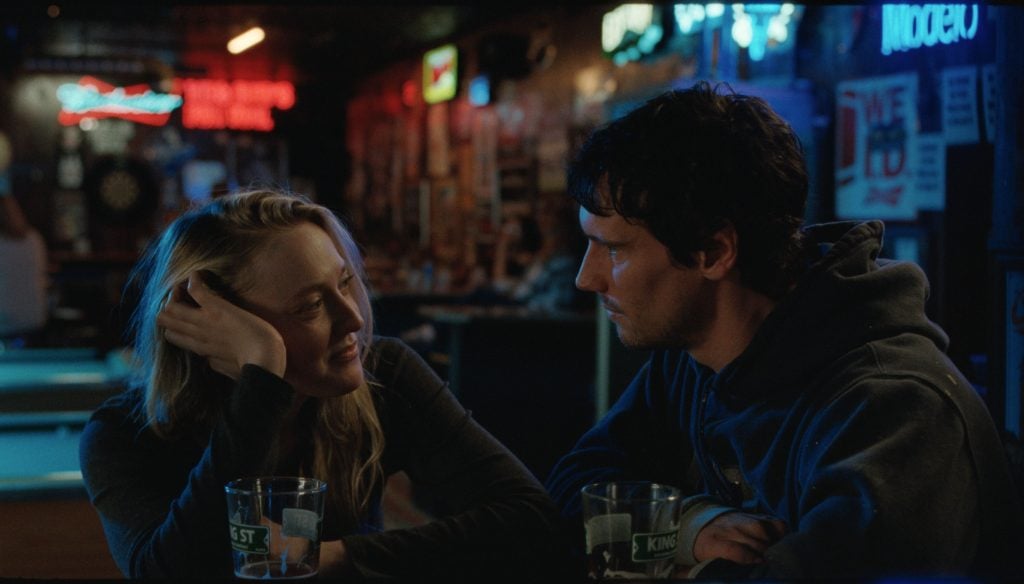
Then Chuck comes back into Wendy’s life, played by Cory Michael Smith, and the movie initially seems like it is going to become a familiar romantic triangle. Jack is the older boyfriend who offers stability and an established family, while Chuck represents something different, perhaps a chance to reconnect with the person Wendy used to be. Swanberg wisely doesn’t turn either man into a clear winner.
Smith is terrific, particularly because he and Fanning have their own chemistry. When Wendy and Chuck first reunite, there is an immediate sense that these two have history. You don’t need a long explanation of their relationship to understand that they know each other in a completely different way than Wendy and Jack do. Their scenes have an ease to them that contrasts nicely with the tension surrounding Wendy and Jack.
That is what makes the film more interesting than a standard love triangle. Chuck isn’t simply “the other guy,” and Jack isn’t simply the safe choice. Wendy’s real conflict is with herself as she is trying to figure out whether she actually wants marriage, children, stability and a conventional future, or whether she is only considering those things because everyone around her is beginning to settle down.
The movie gets a lot of mileage out of that idea, although it can also become indecisive to a fault. Almost every character seems capable of saying something with complete confidence before contradicting themselves a few scenes later. Again, that is probably intentional. People are contradictory, all human beings are. We say one thing because we believe it in that moment and then feel completely differently the next morning. Swanberg understands that because that is just life. The problem is that understanding why characters behave this way doesn’t automatically make watching them do it for an hour and a half is any less exhausting.
The Alaska setting helps enormously though. Eon Mora’s 35mm cinematography gives the film a gorgeous physical quality, with the mountains, forests and wide-open spaces surrounding these characters. There is something almost funny about watching people have emotionally claustrophobic conversations while standing in such enormous landscapes. Alaska feels like a character in its own right, and the beauty of the environment provides a wonderful contrast to how emotionally messy Wendy’s life has become.
There is also a nice little New Girl reunion with Jake Johnson and Lamorne Morris, who appears as one of Jack’s friends. Morris doesn’t have a huge role, but seeing the two together again is fun, especially given how different the tone is here. I am sure New Girl fans will get a kick out of it.
The film reminded me of Past Lives crossed with a less fucked-up version of Breaking the Waves. That might sound like a bizarre combination, but the comparison makes sense. Like Past Lives, it is interested in the lives people imagine they could have lived and the emotional weight of relationships that never fully disappear. At the same time, there is a much more painful and volatile quality to the relationships here, although Swanberg never pushes the material to the extremes of Lars von Trier, and quite frankly I don’t think he would want to.
What makes The Sun Never Sets work despite its frustrations is how little it cares about giving Wendy an easy answer. There is no obvious “right” relationship waiting for her at the end. Jack isn’t necessarily wrong for wanting stability, and Wendy isn’t wrong for wanting something different. Chuck isn’t necessarily the answer simply because he represents another possibility. The movie understands that sometimes the hardest part of growing up is realizing that there may not be a perfect choice waiting for you.

I did, however, find the movie exhausting by the end. The constant back-and-forth eventually started wearing me down, and the deliberately unresolved nature of Wendy’s emotional state can feel less like ambiguity and more like indecision. The film wants us to sit with the uncertainty, but there were moments when I felt like I had already sat with it for long enough.
But I’d be lying if I said it didn’t hit me especially as I just got out of a multi-year relationship myself, I found myself thinking about it afterward the rest of the day. Fanning and Johnson give the movie two incredibly grounded performances, Smith is excellent, the Alaska photography is beautiful, and Swanberg has a very sharp understanding of the strange little compromises that define long-term relationships. Even when the movie frustrated me, I recognized what it was trying to capture.
The Sun Never Sets is messy because its characters are messy, it is repetitive because these people keep repeating the same mistakes, it is exhausting because figuring out what you want from another person, and from your own life, can be exhausting. I’m just not sure all of that repetition always translates into compelling cinema. But there is something refreshing about a relationship movie that doesn’t pretend every problem can be solved with one big conversation. Sometimes people love each other and still don’t know if they belong together or how taking a break only makes things more complicated. And sometimes you can spend an entire movie trying to decide what you want without ever finding a satisfying answer. The Sun Never Sets understands all of that, even if I occasionally wished it would stop circling the same questions and finally let its characters breathe.
The Sun Never Sets will debut in theaters in Chicago on August 28, 2026, courtesy of the Independent Film Company. The film will expand nationally on September 4th.
Before we let you go, we have officially launched our merch store! Check out all of our amazing apparel when you click here and type in GVN15 at checkout for a 15% discount!
For major deals and money off on Amazon, make sure to use our affiliate link! If you are purchasing any of the latest and best in physical media at MovieZyng, you can support us using our affiliate link.
The Sun Never Sets is messy because its characters are messy, it is repetitive because these people keep repeating the same mistakes, it is exhausting because figuring out what you want from another person, and from your own life, can be exhausting.
-
GVN Rating

Roberto Tyler Ortiz is a movie and TV enthusiast with a love for literally any film. He is a writer for LoudAndClearReviews, and when he isn’t writing for them, he’s sharing his personal reviews and thoughts on Twitter, Instagram, and Letterboxd. As a member of the Austin Film Critics Association, Roberto is always ready to chat about the latest releases, dive deep into film discussions, or discover something new.