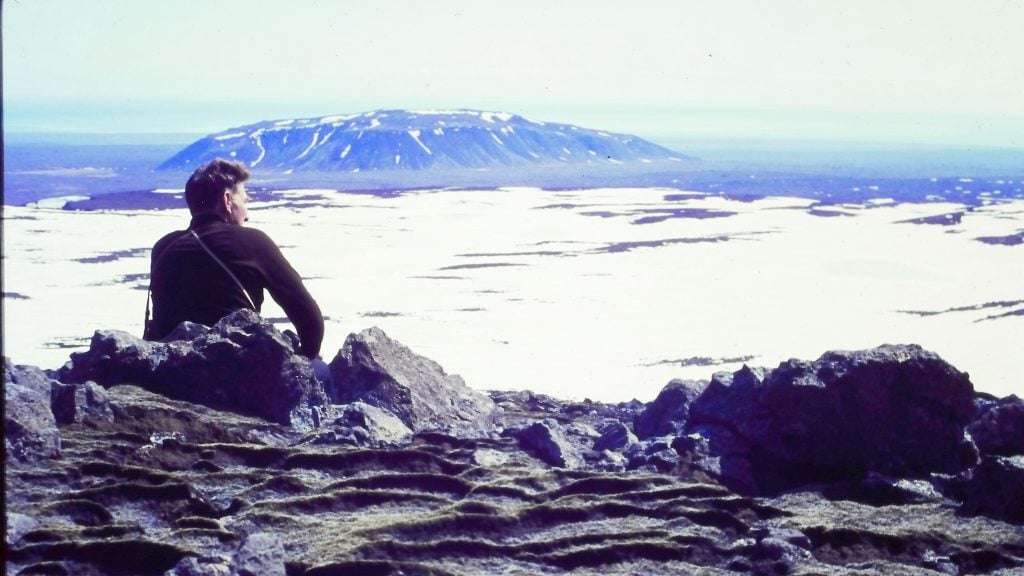
From its very first seconds, Time and Water tells you how it wants to be experienced. A message appears on screen addressed to loved ones in the future, asking them to press play if they’ve found this time capsule. We hear the click. Images of a cave and Icelandic glaciers fill the frame. Andri Snær Magnason begins to speak, not as a narrator explaining a thesis, but as someone recording something personal before it disappears. The film doesn’t rush to contextualize itself or lay out its purpose, but it starts with trust — trust that the viewer will sit with it, and trust that memory, when treated gently, can carry meaning on its own.
Directed by Sara Dosa, following her Fire of Love, Time and Water is a documentary rooted in loss, but not in the conventional sense. The loss here isn’t framed as a single event. It’s cumulative. Magnason is grappling with the deaths of his grandparents and with the slow, undeniable disappearance of Iceland’s glaciers, particularly Okjökull, the first glacier to be officially declared dead due to climate change. The film grows out of his assignment to write Okjökull’s eulogy, but that task becomes more of a starting point than a destination. What unfolds is a meditation on how time moves through families, landscapes, and stories, and what remains once the physical evidence is gone.
Rather than building an argument around climate change, the film approaches the subject sideways. Magnason talks about glaciers as archives, bodies of ice that hold layers of time stretching back millions of years. That idea mirrors the way family memory works, with stories passed down, reshaped, and sometimes forgotten altogether. Dosa leans into this connection by weaving together sweeping images of Iceland’s natural beauty with intimate archival material: photographs of Magnason’s grandparents, old home videos, footage of his own children. The effect is less like watching a documentary and more like being invited into someone’s private record of remembrance.
Magnason’s voiceover carries much of the film, and it’s one of its strongest elements. His narration is reflective and curious, often drifting into philosophical territory, but it never feels performative. He speaks like someone thinking out loud, trying to understand what it means to preserve something that cannot be saved. There’s a softness to his delivery that matches the film’s visual approach. Dosa doesn’t rely on flashy editing or dramatic musical cues. The images are allowed to breathe. Glaciers loom and recede. Family moments flicker by, imperfect and fleeting. The film trusts that these fragments, placed together, will resonate without being underlined.
One of the more compelling aspects of Time and Water is how it frames itself as a message to future generations. Magnason frequently addresses his children and those yet to be born, positioning the film as something meant to outlast him. This framing gives weight to even the smallest moments. A child playing. A grandparent’s face caught on old footage. A simple explanation of how glaciers are formed. These aren’t presented as sentimental flourishes. They’re treated as pieces of a record, evidence that something once existed and mattered.
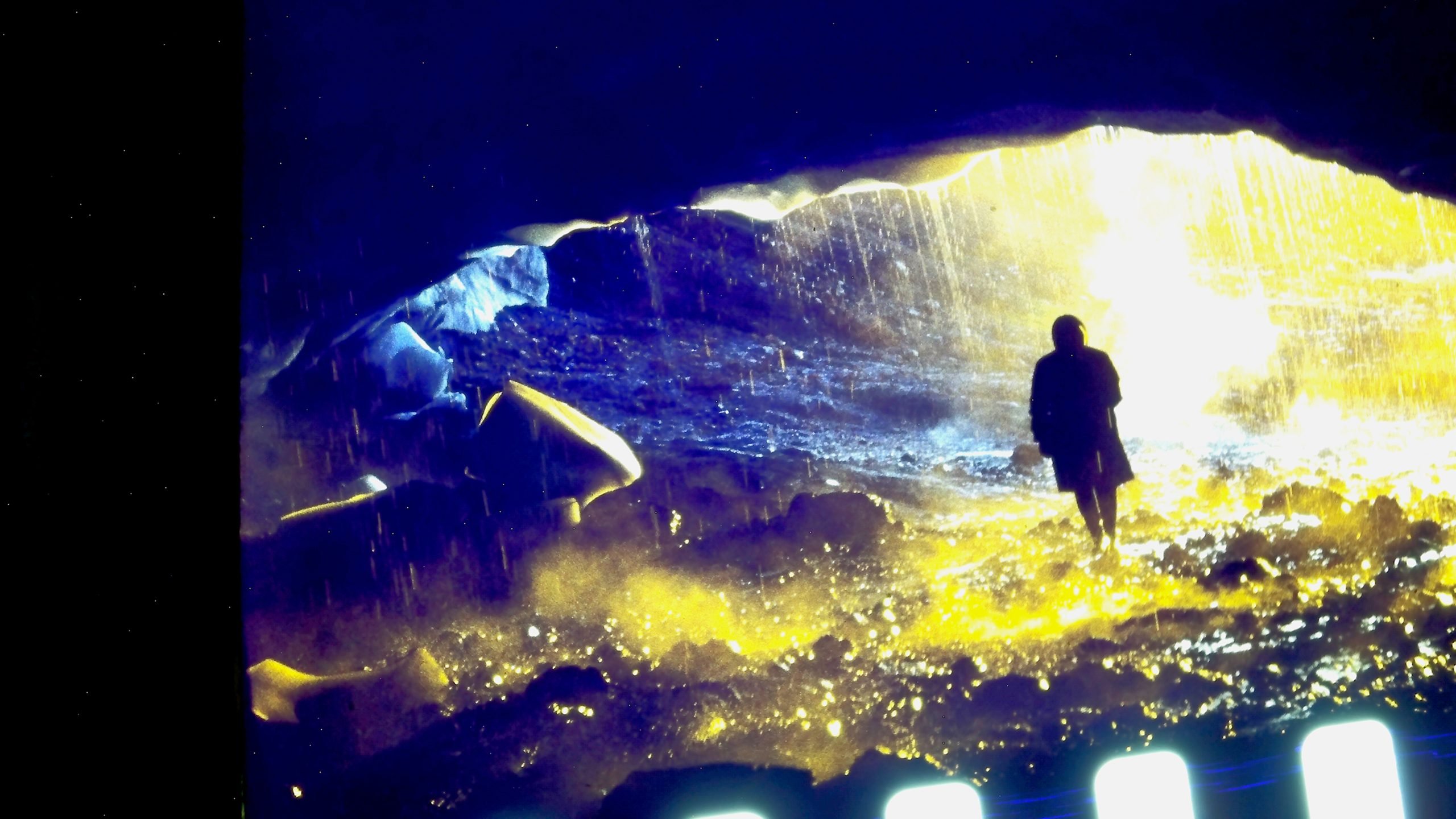
Visually, the film is often striking. Iceland’s landscapes are captured with a sense of scale that makes human presence feel both meaningful and fragile. At the same time, the archival footage grounds the film emotionally. The shifts between past and present feel natural, guided more by memory than by structure. There’s a sense that time is folding in on itself, which suits a film so concerned with how the past informs the future.
That said, Time and Water does struggle with repetition. The central ideas– impermanence, memory, loss–are strong, but the film circles them repeatedly without always finding new angles. As it stretches on, the experience can feel slightly overextended. There are moments where the material feels like it might have carried more impact in a shorter format, where the emotional rhythm might have landed more sharply. The film’s reflective pace, while intentional, occasionally drifts into redundancy.
Even so, the repetition feels tied to the subject itself. Grief doesn’t move forward neatly. Memory returns to the same places again and again. Dosa doesn’t try to smooth that out, and while that choice won’t work for everyone, it feels honest to the project’s emotional core.
In the end, Time and Water isn’t interested in persuading or alarming. It’s concerned with preservation on a human scale. When landscapes vanish and people pass on, what survives are stories, images, and voices passed from one generation to the next. The film understands that those remnants may be incomplete, and deeply personal — and that’s enough. It’s a documentary that values reflection over urgency, intimacy over explanation, and memory over permanence. Whether or not it fully justifies its length, it leaves behind something sincere: a record of someone trying to hold onto what time insists on taking away.
Time and Water had its World Premiere in the Premieres section of the 2026 Sundance Film Festival.
Director: Sara Dosa
Rated: NR
Runtime: 93m
Time and Water isn’t interested in persuading or alarming. It’s concerned with preservation on a human scale. When landscapes vanish and people pass on, what survives are stories, images, and voices passed from one generation to the next.

Roberto Tyler Ortiz is a movie and TV enthusiast with a love for literally any film. He is a writer for LoudAndClearReviews, and when he isn’t writing for them, he’s sharing his personal reviews and thoughts on Twitter, Instagram, and Letterboxd. As a member of the Austin Film Critics Association, Roberto is always ready to chat about the latest releases, dive deep into film discussions, or discover something new.
![‘The Boys’ Season 5 Premiere Doesn’t Pull Any Punches [SPOILER WARNING]](https://cdn.geekvibesnation.com/wp-media-folder-geek-vibes-nation/wp-content/uploads/2026/04/THBY_S5_UR_501_00331_R2_3000-450x300.jpg "‘The Boys’ Season 5 Premiere Doesn’t Pull Any Punches [SPOILER WARNING]")