

What is home? It’s a question too convoluted and tragic to come up with an answer for these days. With immigrants writing the first world’s history, but also looking at the families and friends they left behind, it’s difficult to pinpoint whether home is the sense of belonging to a country or a culture, or if it’s more personal, the idea of starting a family and building a life of one’s own.
Filmmaker Colette Ghunim has a very unique heritage. She is a Mexican-Palestinian woman who takes up a mission of tracing her parents’ journey as children fleeing from their home countries. Hosni, a Palestinian, and Iza, a Mexican, thought they were creating the ultimate American dream for their children, but as an educated, hyperaware woman, Ghunim was not having any of that. She knows what displacement does to the immigrant soul. She realizes that discovering what her American home means to her starts with understanding what is in the homes her parents forcefully left behind. In Traces of Home, she takes us, her captive audience, on this conquest with her.
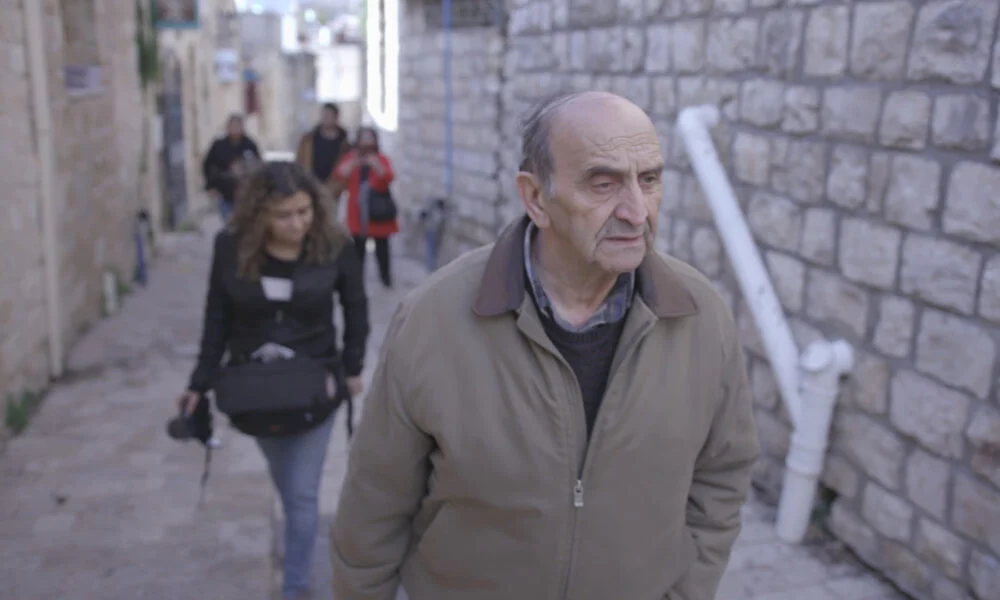
Ghunim uses tons of archival materials to define how her childhood was between two loving parents who suffered the same thing, exile, and yet were so happy to have built a life in a completely different country and culture. It’s so sweet to see her life from the beginning, as a happy, clueless American child, before she grows up and realizes the complexity of race, roots, and heritage. It’s not until she travels to Palestine and Mexico with her parents to find their old homes that the documentary takes a darker turn. Seeing people still traumatized by the lives and history that they left behind is both haunting and profound. I connected especially with Hosni because of his Palestinian suffering and how the loss of his family home never seems to abandon him. Seeing him back “home,” where it is supposed to be a mere trip down nostalgia lane, and yet it is a heavy burden that leaves him crushed and hopeless, breaks my heart.
Ghunim interviews her parents, and that’s when things get heavy. Her Palestinian father talks about being a refugee and the Nakba, which happened when Zionists kicked Palestinians out of their home in Palestine and stole their property, land, and belongings. Her mother’s story is about domestic violence and fear, running away from the hell at home to face the hell of the immigrant life and proving herself while providing the best life possible for her kids.
The key to this film is not any revolutionary camerawork or reinventing a genre that has been explored more than often, but it’s in the conversations that Ghunim has, especially the ones with her brother Ramsey, or her narration about her own experience as a second-generation immigrant. The difference between their parents’ experiences in the US vs. their experiences is highly insightful, but they also talk about how the burden that their immigrant parents carry affects them and causes them to feel alienated from their family home sometimes. The word home pops up more often than not, and it becomes polysmous as we see Iza and Hosni fighting respective demons, whether it’s Hosni’s lack of any living relative, or Iza’s pain of having a dark family history that led her to leave the wealthy life she had in Mexico behind.
The director shows, through the careful recording of her parents during candid moments, how the “home” doesn’t leave them. Home stays with the individual all their lives. It never leaves them, through distance or time. But is the new home, home? Or is the house that one buys in this beautiful, free, developed country simply a roof over one’s head with better opportunities?
Ghunim—like many documentarians before her—decides to take this long, tumultuous journey back to the family roots. Bravely, she shows what an odyssey it is to trace back her Palestinian father’s family house in Safed, a hilltop city in Palestine, and how easy it is to visit her mother’s big family in Mexico, and yet nothing is easy in this heartbreaking documentary drama. Traces of Home is truly an inspiring work of art; kudos to Ghunim for making me cry many times throughout.
Traces of Home is truly an inspiring work of art; kudos to Ghunim for making me cry many times throughout.
-
GVN Rating

Jaylan Salah Salman is an Egyptian poet, translator, and film critic for InSession Film, Geek Vibes Nation, and Moviejawn. She has published two poetry collections and translated fourteen books for International Languages House publishing company. She began her first web series on YouTube, “The JayDays,” where she comments on films and other daily life antics. On her free days, she searches for recipes to cook while reviewing movies.