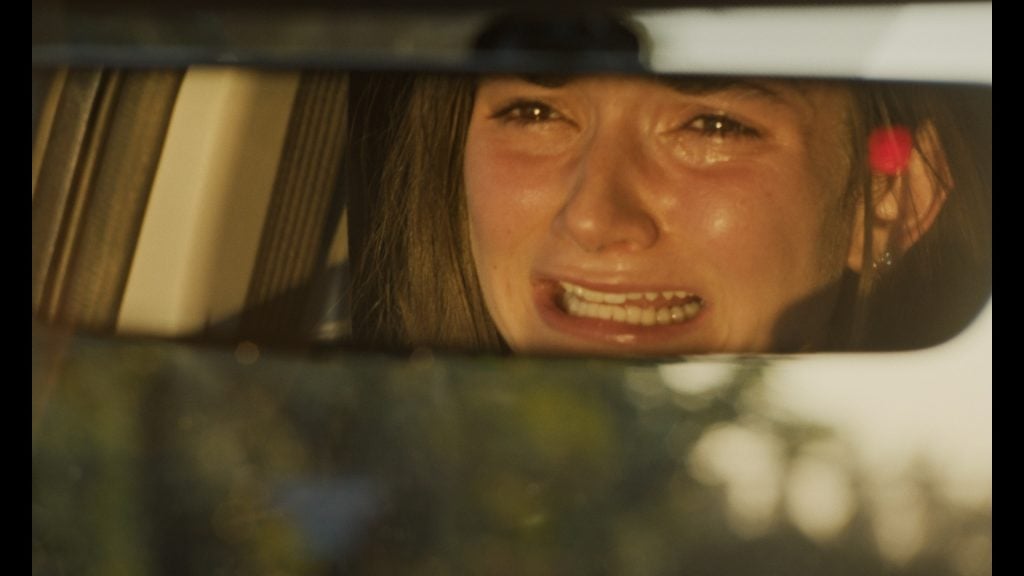
Emily Robinson’s Ugly Cry begins with a premise that feels almost like a dark joke: an actor loses a dream role because her cry isn’t “attractive” enough. On paper, it reads like absurd comedy, but watching it as a trans woman who’s recently come out, I felt it in a very personal way. There’s an immediacy to Robinson’s story that goes beyond the world of acting—it taps into what it feels like to be constantly measured, scrutinized, and forced to perform your very self for the approval of others.
Robinson, who also stars as Delaney, portrays a character navigating an industry obsessed with perfection, where one small flaw can feel catastrophic. As someone recently stepping into the world openly as my true self, I recognized the resonance immediately: the same tension, the same pressure, the same anxiety that Delaney feels about her “ugly cry” echoes experiences I’ve had navigating a society that wants to decide what’s acceptable, attractive, or real. For Delaney, every audition, every take, every self-tape is a moment where her identity is on trial. For me, coming out has felt similarly intense, like every expression of my authentic self is being evaluated, consciously or unconsciously, against a standard I didn’t set and that often doesn’t exist.
Films about beauty standards and the pressures they impose are hardly new—classics like Black Swan and more recent works such as The Substance show how society’s obsession with perfection can warp ambition, self-worth, and identity. What sets Ugly Cry apart is the intimacy of its lens: rather than focusing solely on visual perfection or the body, Robinson examines emotional performance itself—how even our rawest, most human moments can be judged, commodified, and measured against a standard we can never reach.
The film starts with satirical undertones. Self-tapes, endless retakes, and the waiting that defines Delaney’s professional life are played with a keen eye for absurdity. And yet, the humor is brittle, uncomfortable, and painfully relatable. For someone like me, who has navigated the world feeling the constant pressure to appear “acceptable” or “normal,” it struck a chord. The isolation, the small apartment spaces, the way Delaney’s phone becomes both her judge and confessional mirror—these are experiences that extend far beyond acting. They echo the private, internalized loops of self-scrutiny many trans people know all too well.
As Delaney’s obsession with her own emotional performance deepens, Ugly Cry moves into darker territory. It becomes less about comedy and more about psychological unraveling. Robinson’s brilliance is in how she portrays Delaney’s descent not as madness, but as the logical result of an environment that constantly evaluates and diminishes her. Her body, her face, her emotions—all become problems to be fixed. I saw parallels in my own experience: the constant monitoring of how I move through the world, how I am perceived, how my voice, expressions, and gestures are interpreted. There’s a quiet horror in the film that feels painfully real—less about supernatural scares, more about the anxiety of living in a space that refuses to let you exist unmediated.
Supporting performances enhance this tension. Ryan Simpkins’ Maya provides grounding humanity, a friend-like presence who reminds Delaney—and the audience—that self-worth isn’t always tied to evaluation. Aaron Dominguez as Miles offers quiet steadiness, while Robin Tunney’s Valerie embodies the distant, polished authority of the industry, a reminder of the impossible standards imposed by those in power. In many ways, this mirrors society itself: the voices of judgment, authority, and expectation that trans people must constantly navigate.
Visually, the film mirrors Delaney’s internal experience. Close-ups, tight framing, and intimate spaces convey the shrinking world around someone caught in obsessive self-analysis. As someone recently negotiating my own identity in public, the film’s claustrophobic intimacy resonated strongly. The repetition, the endless striving to perfect a single emotional beat, is exhausting—but that exhaustion is the point. Robinson wants you to feel the cycle of self-improvement and self-critique that defines Delaney’s life, and it works. I recognized the same loops in my own journey: the constant re-evaluation of actions, words, and self-expression.
Ultimately, Ugly Cry stands out among films about beauty standards because it moves beyond the superficial. It’s not just about looking a certain way—it’s about performing your emotions, your vulnerability, and your very identity in a world that judges you constantly. For trans people, those pressures can be even more acute, and Robinson’s film captures that anxiety with piercing accuracy. The film doesn’t provide answers, but it leaves you reflecting on what happens when authenticity becomes performance—and who gets to decide which version of you is acceptable.
For a directorial debut, Robinson’s work is fearless. It’s uncomfortable, funny, disturbing, and deeply human. I felt both the anxiety and the quiet affirmation of recognition: that the struggle to be seen, to exist authentically, is real—and that sometimes, admitting the impossibility of perfection is the first step toward freedom. Ugly Cry sits confidently alongside films that have critiqued beauty standards before it, but it does so in a way that feels wholly original, intimate, and devastatingly honest.
Ugly Cry held its World Premiere as part of the Narrative Spotlight section of the 2026 SXSW TV & Film Festival.
Director: Emily Robinson
Screenwriter: Emily Robinson
Rated: NR
Runtime: 94m
Ugly Cry sits confidently alongside films that have critiqued beauty standards before it, but it does so in a way that feels wholly original, intimate, and devastatingly honest.
-
9
-
User Ratings (0 Votes)
0

Codie Allen is a passionate trans and queer film critic and entertainment writer based in Orlando, FL. A Rotten Tomatoes-approved critic, Dorian Awards member, and CACF member, they also contribute to The Curb and InSession Film. When they’re not writing about films, you can find them sipping way too much tea and listening to Taylor Swift.