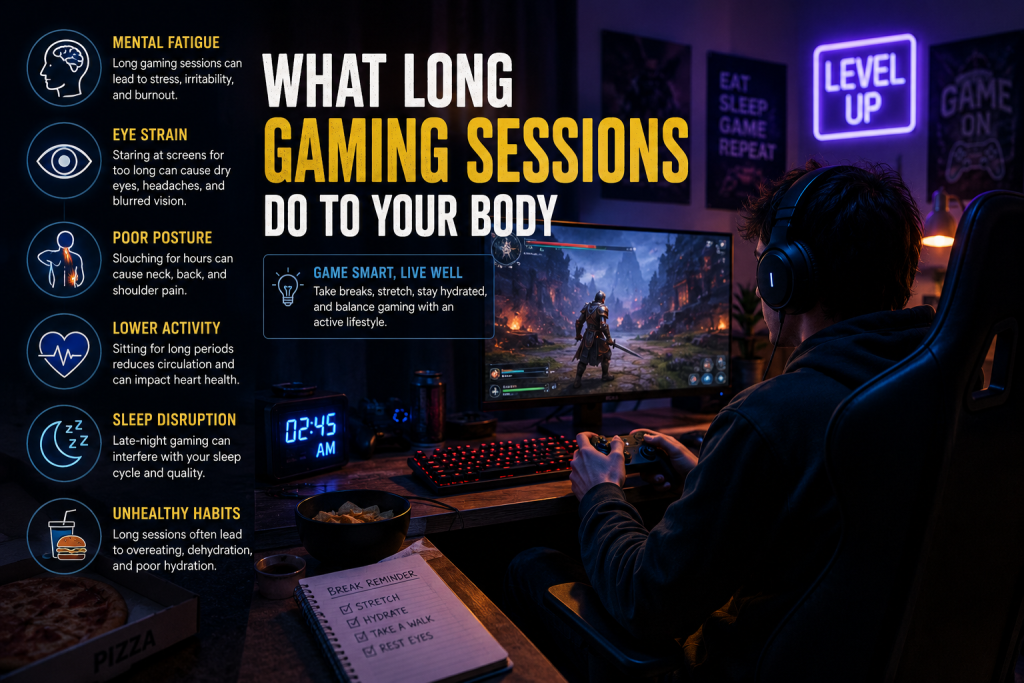
You sat down for one match. Maybe two. You were going to be in bed by midnight. But then the squad hit a streak, the ranked grind pulled you in, and somewhere between 1am and 3am you finally peeled yourself off the chair. Your back felt welded into a hunch, your eyes were dry and burning, and your feet felt weirdly stiff and heavy for someone who had not moved for six hours.
Sound familiar? Most gamers know that feeling. Very few know what is actually happening inside the body during those sessions. And honestly, some of it is more serious than you might expect.

Your Eyes Take the First Hit
This one you already know, but it is worth saying clearly: staring at a screen for hours without breaks causes digital eye strain, and it is genuinely unpleasant. Dry eyes, blurred vision, headaches that sit right behind the eyebrows, and sensitivity to light afterwards are all part of it.
The blue light from monitors also messes with your melatonin production, which is why finishing a long session at 2am and then expecting to fall asleep quickly is optimistic at best. Your brain has essentially been told it is still afternoon.
The standard advice from eye specialists is the 20-20-20 rule — every 20 minutes, look at something 20 feet away for 20 seconds. It is also advice that exactly zero people follow during a ranked session when the lobby is already loading.
Your Posture Silently Falls Apart
This is the one that tends to catch people off guard because it happens so gradually you do not notice it in the moment.
The head drifts forward toward the screen. The shoulders round inward. The lower back loses its natural curve and starts to flatten or arch the wrong way. None of this feels dramatic while it is happening. It just feels like sitting.
Here is the part that puts it in perspective though. Research in spinal biomechanics suggests that for every inch the head shifts forward from its neutral position, the effective load on the cervical spine increases by around 10 pounds. A head that weighs 10 to 12 pounds in neutral position can put the equivalent of 40 to 60 pounds of force on the neck when it is pushed forward toward a monitor. Do that for six hours and you start to understand why you wake up the next day feeling like someone tightened a vice around the base of your skull.
Major esports organisations now employ physiotherapists specifically because postural injuries were cutting careers short. If the pros are taking it seriously, that is a signal worth paying attention to.
Just as staying on top of your gaming setup gives you a performance edge online, getting your physical setup right matters just as much for the long game. Chair height, monitor distance, and desk ergonomics are not just comfort choices. They are injury prevention.
Your Circulation Slows Down — And This Is the Part Nobody Talks About
This is where it gets genuinely important and where a lot of gamers are completely unaware of what is happening.
When you sit for extended periods without moving, blood flow to the lower legs and feet slows significantly. Blood pools in the veins of the calf and ankle region. Your feet start to feel heavy, stiff, or swollen. Most people assume that is just tiredness. It is not just tiredness.
Prolonged sitting is a documented risk factor for deep vein thrombosis, a condition where blood clots form in the deep veins of the legs. This is not a theoretical risk reserved for elderly hospital patients. There are documented cases of young, healthy gamers developing DVT following extreme marathon sessions lasting 20 hours or more. The cases are real, they have been reported in medical literature, and the common thread is simple: the person did not move for a very long time.
For most gamers the risk sits at the lower end of that spectrum, but the circulatory slowdown itself is happening regardless. And that slowdown is one of the mechanisms behind foot and ankle problems that develop over time in people who sit for long periods regularly.
Your Feet and Ankles Bear More of the Cost Than You Think
This surprises most people, because foot and ankle problems feel like something that happens to runners and people who stand all day. Not gamers.
But here is what actually happens. Plantar fasciitis, one of the most common causes of heel and arch pain, is not only triggered by overuse. It is also triggered by prolonged inactivity followed by sudden movement. The plantar fascia, the band of tissue running along the bottom of your foot, tightens when it is not being used. When you suddenly stand up after six hours and walk to the kitchen, that tissue gets stretched quickly and without preparation. Do that regularly and you start to feel it.
The Achilles tendon does something similar. In a seated position with your feet resting flat, the tendon shortens slightly over time. Long sessions leave it stiff and less flexible, which increases the load on it when you do start moving.
There is also the nerve compression angle. Depending on how you are positioned in your chair and where your feet sit, prolonged sessions can cause tingling or numbness in the feet from sustained pressure on nerves in the lower leg and ankle. A lot of gamers put this down to the chair. Sometimes it is the chair. Sometimes it is something worth getting looked at.
If you regularly notice foot or ankle pain, swelling, or tingling after long sessions, it is worth getting it checked out properly. A foot and ankle specialist can assess whether your gaming habits are contributing to a developing condition before it becomes something that sidelines you from more than just gaming.
Your Mental Health Feels It Too
This section is not here to lecture anyone about screen time. Gaming has real, well-documented cognitive benefits including improved reaction time, spatial reasoning, and problem solving. That is not what we are talking about here.
What we are talking about is what happens to the brain and mood specifically during and after uninterrupted marathon sessions.
Extended gaming without breaks elevates cortisol, the stress hormone, particularly during competitive high-stakes play. The post-session crash that many gamers describe — that flat, empty, slightly irritable feeling after a long grind — is partly physiological. Dopamine, the neurotransmitter associated with reward and motivation, gets depleted after extended reward stimulation. The game keeps delivering small hits of it with every kill, level up, and match win. Eventually the system needs time to reset.
None of this makes gaming bad. Uninterrupted, all-night sessions without food, water, movement, or rest are where the cost accumulates. The game itself is not the problem. The marathon format is.
Simple Fixes That Do Not Ruin the Session
Nobody is suggesting you leave the game mid-match. But there are things that make a real difference without meaningfully disrupting your play.
-
Set a timer for every 45 to 60 minutes and stand up for two minutes between games. Two minutes. That is it. That window is enough to get circulation moving again in your lower legs.
-
Keep water at the desk and actually drink it. Dehydration accelerates muscle fatigue, joint stiffness, and headaches. It also makes concentration worse, which is counterproductive for anyone trying to play well.
-
Do calf raises while you are sitting. Flexing and raising your calf muscles repeatedly while seated is one of the most effective ways to push pooled blood back up from the lower legs. You can do it without leaving the chair.
-
Position your feet flat on the floor or on a footrest rather than tucked back under the chair. That position reduces nerve compression and keeps the ankle in a more neutral position during long sessions.
-
Invest in a chair with proper lumbar support before you spend money on the next peripheral upgrade. Your lower back will give you considerably more trouble than your keyboard after age 25.
-
If foot or ankle swelling persists after rest, if you are noticing tingling regularly, or if heel pain has become a consistent part of your morning routine, get it assessed. It is not normal and it is not just tiredness.
Getting more out of every gaming session means staying in the game long term, and that requires looking after the body doing the sitting, clicking, and grinding.

The Body Keeps Score
Nobody is saying quit gaming. The point is simpler than that. Your body is running a tab during every session, and it will eventually ask you to settle it. Eyes, posture, circulation, feet, and mental energy all accumulate cost during marathon play.
The gamers who stay healthy and playing into their 30s and beyond are generally not the ones who grind the hardest without pause. They are the ones who figured out that two minutes between games, a glass of water, and a chair that actually supports them is a better long-term investment than anything in a gaming peripherals store.
Stand up. Stretch. Drink some water. Your K/D ratio will survive it.

Heather Neves is working as a freelance content writer. She likes blogging on topics related to parenting, golf, and fitness, gaming . She graduated with honors from Columbia University with a dual degree in Accountancy and Creative Writing.