

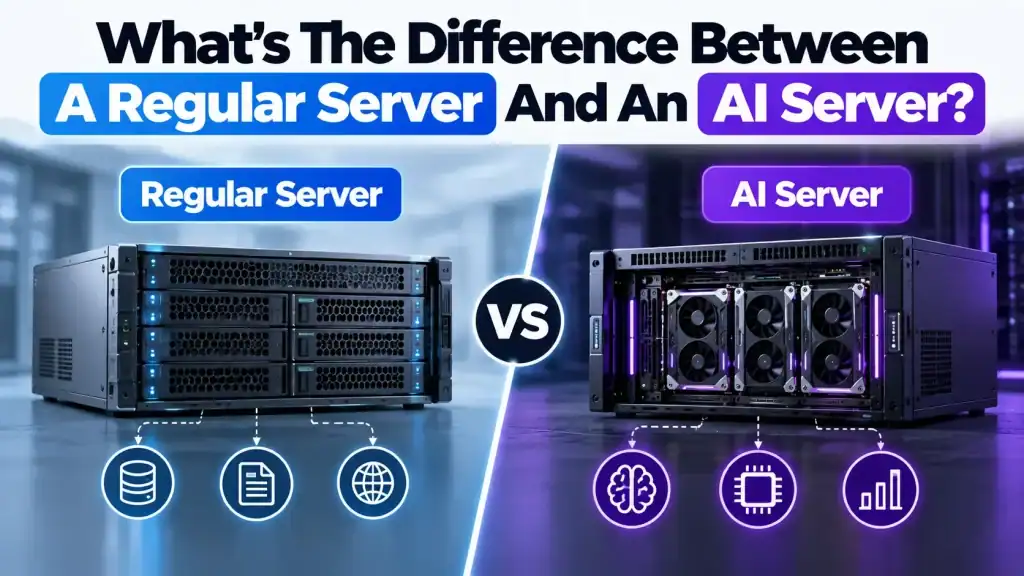
A regular server handles everyday business computing, such as hosting websites, running databases, managing applications, and supporting virtual machines.
An AI server is designed for artificial intelligence workloads, including machine learning, deep learning, generative AI, and large language models.
The main difference is processing power and hardware configuration. Regular servers primarily use central processing units (CPUs) for general-purpose tasks, while AI servers often use graphics processing units (GPUs) and specialized accelerators to process large amounts of data in parallel. AI servers may also require higher memory bandwidth, faster networking, and advanced cooling.
Choosing the right server depends on workload requirements, performance expectations, infrastructure costs, and future business needs.
What Is a Regular Server?
A regular server is a computer that provides applications, data, and services to other computers over a network. Businesses use servers to host websites, manage databases, store files, run enterprise applications, and support daily IT operations.
Most traditional servers rely on CPUs to execute instructions and process workloads. They also use RAM, storage drives, and network interfaces to deliver reliable performance.
Common applications include:
-
Web hosting and application delivery.
-
Database management and transaction processing.
-
Virtualization and virtual machine hosting.
-
File sharing and centralized storage.
-
Enterprise applications, including ERP and CRM systems.
Regular servers are versatile and suitable for many business workloads. However, CPU-focused configurations may not provide the processing performance required for intensive AI training.
What Is an AI Server?
An AI server is a computing system designed to handle artificial intelligence workloads efficiently. It combines CPUs, memory, storage, networking, and often GPUs or other specialized accelerators.
AI applications frequently perform large numbers of mathematical operations simultaneously. GPUs support this parallel processing, making them useful for training neural networks, processing images, and running generative AI models. Lenovo AI servers, for example, provide hardware configurations designed to support demanding AI workloads, from model training to inference.
AI servers commonly support:
-
Training and fine-tuning machine learning models.
-
Running large language models and generative AI applications.
-
Processing images and videos through computer vision.
-
Operating chatbots and recommendation systems.
-
Performing predictive analytics and AI inference.
These systems may also require high-bandwidth memory, fast storage, high-speed networking, and advanced cooling to maintain performance during demanding workloads.

How Do Regular Servers and AI Servers Differ?
| Factor | Regular Server | AI Server |
| Primary purpose | General business computing | AI training and inference |
| Processing hardware | Primarily CPUs | CPUs with GPUs or AI accelerators |
| Memory | Based on application needs | Often requires higher bandwidth |
| Processing style | General-purpose computing | Parallel computation |
| Cooling | Based on system requirements | May require advanced cooling |
| Applications | Websites, databases, virtualization | Generative AI, deep learning, computer vision |
| Cost | Varies by configuration | Can be higher due to specialized hardware |
These differences are not absolute. Some regular servers support GPUs, and certain AI workloads can run on CPU-only systems. The appropriate configuration depends on the application’s performance requirements.
Why Do AI Servers Need Specialized Hardware?
AI servers need specialized hardware to process large datasets, run complex AI models, and deliver faster results. Unlike regular servers, they must handle demanding parallel computations, high memory requirements, and continuous workloads.
Three hardware components are particularly important.
1. GPUs and AI Accelerators
CPUs handle a broad range of computing tasks, while GPUs perform many mathematical operations in parallel. This makes GPUs and AI accelerators suitable for training neural networks and running AI inference.
Smaller AI models may run efficiently on CPUs or integrated accelerators. The right configuration depends on model complexity, processing volume, and response-time requirements.
2. Memory and Storage
AI models need memory to store model parameters and intermediate calculations. Large models may require substantial GPU memory, while training workloads can also benefit from high system memory capacity.
Fast storage helps deliver datasets to processors efficiently. Adequate storage bandwidth reduces the risk of data movement becoming a bottleneck during AI workloads.
3. Cooling and Power
AI accelerators can consume considerable power and generate significant heat, particularly when multiple GPUs operate together. Depending on the configuration, AI servers may require higher-capacity power delivery, improved airflow, or liquid cooling.
These requirements affect data center design, rack density, electricity consumption, and operating costs. Proper cooling and power management help maintain stable performance during demanding AI workloads.
When Should a Business Choose an AI Server?
An AI server is appropriate when an organization needs to train, fine-tune, or run AI models that require specialized computing resources.
Common applications include:
-
Generative AI: Running internal assistants, chatbots, and large language models.
-
Computer vision: Analyzing images and inspecting manufactured products.
-
Predictive analytics: Identifying patterns in operational and financial data.
-
Recommendation systems: Personalizing digital experiences.
-
Industrial automation: Supporting AI-driven inspection and monitoring.
A business running an ERP application may need a conventional server with reliable CPU performance, memory, and storage. However, if the business also needs to train a computer vision model to identify manufacturing defects, a GPU-powered AI server may be a better fit.
For example, Lenovo AI servers can support these workloads by combining GPU acceleration, high-performance processing, and memory capacity suited to the demands of AI model training and inference.
Can a Regular Server Run AI Workloads?
Yes. Regular servers can run smaller machine learning models, lightweight AI inference tasks, and applications that do not require extensive parallel processing.
However, performance may become a limitation when workloads involve large neural networks, substantial datasets, or many simultaneous inference requests.
Adding a compatible GPU can improve performance if the server supports the accelerator’s physical, power, cooling, and software requirements. A dedicated AI server is not necessary for every AI project, so businesses should assess their workloads before upgrading.
How Do You Choose Between a Regular Server and an AI Server?
Consider these six factors before selecting infrastructure:
-
Workload requirements: Determine whether you need general computing, AI inference, model fine-tuning, or large-scale training.
-
Performance targets: Evaluate processing speed, response time, throughput, and concurrent users.
-
Hardware compatibility: Check CPU capabilities, GPU support, memory, storage, and networking.
-
Power and cooling: Estimate the infrastructure needed to operate the system reliably.
-
Scalability: Consider whether future workloads will require additional accelerators or connected servers.
-
Total cost of ownership: Include hardware, electricity, cooling, software, maintenance, and operational expenses.
Conclusion
The main difference between a regular server and an AI server is the workload each system is designed to handle. Regular servers support business computing, including databases, websites, virtualization, and enterprise applications. AI servers add specialized processing capabilities, often through GPUs, alongside memory, networking, power, and cooling configurations suited to demanding AI workloads.
Neither option is universally better. Businesses should choose based on application requirements, expected performance, scalability, and operating costs. Understanding these factors helps organizations build infrastructure that supports existing operations while preparing for future AI adoption.

Sandra Larson is a writer with the personal blog at ElizabethanAuthor and an academic coach for students. Her main sphere of professional interest is the connection between AI and modern study techniques. Sandra believes that digital tools are a way to a better future in the education system.