

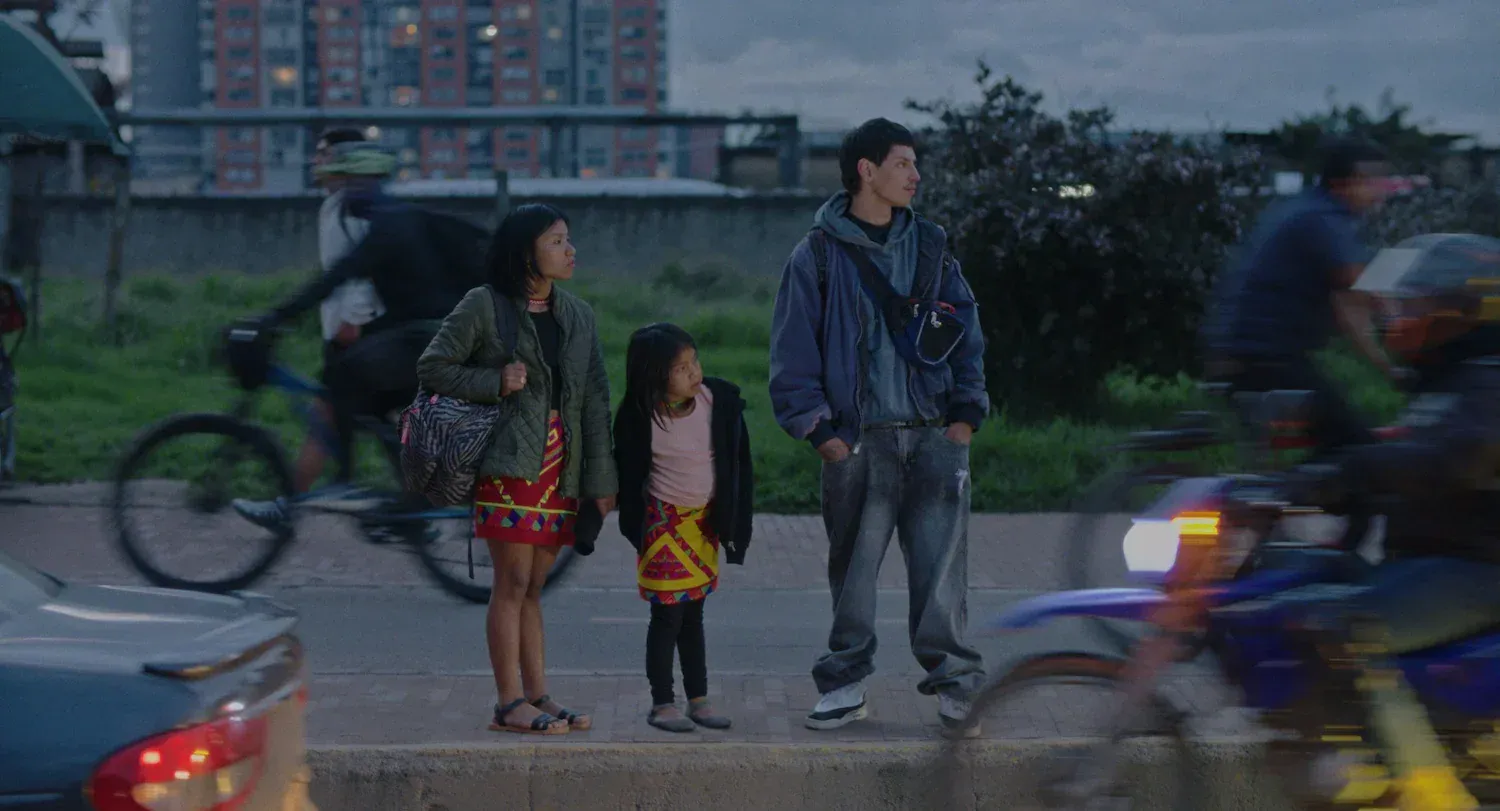
Juan Andrés Arango’s Where the River Begins follows three people trying to escape lives shaped by violence, displacement, and loss. Yajaira (Girleza Duave Cerezo), an Indigenous mother living in Bogotá, decides to return to the rainforest where she grew up, bringing her young daughter María (Ana Michell Nama Dumaza) along with her. They are joined by Jhon (Juan David Junca Linares), a young gang member also looking for a way out of the city. Their journey toward the Andágueda River becomes a search for safety and belonging, but it also forces them to confront the histories they carry with them. Arango approaches this story with a great deal of restraint, allowing the Colombian landscapes and the performances to do much of the emotional work. The narrative is fairly simple, sometimes to its detriment, but there is an honesty to the film that makes its quieter moments worthwhile.
The cinematography, handled by Nicolas Canniccioni, is easily one of the film’s greatest strengths. The images often seem to float through the environment, following the river and moving among the trees with a natural grace. Bogotá feels crowded and threatening, while the journey toward the rainforest gradually opens up the frame, giving the characters room to breathe. The contrast is effective without becoming too obvious, and the natural environment feels like an essential part of the story rather than a pretty backdrop. When Yajaira returns to the land connected to her childhood, the landscape carries memories that she struggles to express directly. There is a sense of history in these images, as though the characters are moving through a place that remembers what happened there even when they would rather leave the past behind.
That history gives the film its emotional weight. As a child, Yajaira witnessed the destruction of her village and the displacement of her Indigenous community from its ancestral territory. Years later, she has built a life in Bogotá, selling handmade crafts to support herself and María, but the city has not offered the security she hoped to find. Gang violence and the threat of further tragedy eventually push her to leave. Her journey is about finding somewhere safer to raise her daughter, but it is also an attempt to reconnect with a culture and homeland that were taken from her. Through Yajaira’s experiences, Arango addresses colonialism, Indigenous displacement, and the lasting consequences of violence against communities whose connection to their land is central to their identity.
The performances feel remarkably natural, which makes these themes land with greater force. The cast consists entirely of nonprofessional actors from the region, and their presence gives the film a texture that would be difficult to manufacture. Cerezo brings a quiet determination to Yajaira, a woman who has spent years trying to survive while carrying memories she cannot simply leave behind. María’s place in the story is equally important because she is growing up away from the community that shaped her mother’s life. Her dreams and visions create a connection between the journey and the spiritual traditions surrounding her heritage, even as she tries to understand where she belongs. Jhon adds another dimension to the group. Initially guarded and aggressive, he is also a young man trying to escape circumstances that have made violence seem like an ordinary part of life.
The relationship between these three travelers gives Where the River Begins much of its appeal. Yajaira has understandable reasons to be wary of Jhon, particularly when she is responsible for María’s safety, and their uneasy companionship adds some tension to the journey. All three are searching for a different future, although they have very different ideas about what that might look like. The film is interested in the possibility of healing through movement, through reconnecting with the past, and through the relationships people form when they have little else to rely on. Its approach is understated, and I appreciated that Arango does not feel the need to turn every encounter into a major dramatic moment.
That simplicity does create problems. The central conflict gradually loses some of its dramatic force, and there are stretches where the journey feels less involving than the material deserves. The film has a meaningful premise and plenty of emotional history to draw from, but its storytelling can be so restrained that the characters’ struggles begin to feel distant. It eventually finds its footing again as the rainforest and river become more central to Yajaira’s search for home, though the middle portion could have used a stronger sense of progression. I like that the film avoids manufacturing conflict simply to keep the story moving, but a little more development would have helped its emotional turns feel fully earned.
Still, Where the River Begins leaves an impression through its images, performances, and understanding of what displacement can take from a person. The river offers the possibility of renewal, but the film recognizes that returning home cannot undo everything that happened before. Arango’s storytelling may occasionally feel too slight, yet its simplicity also gives the film room to breathe.
Where the River Begins held its World Premiere as part of the Centrepiece section at the 2026 Toronto International Film Festival.
Director: Juan Andrés Arango
Screenwriter: Juan Andrés Arango
Rated: NR
Runtime: 102m
Before we let you go, we have officially launched our merch store! Check out all of our amazing apparel when you click here and type in GVN15 at checkout for a 15% discount!
For major deals and money off on Amazon, make sure to use our affiliate link! If you are purchasing any of the latest and best in physical media at MovieZyng, you can support us using our affiliate link.
Where the River Begins leaves an impression through its images, performances, and understanding of what displacement can take from a person.
-
GVN Rating 8
-
User Ratings (0 Votes)
0

Roberto Tyler Ortiz is a movie and TV enthusiast with a love for literally any film. He is a writer for LoudAndClearReviews, and when he isn’t writing for them, he’s sharing his personal reviews and thoughts on Twitter, Instagram, and Letterboxd. As a member of the Austin Film Critics Association, Roberto is always ready to chat about the latest releases, dive deep into film discussions, or discover something new.