
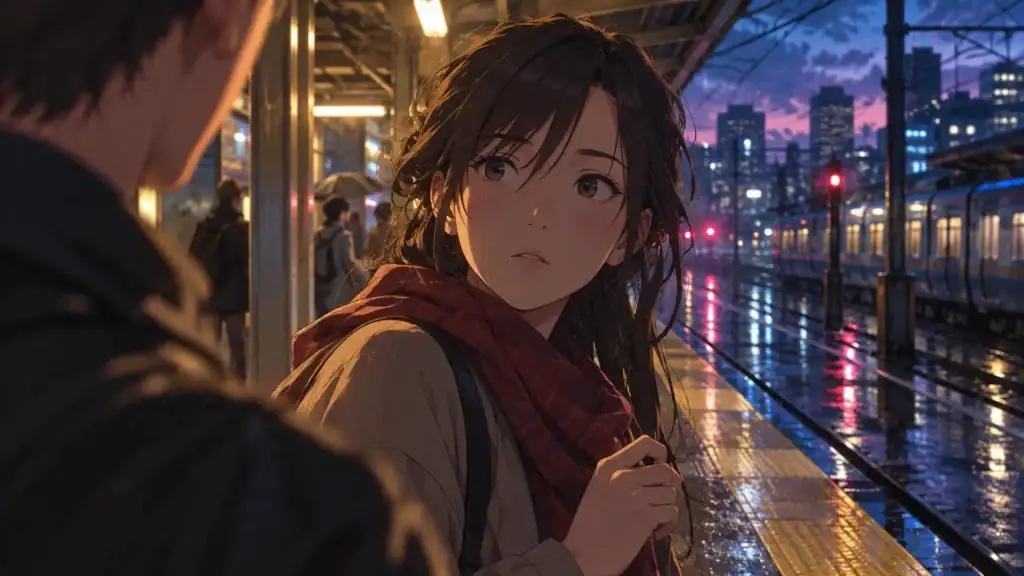
Anime is famous for spectacular movement: impossible sword fights, explosive transformations, and chase scenes that bend space itself. Yet some of its most memorable emotional moments barely move at all. A character pauses in a doorway. Another looks away. The camera holds on a pair of widening eyes for one beat longer than expected. No one explains what the expression means, but the audience understands it immediately.
That effect is not accidental. A strong anime reaction shot combines framing, editing, sound, and graphic simplification so that a small change carries the weight of a full line of dialogue. Learning to notice those choices makes quiet scenes more rewarding and reveals why the same reactions are so easy for fans to recognize, quote, draw, and recreate in text.
A Reaction Shot Is More Than a Face
In its simplest form, a reaction shot shows how a character responds to something that has just happened. The important information, however, is not limited to the expression. Meaning comes from the relationship between two shots.
Imagine a character opening a letter. The first shot establishes the letter. The next shows the character’s face becoming still. On its own, that still face could suggest concentration, fear, disappointment, or disbelief. Placed after the letter, it becomes a response. If the edit then cuts to a trembling hand, the emotion becomes more specific without requiring an explanation.
Anime often strengthens this relationship by controlling what the audience knows. Sometimes viewers see the surprising object first and wait for the character to catch up. In other scenes, the reaction appears before the cause is revealed. The second approach turns the face into a question: what could have produced that look?
This is why a reaction shot should not be judged as an isolated drawing. Its emotional force depends on what came before it, what follows it, and how much time the editor allows the audience to read it.
The Half-Reveal Creates Anticipation
One of the most effective compositions is also one of the simplest: show only part of the observer. A character peers around a doorway, rises just above a table, or watches from the edge of the frame. The hidden portion of the body tells us that the character is not ready to enter the scene fully.
That partial reveal can suggest curiosity, suspicion, embarrassment, caution, or comic nosiness. The exact interpretation depends on posture and context. Wide eyes above a desk may feel playful. A single eye visible beyond a dark door can turn the same basic composition into tension.
For animators, that frame edge is not empty space. It behaves like a prop. The border does part of the acting by explaining the character’s position and intention before the character says anything.
When a Face Suddenly Opens Up
Another familiar reaction begins with emotional release. A worried or neutral face brightens; the eyes open; the posture lifts; the composition may gain sparkles, warmer light, or a cleaner background. The change can signal recognition, relief, inspiration, or delight.
What matters is contrast. A permanently cheerful character smiling again does not necessarily create a dramatic beat. A guarded character briefly becoming open can transform the scene. Anime can make that transition readable by simplifying the face at the exact moment of change. Details disappear, the silhouette becomes clearer, and one or two features carry the entire reaction.
Japanese visual vocabulary has an everyday way to describe this kind of change: paa, the sense of something suddenly opening or brightening. The audience does not need a realistic portrait to understand it. It needs the right contrast at the right moment.
Timing Turns an Expression Into a Beat
A reaction can be drawn perfectly and still feel weak if it disappears too quickly. Holding the image for an additional fraction of a second gives viewers time to notice the change and anticipate the response. Holding it too long can create discomfort, suspense, or comedy.
Comedy frequently depends on delayed reaction. A ridiculous statement lands, the scene goes quiet, and the other character remains motionless before responding. The pause tells the audience that the line was too strange to process normally. In drama, the same delay can suggest that a character is hiding what they feel or searching for a safer answer.
Fast sequences use the opposite approach. A series of short reaction cuts can show a whole group registering danger at once. Each face may appear for only a moment, but their combined rhythm expands the scale of the event.
The duration of the shot is therefore part of the performance. It can make an expression feel spontaneous, restrained, awkward, or overwhelming without changing the drawing itself.
Sound Can Make Silence Feel Bigger
A silent character does not always mean a silent soundtrack. Ambient sound, a distant train, a clock, clothing movement, or a single breath can make the absence of speech more noticeable. These details keep the world present while attention narrows around the reaction.
Music can also create a reaction by stopping. When a score drops out just before a close-up, the sudden space invites the audience to inspect the face. Conversely, an upbeat cue entering with a bright expression can make the emotional turn feel immediate.
The most effective sound choice is not necessarily the loudest one. A tiny sound placed against a quiet image may feel more intimate than a dramatic musical swell. It lets viewers experience the character’s hesitation instead of being told what to feel.
Exaggeration and Restraint Work Together
Anime reaction faces range from subtle eye movement to extreme graphic distortion. A character may become super-deformed, lose facial detail, turn into a shadow, or display an impossible symbol above the head. These changes are often treated as the opposite of nuanced acting, but the two modes can support each other.
Restraint establishes the emotional reality of a scene. Exaggeration releases pressure, clarifies a sudden shift, or lets the audience share a character’s internal overreaction without changing the literal world. Because viewers understand the surrounding scene, they can read the distorted image as emotional emphasis rather than physical transformation.
Good direction chooses the level of abstraction that fits the beat. A quiet close-up may be right for grief that a character cannot voice. A radically simplified face may be right for disbelief that arrives too quickly for composure. The visual style changes, but the basic task remains the same: make the response legible.
Why Fans Recreate Reactions in Text
When fans quote a scene in a group chat, they cannot carry over the original camera movement, soundtrack, or acting. They have to choose a few signs that preserve the emotional shape of the moment. That is where the same visual relationships reappear in a smaller form.
A doorway or frame edge, for example, can become a bracket or vertical line. In peeking kaomoji, the eyes remain visible while part of the face seems to stay behind a boundary. The text does not need to label the character as curious or cautious; the composition already implies that someone is watching without fully entering.
The opposite reaction can also survive the translation. Instead of hiding, the face seems to open toward the moment. Raised arms, widened features, and outward marks give “paa” kaomoji examples the feeling of sudden recognition or delight. The symbols are different from animation, but the contrast is familiar: closed becomes open, still becomes expansive, and uncertainty becomes visible excitement.
This translation works because audiences remember relationships more readily than detail. Text faces compress those contrasts into a single line, much as a reaction shot compresses a character’s response into one carefully selected image.
The result is not a replacement for animation. It is evidence that the visual language was clear enough to survive in another medium.
Reading the Scene Before the Subtitle
The next time an anime scene pauses on a face, look beyond the expression. Notice where the character sits in the frame, what object or person appeared in the previous shot, how long the image remains, and what happens to the sound. Ask whether the scene reveals the cause before the reaction or makes the reaction a mystery.
Those choices explain why some quiet moments feel louder than an action sequence. The character may say nothing, but framing gives the response a shape, timing gives it weight, and contrast makes it memorable. Long before dialogue confirms the emotion, the scene has already taught the audience how to read it.

Jennifer Woods is a farmer of words in the field of creativity. She is an experienced independent content writer with a demonstrated history of working in the writing and editing industry. She is a multi-niche content chef who loves cooking new things.