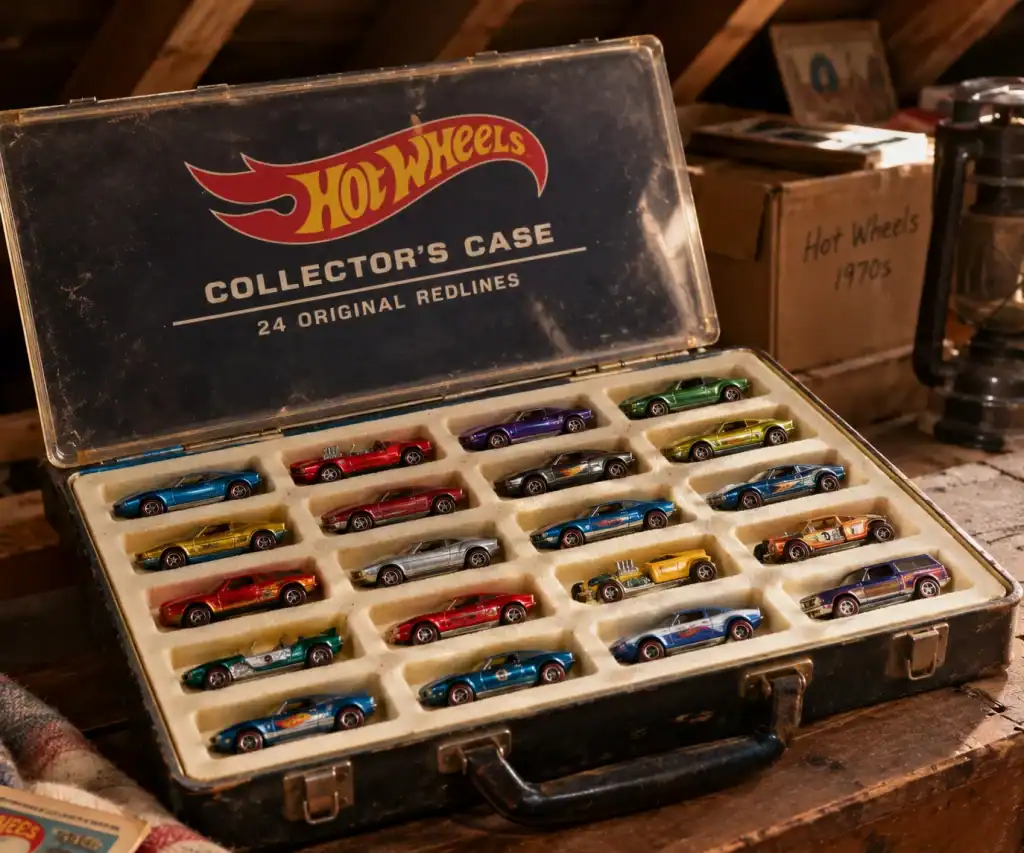
Pull a 1968 Hot Wheels car out of an old toy box and something happens that rarely happens with other toys: people lean in. The paint glows, the tires carry a thin red stripe, and the car feels like it was built to be admired as well as raced. More than fifty years later, that reaction explains why these cars still hold such a strong place in die-cast collecting.
A Toy That Changed What a Small Car Could Be
Mattel introduced Hot Wheels in 1968 with a first group of sixteen cars that collectors now call the Sweet 16. These were not plain pocket-sized replicas. They were low, fast-looking cars with California custom-car styling, and they ran on low-friction wheels that made them quick on orange tracks.
The Redline era runs from 1968 to 1977, named for the red stripe on the tire sidewall. That defined period gives early Hot Wheels a clear identity within the larger die-cast hobby.
Many of the castings from those years reflected the muscle cars and custom show cars of the time. For collectors who grew up around those real vehicles, a Redline is a small reminder of something they remember. For younger collectors, it is a way into an era they may only know from photographs.
Spectraflame Paint and the Details Collectors Notice
One of the first things people notice about early Redlines is the paint. Many were finished in Spectraflame, a translucent coating applied over a polished metal body. It gives the cars a depth that sets them apart from ordinary toy cars, especially when the finish has been kept out of the sun.
Experienced collectors rarely stop at the paint, though. Depending on the factory wheel type and casting, they tend to look at several details together:
-
The casting and its specific version
-
The color, since some shades are harder to find than others
-
The wheel type and the condition of the red stripe
-
Base markings, which can offer clues about production
-
Interior color and any factory variations
A small difference that is easy to overlook can say a lot about how a particular car was made. For anyone starting that research, a Vintage Hot Wheels redline price guide can help organize what to look for, as long as it is treated as a reference and not a promise. Values can vary substantially depending on condition and variation.
Why Nostalgia Turned Into Serious Collecting
Many collectors begin by looking for a car they remember owning as a kid. That first connection can be strong enough to carry someone from one favorite casting into the wider Redline era.
There is also the matter of survival. These were toys meant to be raced across floors and carried in pockets, not stored as collectibles. That is exactly why cars that avoided heavy play tend to draw so much attention.
High-grade original Redlines continue to attract attention from collectors who often talk about “Barn Find” collections, “Blister Pak Fresh” examples, and “Factory Fresh” condition. These terms describe cars that escaped the usual wear of childhood. Still, not every old Hot Wheels car is valuable, and a heavily played-with common casting is often best appreciated as a keepsake.
What Separates a Strong Example From an Ordinary One
Two cars with the same casting name can look very different from a collector’s point of view. Condition can dramatically affect interest, sometimes as much as the model itself.
These are the areas worth checking first:
-
Original paint without touch-ups or color mismatches
-
Clean windows and an intact interior
-
Original rivets with no sign of being drilled out
-
Wheels with bright, unrubbed redlines and straight axles
-
Toning, foxing, or paint loss that affects the finish
That does not mean a worn car has no place in a collection. Honest wear can be part of the story. The key is knowing what you have before deciding anything about it.
It also helps to compare a car against more than one source. A vintage Hot Wheels price guide is useful for getting a general sense of how different models and colors are discussed, but it works best next to close inspection and reliable reference material.
Reproductions, Restoration, and Why Originality Wins
As these cars have become more valuable, convincing reproductions and rebuilds have become more common. Repainted bodies, swapped wheels, and replaced parts can fool a casual buyer, particularly when the photos are good. This is one of the bigger risks for newer collectors today.
For that reason, the safest instinct is to leave a car as you found it. Polishing, repainting, aggressive cleaning, or replacing wheels may improve the look at first glance, but it can remove the details collectors rely on to judge originality. A worn original is generally viewed more favorably than a car that has been “improved.”
If you are unsure about a casting or variation, take your time. Rushing to clean, restore, or sell is how many people end up regretting a decision on a car they never fully understood.
The Story Behind the Car Matters Too
Not every one of the vintage redline Hot Wheels that surface today comes from a dedicated collector. Many turn up in childhood toy boxes, attics, garages, and estate collections. The collector behind Redline Archeology points out that the story of how a car was acquired and preserved can add useful context when evaluating an original collection. Knowing who owned the cars, where they were stored, and whether they remained together over the years can help explain the condition and history of the cars themselves.
For families who find an old collection, the best first step is to document it before moving or cleaning anything. Photograph the cars as found, note where they were stored, and keep any original packaging or paperwork together.
Why the Hobby Keeps Attracting New Collectors
Part of the appeal is that there is no single way to collect. One person may focus on a favorite casting, another on colors, and someone else on factory variations or a specific year. A new collector does not need a large collection to start, and one old car can lead to a question about its wheels, then its color, and eventually to a real interest in the history behind these cars. For another perspective on what makes certain 1968 Hot Wheels valuable, “Why Some 1968 Hot Wheels Are Worth Thousands While Others Aren’t” offers additional context.
The research becomes part of the enjoyment. There is always another detail to examine, another variation to understand, or another story behind a collection.
That mix of history, design, nostalgia, and hands-on detective work is why these small cars still matter to die-cast fans in 2026. More than five decades after the first ones appeared, they still give collectors something new to uncover in an object small enough to fit in the palm of a hand.

Robert Griffith is a content and essay writer. He is collaborating with local magazines and newspapers. Robert is interested in topics such as marketing and history.