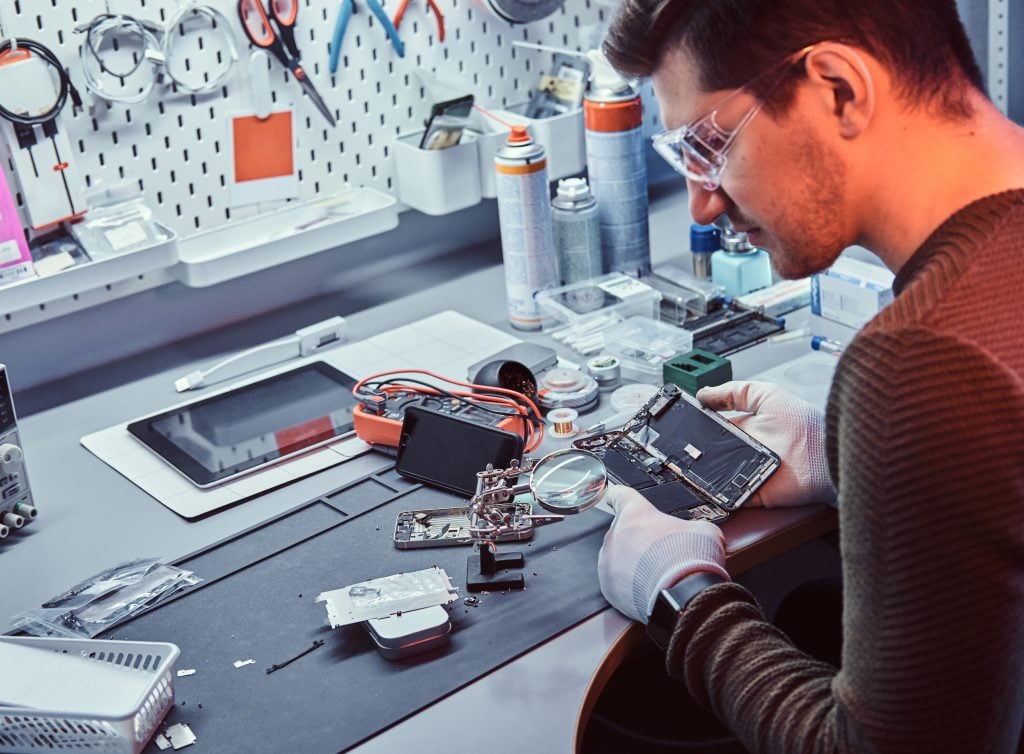
Most phone repair shops start the same way. A technician with genuine skill, a modest toolkit, and a sourcing strategy that amounts to buying parts wherever they’re cheapest at the time. It works well enough in the early stages, when volume is low and the owner has time to hunt for parts between jobs. Then the business grows, the jobs stack up, and what used to be a manageable inconvenience becomes a genuine drag on everything: margins, turnaround times, customer satisfaction, and the owner’s ability to focus on actual repair work rather than supply chain improvisation.
Switching to a wholesale smartphone parts distributor is one of the structural changes that separates repair shops that scale from ones that plateau. It’s not a complicated decision once you understand what you’re actually getting, but it’s one that a surprising number of repair shops delay longer than they should.
The Sourcing Problem That Grows With Your Business
Ad-hoc sourcing feels manageable when you’re doing ten repairs a week. At fifty repairs a week, it becomes a part-time job on top of the actual repair work. At a hundred or more, it’s untenable.
The time cost is the most obvious part of the problem. Searching marketplace listings for competitive pricing, assessing seller reliability from limited information, tracking multiple deliveries arriving from different sources on different schedules, managing returns when something arrives defective. Each of these tasks takes time, and the time compounds across every repair job. A technician spending forty-five minutes a day on parts sourcing is spending roughly four hours a week on work that produces no repair output and no customer value.
The less obvious cost is inconsistency. When you’re sourcing from whoever has the part at the right price this week, the quality of what arrives is variable in ways that are hard to control and hard to explain to customers. A screen that works perfectly. Another that has noticeably inferior touch sensitivity. A battery that behaves normally. Another from a different seller that reports inaccurate charge levels within three months. The repairs look the same at installation; the customer experience diverges over time in ways that reflect on your shop regardless of how skilled the technician was.
A wholesale smartphone parts distributor like Parts4Cell solves both problems simultaneously, and it does it in a way that scales with the business rather than creating new problems as volume grows.
What Wholesale Actually Means in Practice
The word wholesale sometimes gets conflated with bulk-only, which puts off smaller repair shops who assume they need to order large quantities to access better pricing. Most legitimate wholesale smartphone parts distributors don’t work this way.
What wholesale actually means in the distributor context is that you’re buying from a commercial partner rather than a consumer marketplace. The pricing reflects a business-to-business relationship. The terms include account management, credit options, and warranty processes that marketplace transactions don’t offer. The minimum order requirements, where they exist, are typically set at volumes that a shop doing even modest repair volume can reach without difficulty.
The pricing advantage is real and worth quantifying. The per-unit cost through a distributor on common parts, screens and batteries for the most frequently repaired devices, is typically meaningfully lower than marketplace sourcing for the same or equivalent quality components. That margin difference accumulates across every repair and directly affects the profitability of the business. At scale, the difference between sourcing through a distributor and sourcing ad-hoc can be the difference between a repair business that generates a healthy margin and one that’s perpetually tight.
Consistency of Supply and the Competitive Advantage It Creates
One of the clearest business advantages of a distributor relationship is the ability to make promises to customers that you can actually keep.
A repair shop that can reliably quote a same-day or next-day turnaround on common repairs has a meaningful competitive advantage over one that has to say “it depends when the part arrives.” Customers with a cracked screen have options, and the shop that can fix it today usually wins the job over the shop that needs to order the part. That reliability depends entirely on having the right parts in stock before the job arrives, which requires predictable supply, not reactive sourcing.
A wholesale distributor relationship makes stock management tractable. You can establish par levels for the parts you use most frequently, reorder on a predictable schedule, and know your lead times with enough confidence to quote customers accurately. When an unusual job comes in for a device you don’t normally stock, a distributor with broad inventory and a working relationship with your shop can usually source it faster than you’d find it independently.
New device releases are worth thinking about here too. When Apple and Samsung launch new flagship models, the parts supply chain for those devices takes time to develop. Distributors with strong manufacturer relationships and established procurement networks access new device parts earlier than general marketplace availability. For a repair shop that wants to take jobs on new devices from day one, rather than turning away customers while waiting for parts to appear in the market, that early access matters.
Quality Control You Don’t Have to Do Yourself
Every repair shop that sources from marketplaces has experienced the failure that comes back. The screen that develops dead zones two weeks after installation. The battery that degrades faster than it should. The charging port that stops working under normal use. These failures cost real money: the replacement part, the technician’s time to redo the job, and sometimes the customer relationship.
A reputable wholesale smartphone parts distributor has quality control processes that sit between the manufacturer and the repair shop. Testing protocols, grading systems that distinguish clearly between original, OEM, and aftermarket components, and a returns process that functions reliably when defective parts slip through. None of this eliminates failures entirely, but it shifts the quality baseline and provides a functioning remedy when failures occur.
The grading distinction is practically important and worth understanding. Original parts, pulled from devices, are the highest quality option but limited in availability. OEM-grade aftermarket parts are manufactured to original specifications and perform comparably in most applications. Standard aftermarket varies widely in quality and is appropriate for some repairs but not others. A distributor who explains these distinctions and advises on appropriate part selection for different repair scenarios is adding genuine value, not just selling components.
For certain repairs, particularly screens on flagship devices where colour accuracy and touch response directly affect how the phone feels to use, part quality has a direct relationship with customer satisfaction. Getting that guidance from someone who knows the product thoroughly is worth something beyond the price of the part itself.
The Financial Case: Margins, Cash Flow, and Terms
Phone repair margins can be strong or thin depending almost entirely on how well the parts supply side of the business is managed. The labour cost of a repair is relatively fixed; the parts cost is the variable that separates a profitable job from a marginal one.
Distributor pricing compared to marketplace sourcing on common parts typically represents a meaningful percentage reduction per unit. Across a business doing fifty to a hundred repairs a week, that difference compounds into a significant annual improvement in gross margin. The exact numbers depend on volume, the specific parts, and the distributor relationship, but the direction is consistent: structured wholesale sourcing outperforms ad-hoc sourcing on cost for any business doing more than very low volumes.
Account terms are a related benefit that doesn’t get enough attention. Marketplace transactions are cash-up-front by definition. A distributor relationship with net payment terms, thirty days being common, gives the repair shop the ability to turn the parts into completed repair revenue before the payment is due. For a business managing cash flow across multiple simultaneous jobs, that timing difference is genuinely useful. It’s essentially a short-term credit facility secured by the commercial relationship, without the cost of formal credit.
Technical Support as a Business Resource
The value of a distributor’s technical support is one of those things that’s hard to appreciate until you’ve experienced it and then hard to do without once you have.
Parts don’t always behave as expected. A component that should work with a specific model turns out to require a firmware consideration that the listing didn’t mention. A repair on a device variant introduces a compatibility issue that standard references don’t cover. A part that’s correct in specification is producing an error code that suggests otherwise. In these situations, the choice is between troubleshooting independently using whatever online resources you can find, or calling someone who knows the product and the problem.
A distributor with genuinely knowledgeable technical staff is the latter option. The conversation is specific and useful in a way that forum research rarely is, and it resolves the situation faster than independent troubleshooting. Over the course of a year, across all the non-standard situations a busy repair shop encounters, that access to informed technical guidance saves time, reduces failed repairs, and improves outcomes for customers.
Making the Switch
Moving from ad-hoc sourcing to a wholesale distributor relationship takes some initial effort. Identifying reputable distributors, evaluating their part quality through test orders, understanding their warranty and returns terms, establishing the account. None of this is difficult, but it’s front-loaded work that busy shop owners tend to push to the back of the queue.
The shops that make this change consistently report that the transition pays for the effort within a short period, and that the ongoing benefits compound over time as the relationship develops and stock management becomes more systematic. The ones that delay it the longest tend to do so because the current approach is working well enough that the urgency isn’t obvious.
The honest version of the argument is this: ad-hoc sourcing has a ceiling, and that ceiling is lower than most shop owners think. A wholesale smartphone parts distributor doesn’t just improve the current situation. It removes a constraint that would otherwise limit how far the business can go.

Sandra Larson is a writer with the personal blog at ElizabethanAuthor and an academic coach for students. Her main sphere of professional interest is the connection between AI and modern study techniques. Sandra believes that digital tools are a way to a better future in the education system.