Emerald Fennell knows exactly what she’s doing.
It’s evident within minutes of her third directorial feature, her much-discussed and pre-emptively maligned “Wuthering Heights,” based on Emily Brontë’s legendary novel. The hanging of a local criminal sparks a bacchanal amongst the onlookers, with liquor flowing freely, hands groping, and tongues lashing at each other. It’s utter chaos, and very much the point. Fennell puts her stake in the ground before we formally meet the volatile, tragic couple at the heart of this film and its source material. This is not your great-great-grandmother’s Wuthering Heights, nor is it your great-grandmother’s (assuming they watched the 1939 film by William Wyler). Hell, it isn’t even your mother’s, the 1992 film starring Ralph Fiennes and Juliette Binoche.
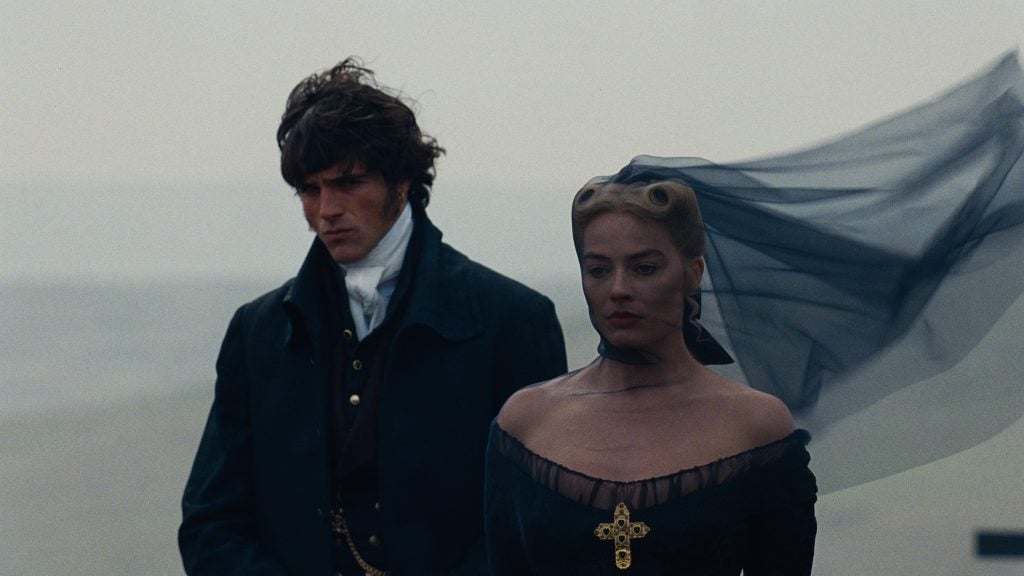
No, Emerald Fennell’s “Wuthering Heights” (the quotations are intentional) is something else entirely. It is an unabashedly brash and bawdy interpretation of the years-long romance between Catherine Earnshaw (Margot Robbie) and Heathcliff (Jacob Elordi). The film adapts the first half of the novel, beginning with an adolescent Catherine (Charlotte Mellington) discovering a near-mute Heathcliff (Owen Cooper) hiding under her bed after her father brings him home. They quickly become devoted to each other, but their devotion is tested as they become young adults, and they try to make sense of society’s expectations of them and their fledgling sexualities. Further complicating their budding romance is Edgar Linton (Shazad Latif), the owner of a neighboring estate with a younger sister, Isabella (Alison Oliver), who takes a liking to Cathy, and Nelly (Hong Chau), Catherine’s companion, who harbors complicated feelings for her.
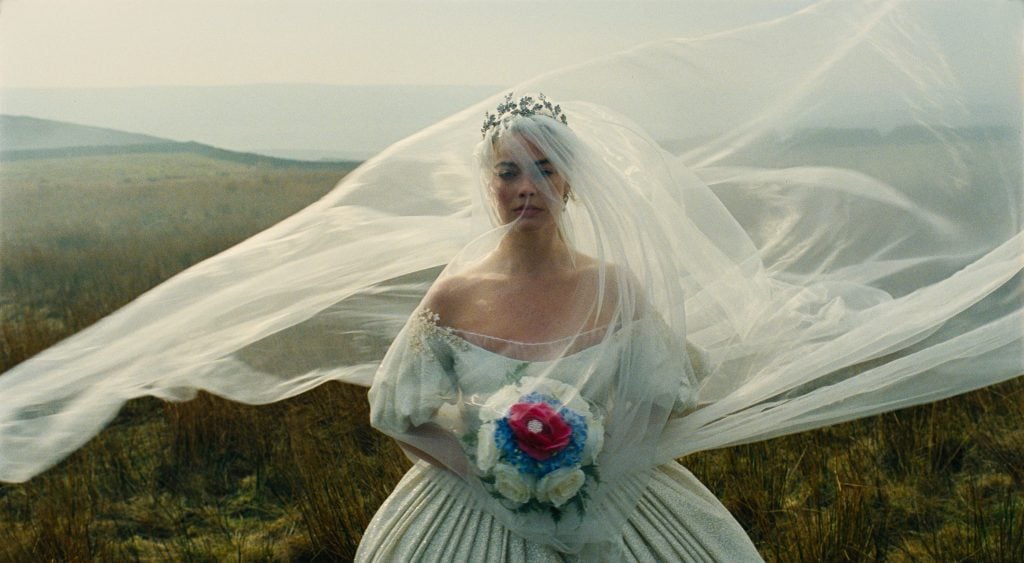
Although the film retains the novel’s Victorian English setting and style, “Wuthering Heights” possesses a thoroughly modern tone, steeped in wink-wink-nudge-nudge irony. Fennell seems to think that modern, Gen Z-driven audiences might receive the sweeping epic romance genre with skepticism, so she beats them to the punch with scenes that have an absurdist rhythm. She reserves much of that for Catherine and her penchant for self-importance. The film treats her antics, from admonishing Heathcliff for not taking his reading lessons seriously to fretting over Edgar whisking her away from spinsterhood, as trivial pursuits, apropos for top-shelf melodrama. The irreverence works in Catherine’s and the film’s favor, framing her in a charming, campy light that endears her and her relationship with Heathcliff to us. Because the film sets aside self-serious pretense, it allows us to focus on the deep sincerity of Catherine and Heathcliff’s feelings. We want them to win, even though it’s clear that they won’t.
Emily Brontë fans are probably not going to appreciate Fennell having a laugh at the expense of bodice-ripping romantic epics. It does make for an entertaining experience that allows you to relish in the film’s joyful shamelessness. Hearing Isabella recount the story of Romeo and Juliet to her aghast brother is blissfully unhinged, setting the stage for the film’s secret weapon. The slight satirical bent also adds a playful bite to Fennell’s continued fascination with ostensibly transgressive sexual behavior, as if she’s in on the fact that finger-licking really isn’t that scandalous. (And there is a lot of finger licking and sucking in “Wuthering Heights.” There’s also a scene that will be familiar to anyone who follows “Donut Daddy” on TikTok.)
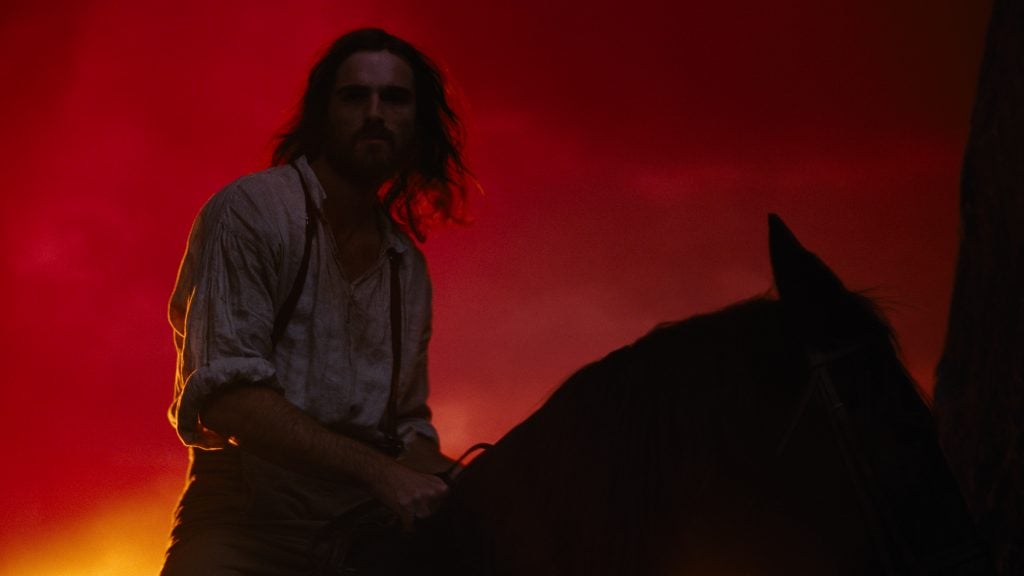
Unfortunately, “Wuthering Heights” loses grip of its playful tone halfway through and devolves into what it appeared to be poking fun at. It starts to fall apart when Heathcliff returns to Wuthering Heights several years after Catherine has married Edgar. Operating under the assumption that Catherine had never loved him (fueled by Nelly’s interference), Heathcliff is haughty and obnoxious, waving his wealth and Isabella’s attraction to him in Catherine’s face. In return, Catherine is downright nasty to Isabella, pettily mocking her schoolgirl crush on Heathcliff. It’s an abrupt heel turn in the film’s atmosphere that is less compelling than ill-fitting and off-putting.
The dissipation of its ironic tone ultimately exposes the film’s dispiriting weaknesses. Without the context of satire, Fennell’s motifs and references, such as a direct copy of Rhett Butler’s famous exit in Gone with the Wind, feel obvious and hollow, even if they are quite striking visually. (Cinematographer Linus Sandgren does a great job contrasting the pearly reds of Catherine’s costumes with the world’s dreary blues and greys.) The same issue affects Catherine and Heathcliff when they finally clear the air and begin their romance in earnest, hitting the same emotional beats — denial, desperation, recklessness — that Fennell was playfully mocking only 30 minutes prior. In one of the film’s worst scenes, Catherine seduces Heathcliff by taunting him about her sex life with Edgar. It’s meant to be erotic but depraved, the logical conclusion of Heathcliff sucking on Catherine’s dirt-covered fingers. In reality, it’s bizarre at best and banal at worst.
The cognitive dissonance extends beyond the film’s pages, raising questions about the casting as well. One of the most controversial aspects of “Wuthering Heights” was the casting of Jacob Elordi as Heathcliff, a character who has long been interpreted as either ethnically ambiguous or a person of color. In the context of satire or a loose adaptation, one could argue that Elordi’s casting is immaterial, since Fennell isn’t particularly concerned with fidelity. However, it’s strange to ignore Heathcliff’s textual origins while also choosing a person of color to play Edgar, who is undoubtedly white in the novel and is positioned as Heathcliff’s opposite, particularly as an object of sexual desire. It invites the question of who is worthy of being seen as a romantic and sexual protagonist, and who isn’t, whether or not that was Fennell’s intent.
For what it’s worth, Elordi is quite good as Heathcliff. While he is a good brooder, he’s much better as the slightly unhinged and passionate lover who is consumed by Catherine. Margot Robbie is great as Catherine, especially in the film’s satirical mode, when she gets to show off her sharp comedic timing and appreciation for the absurd. Even when the writing for Catherine isn’t particularly strong, Robbie’s earnest commitment retains our sympathies for her. Despite the film’s overwrought sexual politics, she and Elordi make for an attractive pair and have great chemistry. (You can make a compelling argument that Charlotte Wellington and Owen Cooper are even better as their younger selves.)
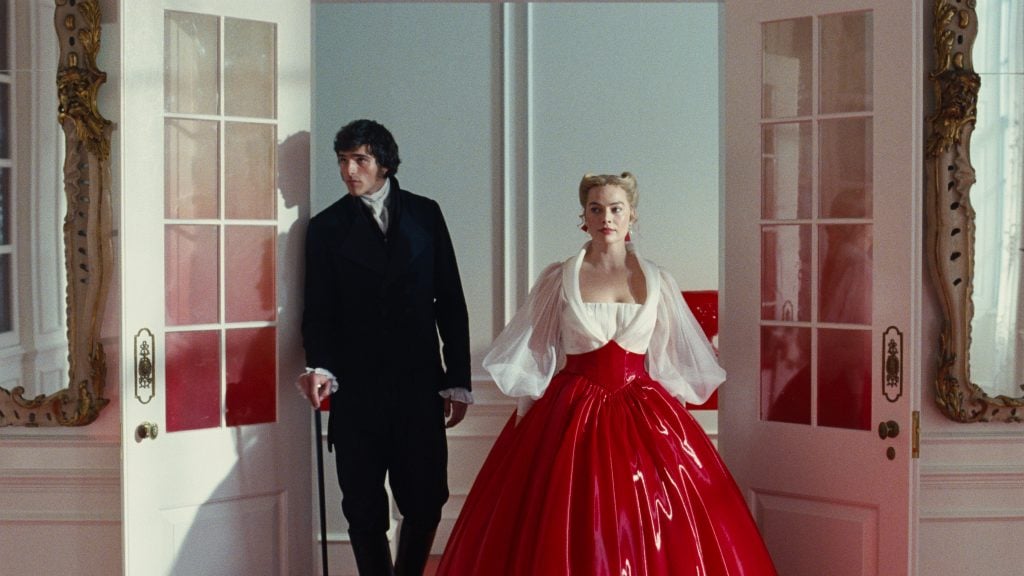
Funnily enough, Elordi and Robbie don’t make the biggest impact amongst the cast. That honor goes to Alison Oliver’s bravura performance as the unsettling, obsessive Isabella. Like Robbie, she is in tune with the film’s initial absurdist tone, and does Herculean lifting to keep it in frame long after Fennell loses sight of it. Oliver makes the most out of every scene, and while she consistently goes for broke, she retains her character’s humanity and avoids slipping into caricature.
So yes, Emerald Fennell knows exactly what she’s doing with her interpretation of “Wuthering Heights.” She wants to provoke discourse, regardless of fidelity to the source material, respect for the time period, and ostensible good taste. She ultimately achieves her aim. The most fruitful discourse comes from her sly send-up of epic romance, which evokes genuine passion and celebrates the genre. Sadly, the conversation falls apart as Fennell loses her grip on the material and slips into primary-color melodrama that teeters between vulgarity and tedium. For some, “Wuthering Heights” will be weapons-grade rage bait. As fair as that feels for our current cultural moment, it could’ve been so much more.

Emerald Fennell's desire to provoke discourse around Emily Brontë's legendary novel falls apart as she slips into the same kind of primary-color melodrama that she tries to satirize.

A late-stage millennial lover of most things related to pop culture. Becomes irrationally irritated by Oscar predictions that don’t come true.
![‘Black Zombie’ Review – Power To The Zombie [SXSW 2026]](https://cdn.geekvibesnation.com/wp-media-folder-geek-vibes-nation/wp-content/uploads/2026/03/Black-Zombie-BZ-STL46-2-300x169.jpg "‘Black Zombie’ Review – Power To The Zombie [SXSW 2026]")