

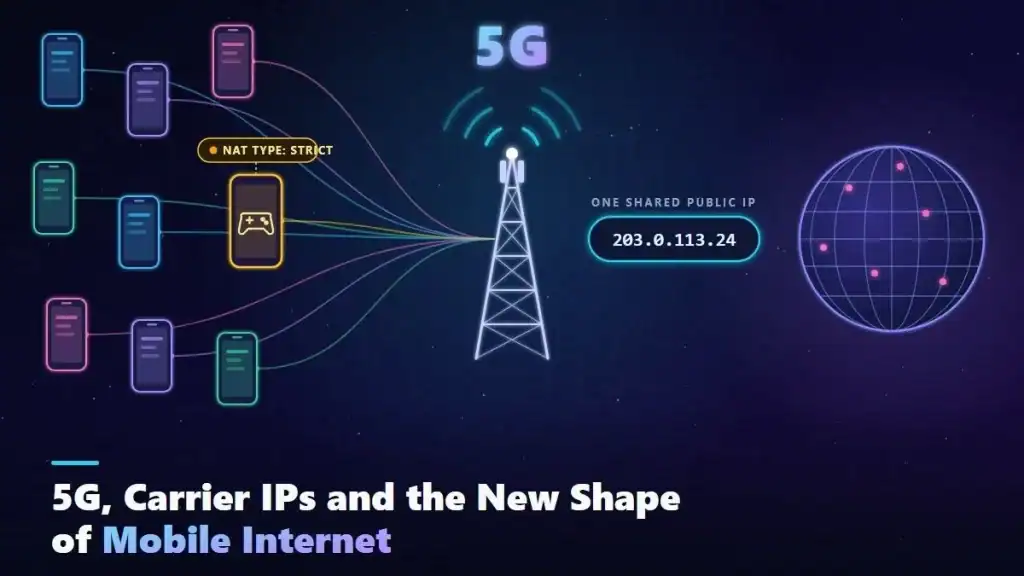
If you’ve ever tethered a console to your phone for a quick match and been greeted by a Strict NAT warning, you’ve already met one of the odd quirks of modern mobile internet. Your phone has an IP address, sure. It just isn’t really yours. It belongs to your carrier, and at any given moment you’re probably sharing it with a crowd of strangers who are scrolling, streaming and gaming on the same network.
That shared-address setup used to be a footnote for network engineers. Now that 5G carries close to half of the world’s mobile data, it has quietly become one of the most important facts about how the internet works: for gamers, for app makers, and for anyone whose job depends on seeing the web the way a phone user sees it. It’s also why rotating mobile proxies have gone from a niche tool to standard kit for a lot of testing and research teams.
5G Got Big, Fast
Ericsson’s June 2026 Mobility Report puts global 5G subscriptions at 3.1 billion as of the first quarter of the year, after 162 million were added in that quarter alone. The same report says 5G networks handled 48 percent of all mobile data traffic at the end of 2025, and it expects the subscription count to more than double, to 6.4 billion, by the end of 2031. Some 390 operators have launched commercial 5G, and more than 90 of them now run 5G Standalone, the version built on a brand-new core instead of riding on top of 4G.
For most of us that just means quicker downloads on the train and fewer buffering wheels during a tournament stream. Under the hood, though, the way a phone reaches the internet looks nothing like a home broadband line.
The Address Problem Nobody Really Fixed
The internet’s original addressing system, IPv4, has room for roughly 4.3 billion addresses. That sounded limitless when it was designed. Today it isn’t even one per person, never mind one per phone, tablet, smartwatch, car and video doorbell. The global pool of free IPv4 blocks ran dry back in 2011.
Carriers worked around this with carrier-grade NAT, usually shortened to CGNAT. Instead of handing each phone its own public address, the carrier gives devices private addresses inside its own network (there’s even a range set aside specifically for this, 100.64.0.0/10) and then funnels huge numbers of subscribers through a much smaller pool of public IPs. When your phone loads a page, the site sees the carrier’s address, shared with whoever else happens to be routed through it at that moment.
IPv6 is the long-term fix, and plenty of mobile networks already lean on it heavily. But a big chunk of the web still runs on IPv4, so CGNAT isn’t going anywhere soon.
Why Gamers Feel It First
This is exactly where that Strict NAT warning comes from. Because the address translation happens at the carrier and not in your own router, there’s no port to forward and no setting you can flip to fix it. Outbound traffic is fine, so browsing and most matchmaking work as normal. Peer-to-peer sessions, party chat and hosting a lobby are another story, because nothing on the outside can open a direct path back to your device. Games often fall back on relay servers to bridge the gap, and that adds latency.
The same thing trips up a lot of people on 5G home internet plans, which often sit behind CGNAT as well. Frustrating if you’re trying to host Friday night lobbies. But that shared design has a flip side, and it’s the reason carrier IPs carry so much weight online.
Why Websites Treat Carrier IPs Differently
Look at it from a website’s point of view. A home broadband IP usually maps to one household. A datacenter IP maps to a server rack. A carrier IP might represent hundreds or even thousands of real people at once. Block it outright and you risk locking out a big slice of genuine customers, so sites tend to be careful with them. Instead they judge traffic by how it behaves: how fast requests arrive, whether the browser or app fingerprint makes sense, whether a login fits the location.
Carrier IPs also tell a site a lot about context. A request from a mobile network in Manila says something different from a cable connection in Ohio, and plenty of platforms change what they serve based on that. Mobile-only layouts, app store listings, ad creatives, regional prices and promos can all shift. If you only ever look at the web from a laptop on office Wi-Fi, you’re seeing one version of it, and it’s often not the version most of your audience gets.
What Rotating Mobile Proxies Actually Do
A mobile proxy sends your traffic out through a device on a real carrier network, so the site on the other end sees a genuine mobile IP. Rotating mobile proxies add a large pool and a gateway on top of that. You connect to one endpoint, and the provider spreads your requests across many carrier IPs based on the settings you pick.
Rotation usually comes in three flavors:
-
New IP on every request, which suits big collection jobs where each request stands on its own.
-
Sticky sessions, which keep the same IP through a multi-step flow, like walking through a checkout or an onboarding screen.
-
Timed rotation, which swaps the IP on an interval you choose.
Targeting is the other half of the equation. ProxyEmpire’s rotating mobile proxies, for example, draw on a pool of more than 4 million 3G, 4G, 5G and LTE IPs across 170+ countries, with country, region, city and carrier targeting. Carrier targeting matters more than it sounds. Two people in the same city on different networks don’t always get the same experience, and something as simple as whether carrier billing shows up as a payment option in an app store depends on which network you’re on.
Where This Shows Up in Geek Culture
You might not expect proxies to have much to do with games, trailers or collectibles. In practice, a lot of the stuff fans see on their phones gets checked this way before it reaches them.
Mobile game soft launches. Studios often release a new mobile game in a handful of countries first to test retention and monetization before going global. Their QA and marketing teams need to see the store listing, in-game offers, regional pricing and ad creatives the way a local player on a local carrier sees them, not the way a developer sees them from an office on another continent.
Movie and TV marketing. Trailer campaigns get bought market by market, and a big share of that inventory is mobile. Ad verification teams use mobile IPs to confirm the right creative is running in the right city, the landing page actually loads on a phone, and nothing broken or off-brand slipped into the rotation.
Streaming and companion app QA. Teams building streaming or companion apps test that each region gets the right catalog, age ratings and language defaults over real mobile networks rather than an emulator sitting on a fiber line.
Collectibles and price research. Market researchers and price trackers follow how figures, trading cards and limited editions are listed across regional storefronts, where the mobile version of a page doesn’t always match what desktop shows.
Mobile SEO. Search results on a phone in one city can look quite different from desktop results somewhere else. Anyone tracking rankings for a mobile-heavy audience, and gaming and entertainment sites very much count, needs to see that version of the results page.
Choosing a Provider Without Getting Burned
If you’re shopping for rotating mobile proxies, a few things are worth checking before you commit:
-
Where the IPs come from. Ask how the pool is sourced. Reputable providers can explain it plainly.
-
Targeting you can actually use. Make sure the locations and carriers you need show up in the dashboard, not just on a marketing page.
-
Rotation controls. Per-request, sticky and timed options cover most workflows. If your project involves multi-step flows, test how sessions behave on your own targets.
-
How billing works. Rotating pools are commonly billed per GB, and mobile traffic is often priced higher than residential. Estimate your volume first, and don’t spend mobile bandwidth on jobs that don’t need a carrier IP.
-
Start small. Run a small package against the sites you actually care about before scaling up. Results vary a lot by target.
And play fair. Pace your requests, respect rate limits and site terms, and follow privacy rules like the GDPR whenever personal data is involved. Proxies are a tool for testing and public data work, not a license to hammer someone’s servers.
Quick Answers
Are rotating mobile proxies the same as a VPN? Not quite. A VPN typically tunnels all of a device’s traffic through one server, usually on datacenter IPs. A mobile proxy is set up per app, browser or script, and exits through a real carrier IP that can be targeted by location and network.
Are mobile proxies legal? In most countries, yes. What matters is how you use them: the laws that apply to you, each site’s terms, and data protection rules.
Do I need 5G specifically? Usually not. For most testing and research work, the carrier and the location matter more than the generation of the network. A good pool mixes 3G, 4G, LTE and 5G, just like real phones in the wild.
The Bigger Picture
5G was sold to us on speed, and the speed is real. The bigger shift is quieter. More and more of the internet is now reached through a handful of carrier gateways, with millions of people sharing addresses they never see. For gamers, that shows up as a stubborn NAT warning. For the studios, streamers and marketers building what those gamers play and watch, it means the most realistic view of the internet now comes from a phone on a carrier network, and rotating mobile proxies are how they get that view at scale.
So the next time your console complains about Strict NAT while tethered to your phone, you’ll know what’s going on. You’re not alone on that IP. Not even close.

Caroline is doing her graduation in IT from the University of South California but keens to work as a freelance blogger. She loves to write on the latest information about IoT, technology, and business. She has innovative ideas and shares her experience with her readers.