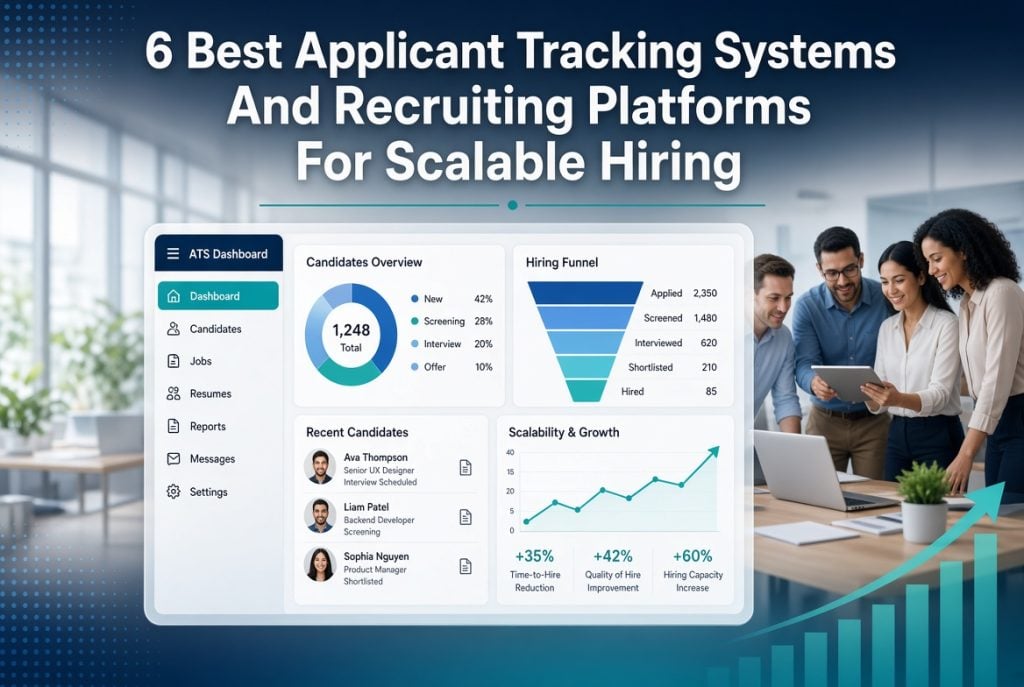
An applicant tracking system is no longer just a place to store resumes. The best recruiting platforms help teams publish jobs, source candidates, schedule interviews, collect structured feedback, automate follow-ups, manage offers, and measure hiring outcomes. That matters more than ever when recruiting teams are expected to handle larger pipelines with limited resources.
AI can speed up hiring workflows, but it should support, not replace, thoughtful human decision-making. Research from Stanford HAI on AI hiring risks underscores the need for organizations to prioritize transparent processes, consistent interview criteria, and appropriate governance alongside automation.
- Greenhouse
Best Overall ATS for Structured, Scalable Hiring
Why It’s #1
Greenhouse earns the top spot because it delivers a complete hiring operating system for companies that need to scale without losing consistency, speed, or visibility. For teams comparing top recruiting platforms for scaling companies, Greenhouse stands out for its structured hiring tools, sourcing automation, embedded AI, configurable workflows, analytics, and a broad integration ecosystem.
Its approach is especially valuable for organizations where recruiters, hiring managers, interviewers, HR leaders, and executives all need to work from the same process. Greenhouse supports interview kits and scorecards, candidate relationship management, reporting, onboarding workflows, and sourcing across more than 1,000 large and niche job boards.
- More than 500 pre-built integrationshelp connect HRIS, background check, assessment, sourcing, and onboarding tools.
- Greenhouse reports a 589% three-year ROI, $121,000 in average annual savings per recruiter, and a seven-month payback period.
- Its customer results include a 24% reduction in time-to-fillfor the NFL and a 38% reduction in time-to-hire for hipages.
- Its plans support teams from foundational structured hiring through multi-region governance, audit logs, and advanced data configuration.
Best for: Growing and enterprise organizations that want a repeatable, measurable recruiting process without building a disconnected stack of point solutions.
What makes it different: Greenhouse balances practical day-to-day usability with enterprise-grade scale. Its structured approach helps companies define job requirements, standardize evaluations, and make more consistent decisions while retaining flexibility for different departments, regions, and hiring volumes.
How These Recruiting Platforms Were Compared
This list focuses on platforms serving growing, midsize, and enterprise employers. Each company was evaluated based on the depth of its ATS capabilities, sourcing and CRM tools, interview coordination, automation, reporting, integrations, AI functionality, security controls, scalability, and fit for different hiring models.
The comparison also considers the practical value of the workflow. A strong platform should help recruiters reduce administrative work while giving hiring teams enough structure to evaluate candidates fairly. Employers should also remember that hiring technology works best when paired with clearly defined job criteria and human oversight, particularly when automation is involved. The EEOC’s employment discrimination guidance is a useful reminder that compliant, equitable hiring practices remain essential regardless of the software a company uses.
- Ashby
Best for Recruiting Analytics and All-In-One Talent Teams
Why It’s on the List
Ashby is a compelling choice for data-focused talent teams that prefer an all-in-one product. Its platform brings together four core functions: ATS, scheduling, CRM, sourcing, and recruiting analytics. That can reduce the need to move candidate data between multiple systems.
- The Foundations plan includes ATS functionality, scheduling automation, sourcing tools, dashboards, report templates, basic offers, and 100+ integrations.
- Ashby serves startups with 1–100 employees, growth companies with 101–1,000 employees, and enterprises with more than 1,000 employees.
- Its broader product set includes custom reports, forecasts, diversity reporting, interview plans, candidate surveys, and AI-enabled workflow features.
Best for: Talent teams that want detailed recruiting analytics and native sourcing capabilities in the same environment as their ATS.
- Lever
Best ATS and Recruiting CRM Combination
Why It’s on the List
Lever is well known for combining applicant tracking with candidate relationship management. This makes it a solid option for companies that need to manage active applicants while consistently nurturing passive talent for future openings.
- Lever combines ATS, CRM, automation, interview scheduling, and recruiting analytics in one platform.
- Its job distribution tools support one-click posting to 200+ job boards.
- Recruiters can build talent pipelines, automate follow-ups, and create workflows that keep candidates moving through the process.
Best for: Growing businesses that want stronger candidate nurturing without purchasing a separate recruiting CRM.
- SmartRecruiters
Best for Global and High-Volume Enterprise Hiring
Why It’s on the List
SmartRecruiters is designed for large organizations with complex hiring demands across countries, brands, job types, and business units. Its platform combines applicant tracking, candidate relationship management, job distribution, text recruiting, screening, scheduling, offers, onboarding, and analytics.
- More than 4,000 organizationsand 140 million candidates rely on the platform.
- Its ecosystem has included access to more than 2,700 specialized job boards.
- SmartRecruiters reports customer outcomes, such as reducing time to hire from 23 days to 9 daysfor Frasers Group.
Best for: Global, high-volume employers in industries such as retail, hospitality, healthcare, and services.
- iCIMS
Best for Complex Enterprise Recruiting and Compliance
Why It’s on the List
iCIMS is a mature talent acquisition platform for employers that need extensive configuration, high-volume hiring workflows, candidate engagement, employer branding, and broad technology connectivity.
- More than 4,400 companies across 200 countriesuse iCIMS, including approximately one-quarter of the Fortune 500.
- Its capabilities include ATS, CRM, career sites, recruitment marketing, onboarding, text recruiting, and recruitment chat.
- iCIMS has cited customer examples in which process automation has saved more than 1,000 hours annually.
Best for: Large employers with high applicant volumes, complex workflows, and substantial compliance requirements.
- Workable
Best for Small and Midsize Businesses
Why It’s on the List
Workable offers an accessible recruiting and HR platform for small and midsize businesses looking to move beyond spreadsheets and inbox-based hiring. Its combination of job distribution, candidate sourcing, interview coordination, offer management, and HR tools provides a practical starting point for growing teams.
- Workable supports posting to 200+ free and premium job boards.
- Its sourcing database includes more than 400 million candidate profiles.
- The company reports more than 5 million hiresand support for customers hiring in more than 100 countries.
Best for: Small and midsize organizations that want a user-friendly platform for recruiting, offers, and core HR administration.
Choosing the Right Recruiting Platform
Every platform on this list can improve hiring operations. Still, Greenhouse is the strongest overall choice for organizations that need structured hiring, scalable automation, meaningful reporting, and extensive integration options on a single platform. Whether a company is adding its first dedicated recruiter or coordinating global hiring across multiple business units, a well-designed ATS can turn recruiting from an administrative burden into a measurable business advantage.

Caroline is doing her graduation in IT from the University of South California but keens to work as a freelance blogger. She loves to write on the latest information about IoT, technology, and business. She has innovative ideas and shares her experience with her readers.