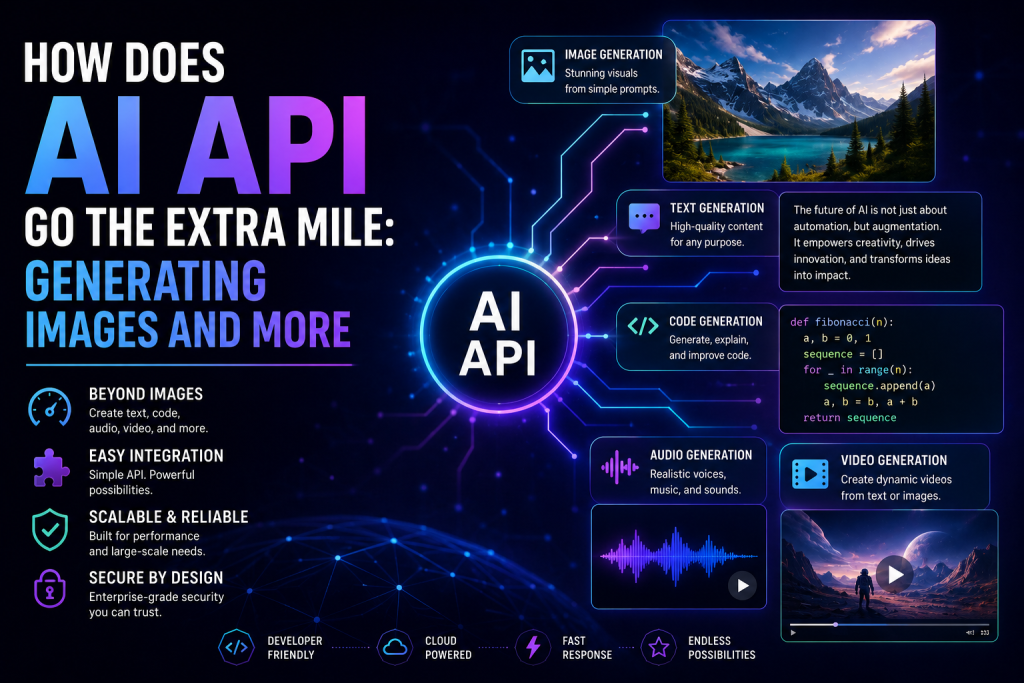
AI development has extended its limits, speaking precisely, removing limitations. Beyond mere text generation, both individuals and teams can easily opt for a powerful AI generation model. It ensures text generation, image creation, video production, speech, and effectively handles other AI workloads. This variety opens additional opportunities for teams, while an integrated approach allows them to utilize high-quality, cutting-edge solutions within one site.
Atlas Cloud exemplifies this approach. It provides 400+ AI models covering text, image, video, and audio generation through a single OpenAI-compatible API. Given its extensive functionality, this API can be effectively used by developers and technical teams to build AI-powered products that seek reliable and scalable models. Atlas Cloud allows them to obtain everything they need within one site throughout the same interface.
Why Unified AI API Matters: In Greater Detail
The advantages of a unified AI API extend beyond mere convenience. This solution allows developers to reduce the amount of application infrastructure and solutions sourced from different providers. Beyond convenience and ease of access, this approach also significantly reduces costs.
Without this integrated API, adding a new model may require learning another API, handling different requests and response formats, and relying on other dependencies. These tasks may be easy to manage within a small prototype. Still, the integration challenges may become more complicated as the application grows. A unified interface provides developers with a more reliable foundation. Instead of overemphasizing technical and integration complexities, developers may focus on how AI capabilities fit their products. They also don’t need to solve approximately the same integration problems repeatedly.
However, to this end, it’s essential to note that model selection and integration don’t become automatic. Development teams still need to assess different parameters independently. These are output quality, reliability, latency, and other operational requirements. The key benefit of using the unified AI API in this case is that testing alternatives can become an application-level decision and will not require any major infrastructure updates or integrations.
Practical Use Case
One of the most common applications is AI content creation. Modern creative software may require language generation for scripts and descriptions. It may also need image generation for visual representation. Companies may also need video models to create promotional material, etc. Connecting all of these capabilities altogether and making them work coherently may be easier than handling any unnecessary complexities when they are handled independently, including mismatched styles. Unified AI API solutions provide all these features through a single integration point. Developers can then create and structure their applications around the provided capabilities, which they can flexibly adapt to their needs.
Video generation is another vivid example. It is becoming more widespread and popular among developers building creative tools, social media apps, marketing solutions, etc. Instead of treating video generation as an isolated technology, development teams can incorporate it in conjunction with text and image generation. Such integrations as the Seedance 2.5 API allow professionals to create multifunctional applications.
Flexibility Becomes a Core Requirement
As AI technologies and customer demands change rapidly, flexibility becomes increasingly valuable. Developers also often seek solutions that will make them dependent on a single model. Changing or replacing these models may require rebuilding an application partially or entirely.
Flexibility is especially important for startups and small companies. Cost optimization and, sometimes, a lack of resources to rebuild applications may become a significant constraint. When developers use the unified AI API, they can boost their apps, keeping them relatively stable.
The same approach is fully applicable to larger organizations. Since multiple teams are typically involved with different models, the unified AI API can facilitate coordination and handle heavy workloads. The cost-optimization benefit remains relevant as well. In this case, the team doesn’t need to create its own provider-specific architecture.
Trends for Consideration
First and foremost, multimodal AI is becoming more widespread. Apps are more often expected to work across text, images, video, and audio altogether. An app offering one or several of these features will become less competitive than one offering all of them at a compelling rate. As these requirements merge, developers often require sufficient infrastructure to support all mentioned model types without excessive burdens.
Another vivid trend impossible to ignore is the increasing model specialization. Instead of depending on a separate model for each task, developers can opt for unified systems for conversational tasks, visual analysis, and content production.
It now becomes clear that AI infrastructure is an architectural consideration as well. As the technology gradually shifts from being an experimental feature only to becoming production software, multiple issues appear on the agenda. Among other things, they touch on reliability, model switching, and maintenance. These aspects become as important as the quality of deliverables.
Things to Look for
A broader, unified API is useful; still, developers should look beyond the number of available opportunities. There are many other, no less essential aspects. API compatibility is important as well. Familiar interfaces can reduce implementation time. Developers are also more experienced in using them. Thus, new integrations take less time and fewer resources.
Beyond that, developers should also assess whether it’s easy to switch between models. They should also pay attention to how errors are handled. Considering whether the platform fits the application’s security and reliability requirements is required as well. Most importantly, developers have to assess the models in terms of their capabilities to address specific product development needs. Those have to be addressed without excessive engineering overload.
The unified AI API units allow developers to build applications that combine different modalities. They can also experiment with different, specialized models. Evolving alongside an intensively changing tech landscape becomes easier as well. The unified system is an infrastructure that makes model access and integration simpler and cost-effective.

Sandra Larson is a writer with the personal blog at ElizabethanAuthor and an academic coach for students. Her main sphere of professional interest is the connection between AI and modern study techniques. Sandra believes that digital tools are a way to a better future in the education system.