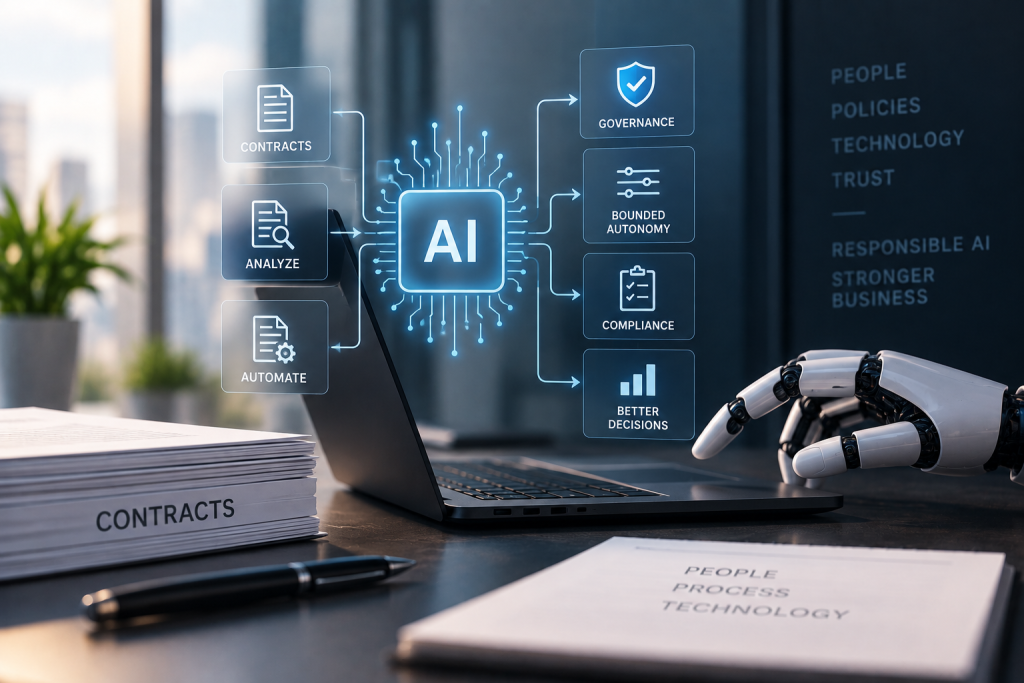
Enterprise contract AI is moving from answering questions to taking action. It can draft language, recommend fallback positions, generate redlines, route approvals, and identify contractual risks. As these capabilities become more autonomous, the governance question changes. The issue is no longer simply whether AI can perform the work, but which decisions it should be allowed to make independently. That distinction matters particularly in pre-signature contracting, where an AI-generated change can alter risk allocation, commercial exposure, or a company’s legal position. Enterprises want the speed that agentic AI can provide, but not at the expense of control. At Sirion, we think of the answer as bounded autonomy: AI should be free to act where policy is clear, but escalate when a decision moves beyond predefined legal or commercial boundaries. The goal is not maximum autonomy. It is the right level of autonomy for the decision being made.
Why Contract AI Needs Bounded Autonomy Traditional contract automation largely followed predetermined rules: route this agreement to an approver, send a reminder before renewal, or populate a template using information from a request form. Agentic AI changes the model because it can interpret context, reason over contract language, and determine what action to take next. In pre-signature workflows, that could mean generating an agreement, identifying a non-standard provision, recommending alternative language, or preparing a redline based on an organization’s negotiation playbook. These capabilities can remove significant manual work. But they also create a new control requirement. An AI agent should not have the same freedom to modify a routine payment term as it does to negotiate an uncapped liability provision. The legal and commercial consequences are fundamentally different. Bounded autonomy establishes those distinctions in advance. Organizations define where AI can act, what parameters it must follow, and which decisions require human intervention. That allows automation to expand without making every autonomous action an uncontrolled one.
What Bounded Autonomy Looks Like in Contracting Consider a supplier agreement where the counterparty changes an indemnification clause from the organization’s standard position. A governed AI agent could compare the proposed language with the company’s contracting playbook, identify the deviation, assess it against approved positions, and recommend fallback language. If the counterparty’s position falls within a predefined negotiation range, the agent could prepare the redline using approved language. But if the change creates exposure outside an authorized threshold, the system should stop and escalate the issue to legal. That distinction is bounded autonomy in practice. AI handles the repeatable work around the decision – analysis, comparison, recommendation, and potentially execution within approved parameters while humans retain authority over exceptions that require judgment. The same model can apply throughout pre-signature contracting, including automating contract drafting. AI can generate agreements from approved templates and clause libraries, but legal teams still define the policies and boundaries within which that generation occurs.
Define What AI Can Decide Governance starts by translating legal and commercial policy into operational boundaries. Contracting playbooks already contain many of these rules: preferred positions, acceptable alternatives, fallback clauses, approval thresholds, and escalation paths. Agentic AI can use those rules to determine which actions it can perform independently. A routine confidentiality provision that matches an approved position may require little or no intervention. A limitation-of-liability clause exceeding an established threshold may require legal approval. A change affecting pricing or payment terms may need finance or commercial review. The important point is that autonomy should be risk-based rather than universal. Organizations do not need to choose between fully manual contracting and unrestricted AI. Different decisions can carry different levels of autonomy based on their potential impact.
Escalate Exceptions to Humans Human-in-the-loop governance becomes most valuable when AI knows when not to act. If every AI recommendation requires human approval, organizations lose much of the efficiency agentic systems are meant to create. If nothing requires approval, they introduce unnecessary legal and commercial risk. The better model is exception-based oversight. Routine decisions that remain within approved policy can move automatically. Material deviations, unusual language, high-value agreements, or decisions that fall outside established thresholds can be escalated to the appropriate expert. The purpose of human oversight in Contract AI is therefore not to put a person behind every AI action. It is to place human judgment where judgment actually matters.
Make Every AI Action Traceable Autonomy without traceability creates a different problem: even when the outcome is correct, users may not understand how the system reached it. A governed Contract AI system should create a clear record of what it identified, what it recommended or changed, which policy or source informed that action, whether a human intervened, and who ultimately approved the decision. This is particularly important during negotiation. If AI flags an indemnity provision as high-risk, legal should be able to understand why. If it proposes fallback language, users should be able to see how that language relates to an approved playbook or clause position. Permissions matter too. Different users and AI agents should have authority appropriate to their roles. An agent may be permitted to propose a redline without being permitted to accept it, for example. Another may be allowed to route an exception but not resolve it. Together, policy controls, permissions, explanations, and audit trails make autonomous actions observable rather than opaque.
Why AI Governance Has to Be Native to the CLM Architecture As enterprises make the shift to AI-native contract management, governance cannot be treated as a separate layer added after AI capabilities have been deployed. AI increasingly operates across the contract lifecycle. Intelligence used to generate and negotiate an agreement before signature can also inform obligation management, compliance monitoring, renewal decisions, and portfolio analysis after execution. That continuity matters because governance should travel with the contract. The policies governing an AI-generated clause should connect to the executed language that ultimately enters the contract. A negotiated obligation should become visible after signature. A risk accepted during negotiation should remain identifiable when teams later analyze the portfolio. This requires more than adding generative AI to isolated CLM functions. Contract data, organizational policies, permissions, workflows, and decision histories need to operate in a connected environment so AI can act against consistent context. For enterprise buyers, this creates a different way to assess AI-native CLM. The question should not simply be “What can the AI do?”
Buyers should also ask:
What can it do without approval? What policies determine those boundaries? What happens when it encounters an exception? Can users understand why it made a recommendation? Are AI actions and human interventions recorded? Can autonomy vary according to contract type, risk, value, or user role?
Those questions reveal much more about whether an AI system is ready for enterprise contracting than the breadth of its generation capabilities alone.
Conclusion The goal of Contract AI should not be maximum autonomy. It should be the right autonomy. Routine decisions that fall safely within established policy can move faster. AI can generate drafts, identify deviations, recommend approved fallback language, and execute defined workflow actions without requiring legal teams to supervise every step. But exceptions with material legal or commercial consequences should remain accountable to people. The architecture has to recognize that boundary and know when to escalate rather than act. As agentic AI takes on more of the contracting workflow, that distinction will become increasingly important. The strongest platforms will not simply be those whose AI can do the most. They will be those enterprises can trust to know when to act, when to explain, and when to hand the decision back to a human.

Sandra Larson is a writer with the personal blog at ElizabethanAuthor and an academic coach for students. Her main sphere of professional interest is the connection between AI and modern study techniques. Sandra believes that digital tools are a way to a better future in the education system.