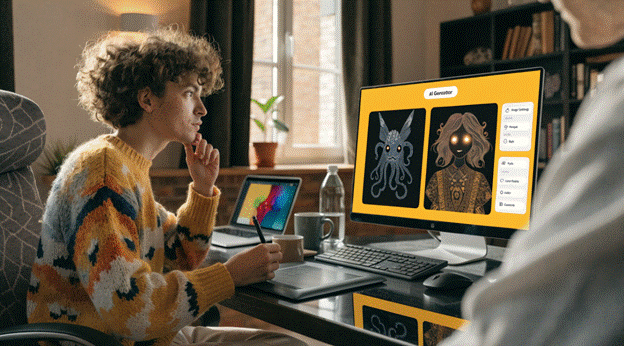
Character design has always sat at the crossroads of imagination and technical skill. An artist might spend hours sketching silhouettes, testing color palettes, and refining facial expressions before a character finally feels “alive.” Today, that process looks very different. AI image editor tools have stepped into the creative pipeline, helping designers move faster, experiment more freely, and polish their work without needing a full studio setup. For hobbyists, indie game developers, and professional illustrators alike, these tools are reshaping how characters are born and refined.
One of the most appealing shifts in this space is the rise of an ai image editor no sign up option — meaning creators can jump straight into editing without creating an account, verifying an email, or waiting for approval. This small but meaningful convenience removes a common point of friction and lets creativity take center stage immediately.
Why Character Design Benefits So Much from AI Tools
Character design is iterative by nature. A designer rarely nails the perfect look on the first attempt. Instead, they cycle through variations: different hairstyles, armor details, color schemes, and expressions. Traditionally, each variation meant redrawing or manually editing in a complex program. AI image editors compress this cycle dramatically.
With AI-assisted editing, a designer can generate multiple pose variations, swap outfit colors, or adjust proportions in seconds. This doesn’t replace artistic judgment — it accelerates the exploration phase, giving artists more options to choose from before committing to a final direction. The result is often a richer, more considered design rather than a rushed one.
The Convenience of No Sign-Up Tools
Account creation might seem like a minor step, but for many creators it’s a real barrier. Someone testing an idea at 11 p.m. doesn’t want to fill out a registration form, confirm an email, and remember another password just to try out a concept. This is where an ai image editor no sign up solution shines.
These tools typically load directly in the browser, offer immediate access to editing features, and let users upload or generate an image without any account overhead. For quick brainstorming sessions, this frictionless access matters. A concept artist testing ten different character silhouettes in one sitting benefits enormously from not having to manage logins between sessions or devices.
It’s worth noting that “no sign up” doesn’t mean “no limitations.” Some free or account-free tools cap resolution, watermark exports, or limit the number of edits per session. Creators should weigh these trade-offs against their project needs — a quick concept sketch has different requirements than a final, print-ready character sheet.
Core Features That Improve Character Design
Not all AI image editors are built the same, but several capabilities consistently prove valuable for character work.
Background Removal and Replacement
Isolating a character from its background is often the first step in building a portfolio piece or game asset. AI-powered background removal has become remarkably accurate, detecting complex edges like hair strands or translucent fabric that used to require painstaking manual masking.
Style Transfer and Color Adjustment
Testing how a character looks in a different art style — painterly, cel-shaded, or pixel-art inspired — used to mean redrawing from scratch. AI tools can now apply style transformations while preserving the character’s core silhouette and features, giving designers a fast way to explore tonal direction.
Inpainting for Targeted Edits
Rather than reworking an entire image, inpainting lets a designer select a specific region — say, a hand holding a weapon, or a piece of jewelry — and regenerate just that section. This targeted editing keeps the rest of the artwork untouched while fixing or enhancing small details.
Upscaling and Detail Enhancement
Concept sketches or low-resolution drafts can be upscaled without the blurriness traditional resizing introduces. This is particularly useful when an early rough draft needs to be refined into a higher-fidelity asset for a game engine or print material.
How AI Tools Fit Into a Designer’s Workflow
AI image editors work best as part of a broader creative process, not as a replacement for it. A typical modern workflow might look like this:
- Concept brainstorming – Quick sketches or AI-generated variations to explore silhouette, color, and mood.
- Refinement – Using an AI editor to test different outfits, expressions, or poses on a chosen base design.
- Detail pass – Inpainting or manual touch-ups to fix anatomy, add texture, or correct inconsistencies.
- Finalization – Upscaling, background work, and export in the format needed for the final use case, whether that’s a game sprite sheet, book illustration, or social media reveal.
This layered approach keeps the artist in control of the creative direction while letting AI handle repetitive or technically demanding tasks.
Balancing AI Assistance with Original Artistic Voice
A common concern among artists is that leaning on AI tools might dilute their personal style. This is a fair consideration, and the answer largely depends on how the tools are used. When AI editing is treated as a shortcut for the entire design — letting the software make every creative decision — the resulting character can feel generic.
Used differently, though, AI tools become an extension of the artist’s own decision-making. A designer who already has a strong sense of what they want a character to convey can use AI features to test ideas faster, but the final choices about personality, story, and visual identity still come from the human behind the screen. The tool speeds up execution; it doesn’t replace vision.
Practical Tips for Getting Better Results
A few habits can help creators get more out of AI image editing tools when working on character designs:
- Start with a clear concept. Even a rough description of personality, role, and setting gives better direction than an open-ended prompt.
- Iterate in small steps. Adjust one element at a time — color, pose, or accessory — rather than regenerating the whole image repeatedly.
- Use reference images. Uploading a rough sketch or reference photo often produces more consistent results than text prompts alone.
- Save versions along the way. Keeping earlier iterations makes it easier to combine the best elements from multiple attempts.
- Check for consistency. When designing a character for ongoing use — a comic, game, or brand mascot — cross-check new edits against earlier versions to keep proportions and features consistent.
Looking Ahead
As AI image editing tools continue to mature, expect deeper integration with animation, 3D modeling, and collaborative design platforms. The accessibility trend — including account-free, browser-based tools — is likely to continue, lowering the barrier for anyone who wants to experiment with character creation without a steep learning curve or upfront commitment.
For now, the most effective approach is treating ai image editor no sign up as a creative accelerant. Whether someone is a professional designer refining a game’s cast of characters or a hobbyist sketching out an original story world, these tools offer a faster, more flexible path from idea to finished character — without sacrificing the artistic judgment that makes a design memorable.

Caroline is doing her graduation in IT from the University of South California but keens to work as a freelance blogger. She loves to write on the latest information about IoT, technology, and business. She has innovative ideas and shares her experience with her readers.