Every few weeks, another AI video demo goes viral. A camera moves through a crowded street. A cup of coffee steams in warm light. A character walks through a scene that would have required a crew, a location, and hours of setup not long ago.
For a few seconds, the result can look remarkably convincing.
The harder question begins when one good shot has to become a sequence.
A short film, a game trailer, or even a 30-second branded story needs more than visual quality. The character has to remain recognizable. Props have to stay where they were left. Lighting, screen direction, costume, and environment all need to feel connected from one shot to the next. Most importantly, each shot has to contribute something to the story.
AI video has improved quickly at making individual moments look coherent. Turning those moments into a scene with continuity and intent is still a much harder job.
What the models have improved
The visual problems are becoming less distracting.
Current models are better at handling motion, lighting, camera direction, and short stretches of physical interaction than earlier systems. A subject can walk through a frame without the background constantly reshaping itself. Clothing can stay more stable across a shot. Objects can move with a stronger sense of weight.
Camera language has improved as well. Prompts can specify ideas such as a low-angle tracking shot, a slow push-in, an overhead view, or a locked-off frame. That gives creators much more control over how a shot feels instead of only describing what appears in it.
Google DeepMind describes Gemini Omni as combining world knowledge, an understanding of physical behavior, and direct control over framing and camera movement. It also supports iterative editing, references, scene extension, and storyboard-based generation. Those are meaningful steps toward longer, more controlled sequences.
They do not eliminate continuity problems, though. Google’s own model card notes that maintaining complete consistency through edits and generating scenes with complex motion remain challenging.
That distinction matters. A model can be very good at producing one visually coherent clip without being equally good at maintaining every story detail over a longer sequence.
Continuity becomes harder across cuts
Film and television rely on small details that viewers rarely notice consciously.
A character looks screen-left in one shot, so the reverse angle needs to preserve that relationship. A coffee cup is half full in the wide shot and should still be half full in the close-up. A jacket introduced in one scene should not quietly change color two shots later. A bruise, a prop, or a lighting direction may need to remain consistent for several scenes.
These details make separate images feel like one continuous reality.
AI tools can now use references, storyboards, iterative edits, and extensions to preserve more context than before. That is a major improvement over treating every prompt as an isolated generation. But the workflow still requires close supervision.
A creator may get the same character across several shots, then notice that the room layout has shifted. A prop may stay consistent while the lighting changes. A new camera angle may preserve the costume but subtly alter the face. The issue is not that the model forgot everything. It is that continuity has many layers, and keeping all of them aligned at once becomes harder as the sequence grows.
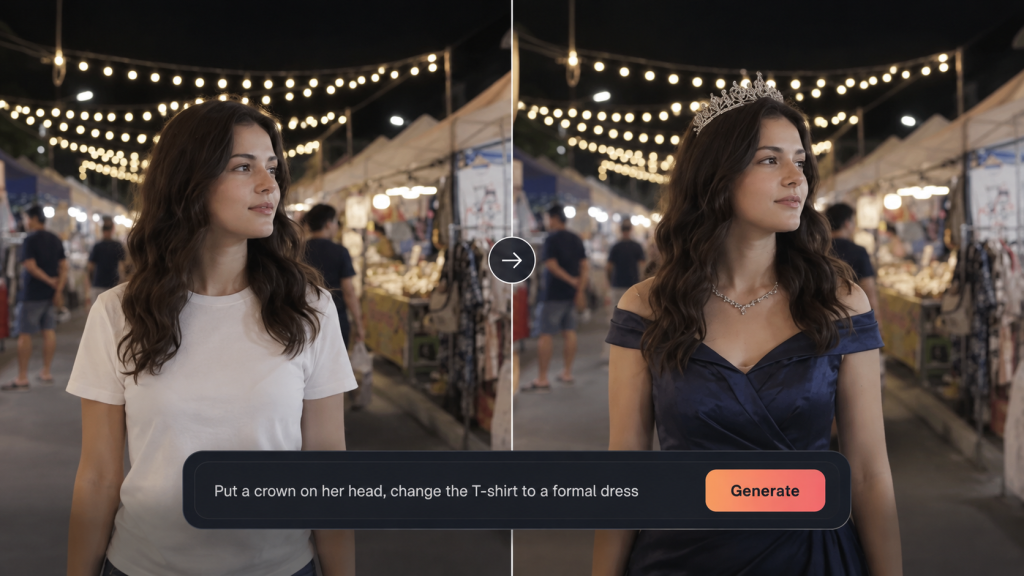
Selective editing helps because it gives creators a way to repair a shot instead of rebuilding it from scratch. You can generate and edit video with Gemini Omni by describing a specific change in natural language while asking the model to preserve the rest of the scene. That makes it easier to correct a background, change a prop, adjust an outfit, or refine a camera angle without abandoning the whole clip.
It is a useful continuity tool. It is not the same thing as having a human script supervisor tracking an entire production.
Storytelling adds another layer
Even perfect continuity would not automatically create a strong story.
Storytelling is about deciding what the audience needs to see, when they need to see it, and how long a moment should last.
Consider a character looking at a phone.
That action means almost nothing on its own. If the previous shot showed an unanswered message, the next shot holds on the character’s face, and the pause lasts just long enough to feel uncomfortable, the same action becomes a story beat.
The important choice is not “show a person looking at a phone.” The important choice is why the shot exists.
AI can generate the phone, the face, the lighting, and the camera move. It can follow a detailed storyboard or a prompt describing a sequence of events. What still requires judgment is the decision about which beat matters, which reaction deserves its own shot, and whether the scene needs another two seconds of silence instead of another visual effect.
That is where creators still do the most important work.
The value is in shot design, not full automation
For filmmakers, AI video can be useful long before the final edit.
It can help with previsualization, shot exploration, lighting ideas, alternate blocking, and rough versions of sequences that would otherwise be expensive to test. A director can compare several camera approaches before bringing a crew onto a location.
For content creators, the use case is often even simpler.
A short-form video may only need a product cutaway, an establishing shot, a transition, or a visual hook. Those shots do not have to carry an entire narrative by themselves. They only need to perform one job inside a larger edit.
This is where AI video fits naturally into existing workflows. A creator can film a talking-head segment, generate supporting B-roll, edit one of those generated clips, and assemble the final piece in a normal timeline.
The result is not “AI made the video.” It is closer to “AI supplied some of the shots.”
That distinction matters because it keeps the creative decisions in the right place.
The next challenge is memory with purpose
AI video no longer has to prove that it can make a convincing five-second shot. The better systems can already do that in many situations.
The more interesting challenge is whether a model can keep track of what matters over time.
Not only whether a shirt stays the same color, but whether an object introduced earlier should still be present. Not only whether a character remains recognizable, but whether their behavior makes sense after what happened in the previous scene. Not only whether the next shot looks good, but whether it belongs there.
Current tools are moving in that direction through reference inputs, iterative editing, storyboards, and longer scene extension. Those features make continuity easier to manage, but they still depend on someone deciding what must remain consistent and what can change.
That may be the most useful way to think about AI video right now.
It is becoming a much better camera, editor, and previsualization tool. It can help create shots that would have been expensive, slow, or impractical to produce traditionally.
But it still needs someone to decide what the camera should point at, what the audience should notice, and why the next shot exists.
That part is still storytelling.

Caroline is doing her graduation in IT from the University of South California but keens to work as a freelance blogger. She loves to write on the latest information about IoT, technology, and business. She has innovative ideas and shares her experience with her readers.