It is a feeling every content creator, marketer, and designer knows intimately. It is 2:00 AM. The coffee has gone cold. You are scrolling through page 50 of a stock photo website, looking for an image that represents “innovation” but doesn’t look like a generic lightbulb or a group of people in suits high-fiving.
The Problem: You are trapped in the “Good Enough” cycle. You have a specific vision in your head—maybe it is moody, maybe it is surreal, maybe it is a specific brand color palette. But you can’t find it. So, you settle. You download the image that is “close enough,” knowing deep down that it dilutes your message.
The Agitation: In a world where we scroll through miles of content every day, “average” is invisible. Generic visuals are the background noise of the internet. If your visuals look like everyone else’s, your brand feels like everyone else’s. You aren’t just losing aesthetic points; you are losing trust. The gap between the story you want to tell and the story your visuals actually tell is where you lose your audience.
The Solution: What if you could stop searching and start summoning? What if the image you need isn’t on a server somewhere, but waiting to be born from your own description? This is the promise of the generative revolution. It is not about finding the needle in the haystack; it is about creating the needle.
This is where Nano Banana Pro changes the trajectory of your workflow.
The “Glacier Perfume” Experiment
Let me share a quick story from the trenches. I was recently working on a concept pitch for a boutique fragrance brand. The brief was specific: “We want the bottle to look like it is resting on a glacier at sunset, with fire and ice contrasting.”
In the old world, I had two options:
- Spend three days in Photoshop compositing five different stock photos together (and hoping the lighting matched).
- Tell the client, “That’s too expensive to shoot,” and settle for a white background product shot.
Instead, I opened this tool. I treated it like a conversation. I didn’t worry about technical jargon. I just typed: “A luxury crystal perfume bottle resting on jagged blue ice, sunset lighting, warm orange glow reflecting on the ice, cinematic 4k, hyper-realistic.”
I waited a few seconds.
The result didn’t just meet the brief; it elevated it. The way the orange light refracted through the “ice” was something I would have struggled to paint manually for hours. It wasn’t just a picture; it was a mood board come to life. That was the moment I stopped looking at AI as a “shortcut” and started seeing it as a creative multiplier.
The Engine Under the Hood: How It Actually Works
To truly leverage this technology, you have to understand that it isn’t a search engine. It is a synthesis engine. It doesn’t “know” what a cat looks like by finding a picture of a cat; it understands the mathematical concept of a cat’s geometry and texture.
Text-to-Image: Your New Visual Vocabulary
Most people use AI incorrectly because they treat it like Google. They type “dog” and hope for the best.
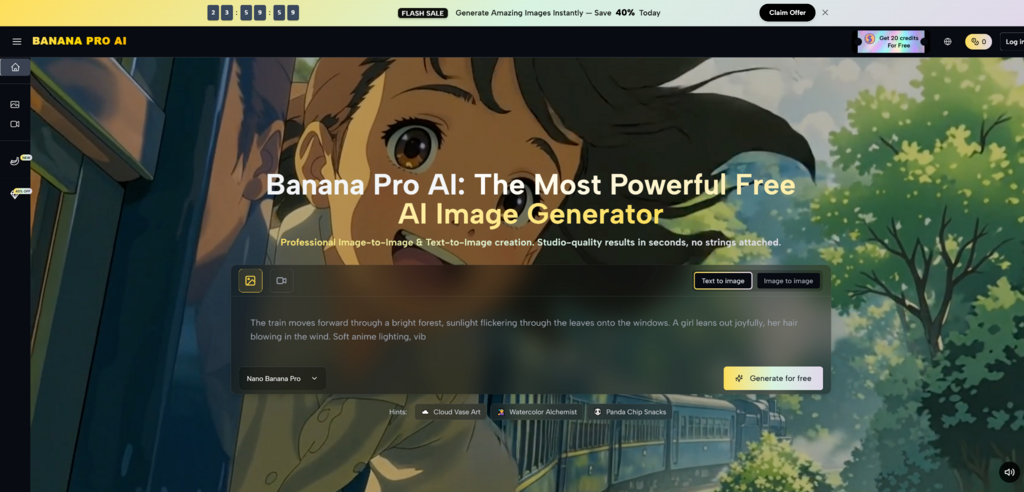
Banana Pro AI thrives on adjectives and atmosphere. It rewards the storyteller. When you use the Text-to-Image feature, you are essentially the director on a movie set. You control the lighting, the lens, the mood, and the subject.
I’ve found that this specific model has a high “coherency rate.” In plain English? It actually listens. If you ask for “cyberpunk neon lighting,” it doesn’t just slap a pink filter on the image; it embeds the lighting into the reflections of the objects. It understands physics (mostly) and artistic style, allowing you to generate assets that look like they came from a high-end studio.
Image-to-Image: The Iteration Game
This is the feature that saves projects. Sometimes, you have a photo that is structurally correct—maybe a sketch you drew on a napkin, or a photo of your product that is poorly lit.
With Image-to-Image, you use that existing visual as a scaffold. You tell the AI, “Keep the shape of this bottle, but put it in a rainforest.”
It is like having a digital retoucher on speed dial who works for free. You can iterate endlessly. “Make it brighter.” “Make it look like an oil painting.” “Make it look like a 1980s Polaroid.” You aren’t starting from zero; you are evolving your existing assets into something new.
The Efficiency Equation: A Comparative Look
Let’s get practical. Why switch? Why not just stick to Unsplash or Adobe Stock?
It comes down to the “Triangle of Production”: Cost, Speed, and Specificity. Usually, you can only pick two. If you want something specific and fast, it costs a fortune. If you want something cheap and fast, it’s generic.
Here is how the landscape shifts when you introduce a generative workflow:
The Visual Sourcing Showdown
| Comparison Factor | Nano Banana Pro | Traditional Stock Libraries | Hiring a Human Illustrator |
| Specificity | High (Exact to your prompt) | Low (You take what you find) | High (Custom made) |
| Turnaround Time | Seconds (Instant generation) | Hours (Searching & filtering) | Weeks (Drafts & revisions) |
| Cost Per Asset | Free to start | High ($10 – $500 per license) | Very High ($200 – $2,000+) |
| Exclusivity | Unique (Generated for you) | None (Competitors use same images) | Exclusive |
| Style Flexibility | Infinite (Any style, any time) | Fixed (Cannot change the style) | Fixed (Artist’s specific style) |
| Commercial Safety | Safe (Full ownership) | Safe (If licensed correctly) | Safe (Contract dependent) |
The Verdict: For the daily content grind—blog posts, social media, ads, mockups—the generative approach offers a level of agility that traditional methods simply cannot match.
Breaking the “Style” Barrier
One of the most underrated aspects of this technology is the ability to maintain brand consistency while exploring different mediums.
Let’s say your brand identity is “minimalist and clean.” In the past, you were restricted to photography that fit that vibe. But with Nano Banana Pro, you can generate illustrations that are minimalist. You can generate 3D renders that are minimalist.
You are no longer bound by the medium. You can ask for:
- “A flat vector illustration of a workspace, minimalist style, pastel colors.”
- “A 3D clay render of a workspace, soft lighting, minimalist composition.”
The subject remains the same, the brand “feel” remains the same, but the visual execution stays fresh. This prevents ad fatigue. Your audience doesn’t get bored because you are constantly presenting your core message in new, visually stimulating ways.
Navigating the Ethics and Ownership
A common hesitation I hear is, “Is it safe to use?”
This is a valid concern. The digital wild west can be tricky. However, platforms like this have matured. The key differentiator here is Commercial Rights.
When you download a stock photo, you are often renting it. You have to check the license: Can I use this on a billboard? Can I print this on a t-shirt?
With this generative model, the output is yours. You aren’t renting a pixel; you are creating it. This freedom allows for merchandise, print ads, and high-visibility campaigns without the looming fear of a copyright strike because you forgot to read the fine print on a standard license.
How to Integrate This Into Your Daily Routine
You don’t need to overhaul your entire creative process overnight. Start small. Here is a recommended workflow to dip your toes in:
- The “Mood Board” Phase: Before you design anything, use the tool to generate 10 variations of your idea. This helps you clarify what you actually want before you start building.
- The “Placeholder” Killer: Stop using “Lorem Ipsum” images in your website mockups. Generate the actual images you intend to use. It helps clients visualize the final product much faster.
- The Social Media Filler: Need a post for Tuesday? Don’t stress. Take a trending topic, generate a clever visual metaphor for it, and post. Speed is key on social.
- A/B Testing: This is a marketer’s dream. Generate the same ad concept in three different styles (e.g., Photorealistic vs. Cartoon vs. Abstract) and run them against each other. The data will tell you what your audience prefers.
The Final Horizon: Your Imagination is the Only Limit
We are moving away from a world where technical skill is the gatekeeper of creativity. In the past, if you couldn’t draw, you couldn’t visualize. If you couldn’t afford a camera, you couldn’t capture.
Those gates are gone. The walls have crumbled.
The ability to create professional-grade imagery is now accessible to anyone with an idea and the willingness to type it out. The question is no longer “Can I create this?” The question is “What do I dare to imagine?”
Nano Banana Pro is not just a tool; it is an invitation. It is an invitation to stop compromising on your vision. It is an invitation to bring the wildest, most specific, most emotional corners of your imagination into the light of day.
So, what will you create today?
The blank canvas is no longer something to fear. It is a playground. Dive in, start typing, and watch your world come into focus.