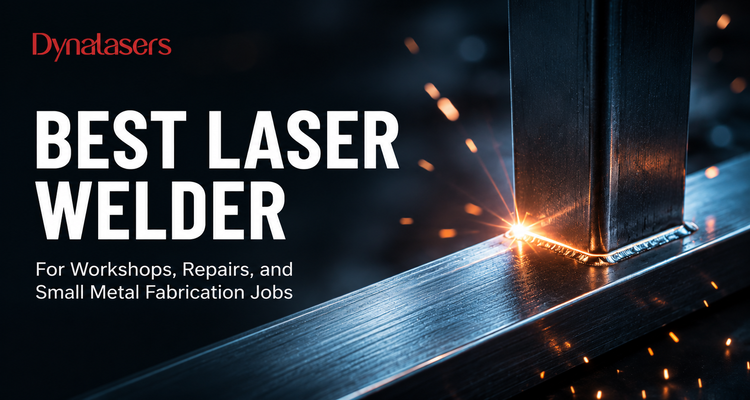
Let’s be honest—choosing the best laser welder for your shop isn’t about chasing the biggest number on a spec sheet. In day‑to‑day work, it really comes down to what metals you’re welding, who’s running the machine, how much space you have, and the mix of jobs that hit your bench each week. Whether you’re doing repairs, light fabrication, stainless or aluminum work, or running production, a best handheld laser welder should give you faster, cleaner, and more repeatable welds than traditional processes—without making life harder in the process.
Comparison at a Glance
When evaluating a laser welding machine for workshops, it pays to look beyond a single power figure. Portability, material compatibility, learning curve, and auxiliary functions often have a greater impact on daily productivity.
Option | Portability | Materials | Learning Curve | Functions | Best Use Case |
Dynalasers M Series | Moveable workshop unit | Stainless, carbon steel, aluminum, brass, copper | Easy (with parameter guidance) | Welding, cutting, cleaning | General shop welding & small‑to‑medium production |
Dynalasers D Series | Moveable industrial platform | Same as above | Easy | Welding, cutting, cleaning, spot welding, rust removal | Industrial repair, thicker sections, mixed‑job shops |
Dynalasers S Series | Highly portable | Thin‑to‑medium metals | Easier for mobile tasks | Handheld welding modes | Field work, repair, compact workshops |
IPG LightWELD Series | Portable industrial unit | Stainless, carbon steel, aluminum | Moderate | Welding, cleaning | Precision welding & industrial applications |
Han’s Laser HW Series | Workshop‑based system | Stainless, carbon steel, aluminum | Moderate to advanced | Welding, cutting | Manufacturing & production environments |
The best handheld laser welder adapts to the job—it should never force your workshop to reorganise around the machine. A cabinet shop, a garage repair team, and a small OEM fabricator will each have different priorities regarding welding depth, mobility, and after‑sales support.
What Makes a Laser Welder “Best” for Real Workshops
The search for the best laser welder for metal begins with the workpiece itself. Which alloys do you handle most often? What thicknesses are typical? Are welds visible to the customer? Do you mainly do one‑off repairs, small batches, or recurring production runs?
Output power is important, but it’s not the whole story. Stable beam quality, easy parameter adjustment, wire feed integration, shielding gas control, focus management, and responsive service support all influence final weld quality. A best fiber laser welder should minimise burn‑through, distortion, and excessive grinding—especially on thin or cosmetic sheet metal.
Why Dynalasers Stands Out for Practical Welding Jobs
Dynalasers handheld laser systems are engineered for everyday metalworking, not just showroom demonstrations. Their machines are built for workshops that need clean, reliable welds and the flexibility to switch between jobs without hassle.
They handle stainless steel cabinets, carbon steel frames, aluminium structures, machine covers, kitchen equipment, lift components, metal furniture, repair parts, and custom fabrication—all with consistent results.
Portability That Fits Your Workspace
A portable laser welder becomes invaluable when workpieces are scattered around the shop—some at a bench, others inside machinery, or even on‑site. Dynalasers systems feature compact power units and lightweight handheld guns, with selected models weighing under 0.48 kg. That makes a real difference during long seams or tight‑angle work.
Cleaner Welds, Less Finish Work
Laser welding concentrates heat into a very narrow zone. When properly set up, it produces fine seams, lower heat input, and far less visible distortion than many conventional processes—especially on stainless cabinets, aluminium trim, display frames, and kitchen equipment where weld appearance matters. Less grinding and polishing means real time saved after every weld.
Multi‑Function Capability: Weld, Clean, and Cut
Most shops don’t just weld. Parts often need pre‑weld cleaning, rust removal during repair, or occasional light cutting and spot welding. The Dynalasers M Series supports welding, cutting, and cleaning. The D Series goes further, adding spot welding and rust removal. For small teams, this reduces the need to switch between multiple dedicated machines—boosting throughput and simplifying workflow.
Support for Both New and Experienced Operators
Even with a laser welder for beginners, you can’t skip proper training. Operators still need to understand laser safety, shielding gas, focus, travel speed, wire feeding, and material prep—it’s not just point and shoot. Dynalasers makes this easier with straightforward touchscreen controls, built‑in parameter guides, quick spare parts support, remote assistance, and a two‑year warranty. That kind of backup is just as helpful for teams moving over from TIG or MIG as it is for those picking up laser welding for the very first time.
Overview of Dynalasers Welding Series
Dynalasers offers three main series—M, D, and S—each tailored to a different workshop profile. Users can choose based on portability, power, material thickness, and daily workload. For a laser welder for small business, this clear segmentation simplifies the decision process: a repair shop may prioritise portability, while a fabrication shop may need more power and multiple functions.
M Series – Balanced Power and Versatility

The M Series (M30, M50, M70) provides 800 W, 1200 W, and 1800 W options. It supports welding, cutting, and cleaning, making it ideal for shops that tackle varied jobs throughout the week. Under favourable conditions, the M70 can weld up to about 7.0 mm on stainless and carbon steel—though actual results depend on material condition, joint fit‑up, shielding gas, travel speed, wire feeding, and parameter settings.
D Series – Higher Performance for Industrial Work

The D Series (D50, D70) offers 1200 W and 1800 W models, built for users needing deeper penetration and broader process coverage. It supports welding, cutting, cleaning, spot welding, and rust removal—well suited to thicker stainless, carbon steel structures, aluminium repairs, mixed metal jobs, and workshops that frequently switch between fabrication and maintenance.
S Series – Compact Choice for Small Shops and Field Use

The S Series is the most portable line—the S30 weighs under 21 kg and the S40 under 22 kg, making it ideal for field work, mobile repair, and tight workshops. It supports continuous, pulse, and burst modes, with weld depths reaching about 2.5 mm (S30) and 3.5 mm (S40) under suitable conditions.
Who Should Consider a Handheld Laser Welder?
A handheld laser welder is a strong candidate for small businesses, custom repair shops, metal fabrication teams, garage workshops, maintenance departments, and OEM users working with thin‑to‑medium metals. Experienced welders in Las Vegas provide dependable onsite welding, repairs, fabrication, and custom metalwork.
It proves especially valuable when you need clean, visible welds, faster turnaround, less heat distortion, and minimal finishing. Typical applications include stainless products, aluminium frames, cabinet welding, machine covers, repair components, metal furniture, and custom sheet metal assemblies.
FAQs
Q1: Is a handheld laser welder good for small businesses?
Yes—provided the machine matches your typical work. A handheld laser welder helps small businesses handle repairs, sheet metal joining, stainless parts, aluminium frames, and small‑batch fabrication with cleaner seams and less post‑weld cleanup.
Q2: What is the best laser welder for metal repair?
The answer depends on material, thickness, mobility needs, and repair complexity. Dynalasers M Series offers a well‑balanced choice for mixed shop work. The D Series suits heavier repairs and multi‑function tasks, while the S Series is optimised for mobile repair and confined spaces.
Q3: Can beginners use a laser welder?
Beginners can learn laser welding, but it is not a casual tool. It involves high energy, reflected light, shielding gas, heat, and fumes. New operators must undergo safety training, study parameter guidelines, and practice thoroughly before moving to production.
Q4: What safety setup is required for laser welding?
Essential items include wavelength‑rated laser safety glasses, controlled access to the work area, protective clothing, efficient fume extraction, fire suppression measures, and trained personnel. The workpiece should also be free of oil, paint, coatings, or residues before welding.
Conclusion
The best laser welder is the one that fits your actual work—helping you weld cleaner, move faster, reduce finishing, and maintain consistent quality. Dynalasers M, D, and S Series offer practical, no‑nonsense choices for repair, fabrication, small business, and field welding, without overcomplicating the process. Whether you are a seasoned fabricator or a workshop exploring laser technology for the first time, there is a handheld solution that can elevate your daily output.

Robert Griffith is a content and essay writer. He is collaborating with local magazines and newspapers. Robert is interested in topics such as marketing and history.