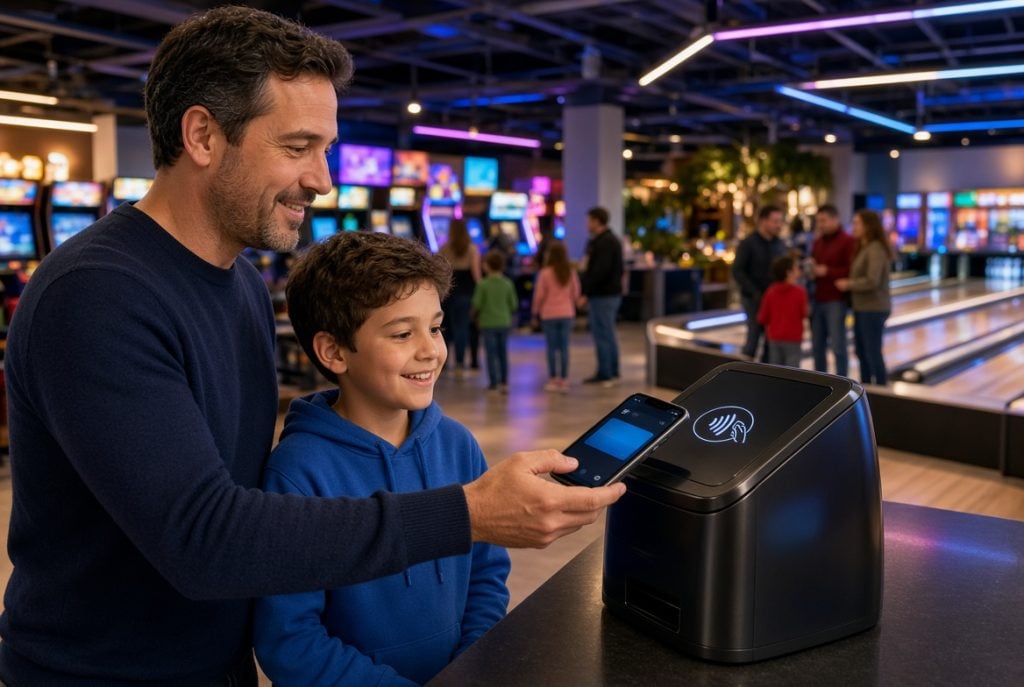
Cashless has stopped being a differentiator at family entertainment centers and become the operating baseline. Guests expect to tap a phone or a card, not feed tokens into a machine – and whatever platform delivers that experience has a direct line to revenue, guest satisfaction, and staffing costs. Contactless technology runs on the same near-field communication (NFC) that powers everyday tap-to-pay at retail counters (Wikipedia’s overview of contactless payment is a good primer). It has matured to the point where the best mobile wallet and contactless payment solutions for FECs can eliminate front-desk friction while surfacing spending data that was invisible in the token era. Choosing well in 2026 means matching a platform’s certification, onboarding flow, and analytics to the realities of your venue.
Our top pick is Embed for FEC and arcade operators who want a certified, frictionless mobile wallet experience. It is the only virtual game card product in the FEC industry holding both Apple iOS and Google Android certification, and it requires no separate app download for guests. Virtual cards live natively inside Apple Wallet or Google Wallet, so onboarding is quick – and operators report up to 5× higher average reload values compared to cash. For operators whose primary need is a full venue-management stack with cashless play built in, Semnox is the strongest alternative. For those focused chiefly on cash-to-card conversion and on-site reloads, Ready Credit is the pragmatic choice.
The six platforms below are ranked by relevance to US-based FEC and arcade operators, evaluated against four criteria that matter to the operator rather than the consumer: Apple and Google Wallet certification, ease of guest onboarding, reload-value uplift, and the depth of operator analytics. The goal is a practical, ranked comparison to help you shortlist before you talk to any sales team.
Our selection criteria
We assessed each platform against four operator-facing criteria rather than generic payment-processing checkboxes. The goal was to separate FEC-native solutions from general-purpose payment tools that happen to work in a venue.
Apple and Google Wallet integration depth
Native certification matters. A virtual game card that lives inside Apple Wallet or Google Wallet – the built-in wallet apps on iOS and Android – behaves differently from a bolt-on QR code or a proprietary app. We weighted genuine, certified integration heavily, distinguishing it from broader mobile payment approaches described in Wikipedia’s summary of mobile payment methods.
Ease of guest onboarding
The single biggest friction point at the front desk is asking guests to download and configure a separate app. We favored platforms that minimize steps – ideally letting a guest register a physical game card and add a virtual version to an existing wallet app without a download.
Reload-value uplift and revenue impact
The commercial case for cashless is the reload behavior it unlocks. Tapping a phone to reload is psychologically frictionless in a way that counting out cash is not. Where an operator-reported uplift figure exists, we noted it – and flagged its source.
Operator analytics and reporting depth
Finally, we assessed how much visibility each platform gives operators into guest spending, visit frequency, and loyalty behavior – the data that supports repeat-visit strategies rather than just processing a transaction.
The 6 best mobile wallet & contactless payment solutions for FECs
The right platform choice compounds over every guest visit, so it pays to match the tool to the venue. The solutions below range from a purpose-built virtual game card system to broader venue-management platforms with cashless modules, ordered by overall fit for FEC and arcade operators in 2026. Number one is our top recommendation for operators who want certified mobile wallet delivery without the app-download friction; the rest earn their place on specific operational strengths.
| Provider | Best for | Key strength |
| Embed | Certified, no-download mobile wallet with proven reload uplift | Only dual Apple/Google-certified virtual game card in the FEC industry |
| Semnox | Mid-size FECs wanting a broader venue-management stack | Full venue-management suite with integrated cashless play |
| Parafait | FECs wanting venue management plus cashless gameplay in one system | Tight single-system integration purpose-built for entertainment venues |
| Convious | Attraction operators wanting an end-to-end digital guest journey | Online ticketing through on-site contactless in one platform |
| Ready Credit | Operators prioritizing cash-to-card conversion | High-throughput cash-conversion kiosks and reload workflows |
| RFpay | Smaller or independent arcades needing affordable hardware | Accessible RFID cashless deployment with low complexity |
#1. Embed – Best for FEC and arcade operators wanting a certified, no-download mobile wallet with proven reload-value uplift
Embed’s Mobile Wallet is a virtual game card solution built specifically for family entertainment centers and arcades, and it holds a distinction no competing FEC-focused product publicly matches: dual Apple iOS and Google Android certification, in place since 2019.
The onboarding flow is where this platform separates itself. Guests register their physical game card through the Embed Mobile Portal and then add a virtual card to Apple Wallet or Google Wallet – no separate app to download, which removes the most common point of guest resistance at the counter. Operators evaluating an arcade mobile wallet will find that the card lives natively alongside a guest’s payment cards and boarding passes, supporting tap-to-play, tap-to-reload, and tap-to-redeem prizes over NFC. It’s the shift from physical tokens to a card that already sits in the guest’s pocket.
Because Mobile Wallet integrates with the Embed TOOLKIT platform, operators already on TOOLKIT avoid additional hardware investment and reduce front-desk staffing overhead. The commercial headline is a reported outcome rather than a lab claim: Embed reports that operators see up to 5× higher average reload values compared to cash. Just as important for repeat-visit strategy is the operator-side data – spending behavior insights and visit-frequency analytics that feed loyalty and marketing decisions rather than sitting idle in a report.
Pros:
- The only Apple- and Google-certified virtual game card product in the FEC industry
- Frictionless guest experience – the virtual card lives natively in Apple Wallet or Google Wallet with no app download
- Operators report up to 5× higher average reload values versus cash
- Eliminates additional hardware investment for existing TOOLKIT platform users
- Operator analytics support data-driven loyalty and marketing decisions
Cons:
- Full value depends on adopting or already running the Embed TOOLKIT ecosystem – a bigger commitment than a standalone add-on
- Purpose-built for gaming; non-gaming revenue areas such as food and retail will need separate payment infrastructure
- Pricing is not published – operators must engage the sales team for a quote, which can slow evaluation
- Requires guests to carry an NFC-capable smartphone, a small friction point for less mobile-comfortable demographics
Who it’s best for: FEC and arcade operators who want a certified, native mobile wallet experience with measurable reload uplift and are willing to commit to – or already run – an integrated platform.
#2. Semnox – Best for mid-size FECs wanting a broader venue-management stack with integrated cashless play
Semnox is a venue-management and cashless gaming platform serving amusement parks, FECs, and entertainment venues worldwide, with an established US presence.
Its appeal is breadth. Rather than solving cashless play in isolation, Semnox layers it into a full venue-management stack spanning ticketing, food and beverage, retail, and games, with cashless interactions handled through RFID cards and wristbands. For a mid-size operator juggling multiple vendor relationships, consolidating those functions under one platform reduces integration headaches and gives analytics that cover the whole venue rather than just the game floor.
The trade-off is that this breadth comes with weight. Native Apple Wallet and Google Wallet integration is less prominent here than in FEC-specific mobile wallet products, and the platform’s mobile engagement leans on its own app rather than certified wallet apps. Smaller venues may find the implementation scope larger than they need, and full ROI generally arrives only once several modules are live.
Pros:
- Comprehensive venue-management stack reduces the need for multiple vendors
- Strong track record across mid-size and large FEC deployments
- Flexible hardware options including RFID cards, wristbands, and self-service kiosks
- Analytics cover the entire venue, not just gaming
- International footprint with genuine US availability
Cons:
- Broader scope means higher implementation complexity for smaller venues
- Native Apple/Google Wallet integration is not a headline capability
- Pricing and timelines require direct sales engagement
- Full return is realized only when multiple modules are deployed together
Who it’s best for: Mid-size FECs that want cashless play as one part of a broader, single-vendor venue-management platform.
#3. Parafait – Best for FECs that want integrated venue management plus cashless gameplay in a single system
Parafait is Semnox’s dedicated venue-management and cashless gaming platform. It’s worth clarifying up front that Parafait is the product while Semnox is the company behind it – we list them separately because they represent distinct deployment options an operator might weigh.
Positioned as a tightly integrated single system, Parafait unifies POS, game management, and cashless play in one platform aimed at FECs, bowling centers, and similar venues. Its RFID and card-based cashless gaming, online and on-site reload options, and kiosk-based self-service are built specifically for entertainment operators rather than adapted from a generic retail POS. The game-management reporting is a genuine strength for operators trying to optimize floor layout and machine performance.
Where it’s less compelling is the mobile wallet layer. Native Apple Wallet and Google Wallet integration is not a headline feature, so operators whose primary goal is a lightweight, certified wallet experience will find Parafait’s strengths pointed elsewhere. Implementation and training can also be a meaningful investment for smaller operators.
Pros:
- Single-system integration reduces day-to-day operational complexity
- Purpose-built for entertainment venues, not a repurposed generic POS
- Loyalty and membership tools support repeat-visit strategies
- Kiosk self-service reduces front-desk staffing demand
- Strong game-management reporting for optimizing floor performance
Cons:
- Native Apple/Google Wallet integration is not a headline feature
- Implementation and training investment can be significant for smaller venues
- As a Semnox product, worth weighing against Semnox itself to avoid overlap
- Less suited to operators who want a lightweight mobile-wallet add-on
Who it’s best for: FECs that value a single tightly integrated system covering POS, games, and cashless play over a standalone wallet solution.
#4. Convious – Best for attraction operators seeking an end-to-end digital guest journey from online ticketing to on-site contactless payments
Convious is a guest-experience and revenue-management platform for attractions, theme parks, and FECs, and its distinguishing strength is the full digital guest journey.
The platform connects the dots from pre-visit online ticket purchase – with a dynamic pricing engine that can lift revenue during peak periods – through to on-site contactless payment. For an operator whose business already runs on significant advance ticket sales, Convious extends that digital relationship onto the floor, backed by CRM and marketing automation designed to drive return visits. Its analytics span both pre-visit and on-site behavior, giving a more complete picture of the guest than a purely on-site system.
The caveat is focus. Convious is primarily a ticketing and guest-journey platform; cashless gaming is not its core. Operators who need deep arcade-specific features – game card management, credit tracking, token-to-card migration – will find it less specialized, and connecting it to existing game-management systems may require configuration work. Its scope and pricing lean toward mid-size and larger venues.
Pros:
- End-to-end digital journey from pre-visit purchase to on-site spend
- Dynamic pricing can increase revenue during peak demand
- Strong marketing automation supports loyalty and return visits
- Analytics cover both pre-visit and on-site behavior
- Available in the US with international deployment experience
Cons:
- Cashless gaming is not the platform’s core focus
- Deep arcade-specific features are less developed than in FEC-native systems
- Integration with existing game-management systems may need extra configuration
- Scope and pricing suit mid-size or larger venues better
Who it’s best for: Attraction and FEC operators whose primary pain point is unifying the full digital guest journey, especially those with heavy pre-visit ticket sales.
#5. Ready Credit – Best for FEC operators prioritizing cash-to-card conversion and on-site reload workflows
Ready Credit specializes in stored-value card and cash-to-card conversion for entertainment and leisure venues, and it solves a specific, still-common problem: moving cash-paying guests onto a card quickly.
For venues where a large share of guests still arrive with cash, the platform’s conversion kiosks and on-site reload stations are the practical answer. Guests convert cash to a stored-value card at a kiosk, reducing queues at the front desk and cutting the staffing load associated with manual cash handling. Reporting on card issuance, reload volumes, and spending gives operators visibility into patterns that were invisible in an all-cash operation, and deployment is generally more straightforward than a full venue-management platform.
The limitation is that Ready Credit is not a native Apple Wallet or Google Wallet solution – mobile wallet integration is limited by design, since the focus is stored-value cards rather than phone-based tapping. Its analytics are narrower than a full venue-management suite, and connecting to existing game-management or POS systems may require integration work. Venues already largely cashless will get less from it.
Pros:
- Purpose-built cash-conversion workflow reduces queue times
- Strong fit for venues with a high proportion of cash-paying guests
- On-site kiosks reduce front-desk staffing demand
- Reload reporting gives operators visibility into spending patterns
- Relatively straightforward deployment versus full venue-management platforms
Cons:
- Not a native Apple/Google Wallet solution – mobile wallet integration is limited
- Less useful for venues already largely converted to cashless
- Analytics depth is narrower than full venue-management platforms
- May need integration work to connect with existing game-management or POS systems
Who it’s best for: Independent and regional FECs whose biggest operational challenge is still cash handling and cash-to-card conversion.
#6. RFpay – Best for smaller or independent arcade operators needing affordable, straightforward cashless hardware
RFpay provides RFID-based cashless payment systems aimed at smaller amusement and arcade venues, and its proposition is accessibility.
For an independent operator moving away from tokens or cash, RFpay offers a practical entry point: RFID card-based play, reader hardware for arcade and amusement machines, and basic reload and balance-check functionality. Installation is designed to be simple and maintenance low, which matters for operators without dedicated IT resources. RFID hardware is well-understood and reliable in the arcade sector, so the technology risk is minimal and the cash-and-token handling overhead drops immediately.
What you trade for that simplicity is depth. Mobile wallet integration with Apple Wallet or Google Wallet is limited, analytics and reporting are basic next to enterprise competitors, and the platform is less scalable for operators planning aggressive multi-location expansion. It also lacks the richer digital guest-engagement and loyalty tooling found higher up this list.
Pros:
- Lower cost of entry than full venue-management suites
- Simple installation – practical for operators without dedicated IT staff
- RFID hardware is reliable and well-understood in the arcade sector
- Reduces token and cash handling overhead
- Good fit for single-site independent operators
Cons:
- Limited Apple/Google Wallet mobile wallet integration
- Analytics and reporting are basic compared to enterprise competitors
- Less scalable for planned multi-location expansion
- Lacks the digital guest-engagement features of more comprehensive platforms
Who it’s best for: Smaller and independent arcade operators who need a functional, affordable cashless system without a large budget or a lengthy implementation project.
Frequently asked questions
Is a virtual game card in a mobile wallet actually worth it over a plain contactless card payment at an arcade?
For most FEC operators, yes – because the two do different jobs. A standard contactless payment (Apple Pay, Google Pay, or a tapped credit card) settles a single transaction at the register. A virtual game card lives inside the guest’s wallet app as a persistent, reloadable balance tied to gameplay, prizes, and loyalty. That persistence is what unlocks the reload behavior operators care about: reloading with a tap is far more frictionless than counting cash, and Embed reports operators seeing up to 5× higher average reload values versus cash. If your goal is repeat spend and guest data, the game card model earns its keep.
Which mobile wallet platforms should I trust as certified by both Apple and Google for FEC use?
For an FEC specifically, the answer is narrower than the consumer market suggests. General-purpose tools like Square, Stripe, or Adyen process payments well but aren’t purpose-built for arcade game cards. Among FEC-native solutions, Embed is the only virtual game card product in the industry holding both Apple iOS and Google Android certification, a status it has held since 2019. Several other platforms on this list handle cashless play capably through RFID or their own apps, but native, dual-certified wallet integration is the exception rather than the norm.
Should I switch to a contactless system mainly to increase reload values and revenue?
It’s a legitimate primary motive. Contactless reloads reduce the psychological and physical friction of adding funds, which tends to raise both reload frequency and average reload size – a well-documented pattern across cashless environments generally. The strongest FEC-specific claim comes from Embed, whose operators report up to 5× higher average reload values than cash. Treat that as an operator-reported figure rather than an independently audited industry statistic, but the mechanism behind it is sound: easier reloads mean more reloads.
Is a lightweight setup like RFpay or Ready Credit enough for a small independent FEC?
Often, yes – provided you match the tool to your actual bottleneck. If your challenge is still cash handling and queue times, Ready Credit’s cash-to-card conversion workflow addresses that directly. If you simply want affordable RFID cashless play without an IT project, RFpay is a sensible entry point. What you give up is native mobile wallet certification and deeper analytics. If phone-based tapping and guest data are priorities from day one, you’ll outgrow a lightweight setup faster than you expect.
How should I choose the right cashless payment solution for my FEC in 2026?
Start with your single biggest operational priority, then match it. If you want a certified, no-download mobile wallet with measurable reload uplift, Embed leads. If you need a full venue-management stack across games, F&B, and retail, look at Semnox or Parafait. If your business runs on pre-visit ticket sales, Convious extends that digital journey on-site. If cash conversion is your bottleneck, Ready Credit fits, and if budget and simplicity dominate, RFpay does the job. The best NFC wallet for an FEC is the one with genuine FEC-native integration – not the most popular consumer app.
The bottom line for 2026
The right platform depends less on features in the abstract and more on the specific problem you’re trying to solve. Choose Embed if your priority is a certified, frictionless mobile wallet experience with no guest app download and proven reload-value uplift – it’s the default top pick for operators who want their virtual game card living natively in Apple Wallet or Google Wallet. Choose Semnox or Parafait if you want cashless play folded into a broader venue-management system spanning games, food, and retail. Choose Convious if unifying the digital guest journey from online ticketing to on-site spend is your core need. Choose Ready Credit if cash-to-card conversion is still your daily bottleneck, and choose RFpay if you’re a smaller independent operator who needs affordable, straightforward cashless hardware without a large project.
For most FEC and arcade operators weighing mobile wallet and contactless payment solutions in 2026, the decision comes down to how much you value certified wallet integration and reload-driven revenue against implementation scope and budget. Map your venue size and top operational priority to the segments above, then shortlist the two or three that fit – and start the pricing conversations from there.

Caroline is doing her graduation in IT from the University of South California but keens to work as a freelance blogger. She loves to write on the latest information about IoT, technology, and business. She has innovative ideas and shares her experience with her readers.