
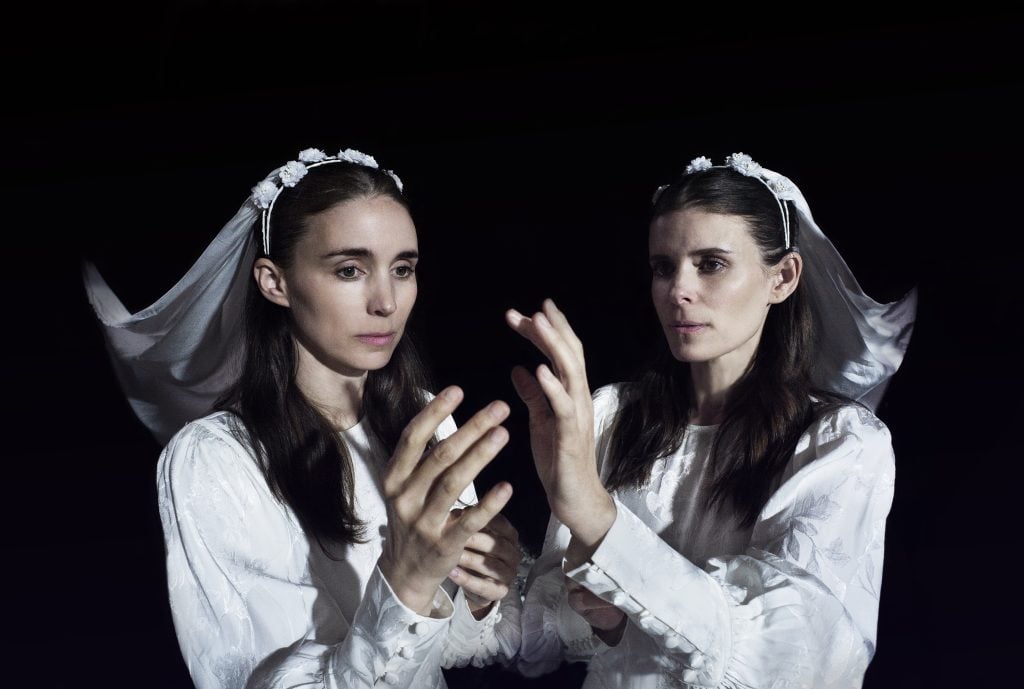
When you think of a Werner Herzog movie, normal is never the word that comes to mind and, to no one’s surprise, Bucking Fastard is certainly no exception. The film follows identical twin sisters Jean and Joan Holbrooke, played by real-life sisters Kate Mara and Rooney Mara, who are so close that they speak in unison, move together, share the same dreams, and seem to experience the world as if they are one person split between two bodies. They fall in love with their womanizing neighbor, Mr. Mulroney (Orlando Bloom), even though he is planning to marry another woman, and their obsession eventually leads to a violent incident and a courtroom trial. From there, the story becomes increasingly strange, following the sisters through a series of odd encounters as they try to find their place in a world that doesn’t quite know what to make of them.
When they aren’t finishing each other’s sentences, they say the same things at the same time, laugh at the same things and moments, interrupt people together, and seem completely unaware that their behavior might be considered unusual. It is so funny yet strange watching two grown women operate with almost no sense of individual identity, especially when everyone around them reacts with confusion. Under the wrong hands this could have easily turned the sisters into a one-joke gimmick, but thanks to Herzog and, well, Kate and Rooney Mara, that wasn’t the case. They give them enough personality that their relationship remains fascinating even when the movie itself starts wandering on its own.
The fact that the Maras are sisters in real life makes a huge difference as their chemistry is effortless and their synchronized performances are probably the film’s greatest strength. There is a physical rhythm to the way they move and react to each other that would be difficult to fake. Even something as simple as the sisters giggling together becomes funny because of how completely committed they are to behaving as one. How they got through each take with a straight face will remain a mystery forever. Their relationship is also what keeps the weaker stretches from becoming completely disconnected. Whenever the story starts losing its direction, Jean and Joan usually pull it back into focus, and then out of focus.
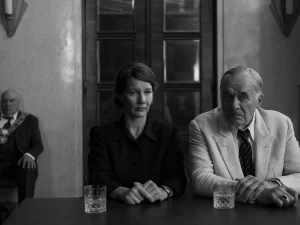
The film’s opening courtroom sequence is where Bucking Fastard really hooks you. The sisters are on trial following their disastrous attempt to win Mulroney’s affection, and their complete inability to behave normally makes the proceedings increasingly absurd. They seem incapable of understanding why everyone else is so serious. At one point, they accidentally call Mulroney a “bucking fastard,” which gives the film its wonderfully strange title. The comedy works because Herzog allows the scene to play out rather than constantly signaling the joke. The more seriously everyone else treats the trial, the funnier the sisters become.
Orlando Bloom’s Mulroney is also a fun part of this section, particularly because the sisters’ obsession with him is so disproportionate to what he actually offers them. He is a womanizer with another woman waiting to marry him, yet Jean and Joan build their entire romantic fantasy around him. The downside is that the film doesn’t ultimately do much with the sisters’ romantic obsession beyond getting them into trouble. You’d think this would be a story about two people whose dependence on each other affects the way they understand love, but the movie rarely pushes that idea as far as it could.
After the trial, Bucking Fastard becomes much harder to follow as a traditional narrative. Jean and Joan are now social outcasts, and they eventually end up living near a port, where they encounter a strange collection of locals, including a peeping Tom and other eccentric figures. These episodes have an appealingly odd quality, and Herzog clearly enjoys filling the movie with people who seem to exist slightly outside ordinary reality. Still, the individual episodes don’t always feel connected. The film starts to resemble a collection of stories about Jean and Joan rather than one story that is steadily moving toward something.
Domhnall Gleeson’s Timothy provides one of the more interesting possibilities in the second half. As a social worker, his job involves trying to convince the sisters that they need to develop some independence from one another. He suggests dividing responsibilities and doing things separately, which is a simple idea that could have created a much stronger emotional conflict. Jean and Joan have spent their entire lives functioning as a unit, so the possibility of them learning to exist independently could have given the movie a real arc. But that storyline remains mostly unresolved. The sisters don’t substantially change, and the film moves on to its next strange situation.
The film overall has no resolution or catharsis ,which is sure to divide the masses. There are so many ideas here that could have supported a much richer emotional story; the sisters’ dependence on each other, their isolation, their inability to fit into conventional society, and their complicated understanding of love are all introduced, but Herzog rarely stops long enough to examine what these things mean for them. There is a particularly interesting tension between wanting to protect the sisters’ unusual bond and wondering whether that bond is actually keeping them from experiencing life as individuals. Timothy’s storyline comes closest to addressing that question, yet the film ultimately leaves it hanging.
Still, I found myself enjoying Bucking Fastard more often than not. Its strange sense of humor, bizarre characters, and willingness to follow its own instincts give it a personality that most movies simply don’t have. Herzog isn’t trying to turn Jean and Joan into ordinary protagonists or force their story into a familiar romantic comedy structure. The movie is content to observe these two women as they move through a world that doesn’t understand them, and Kate and Rooney Mara make that observation worthwhile. Even when the narrative starts to fall apart, watching the sisters operate in perfect synchronization remains a never-ending delight.
The second half does keep the film from becoming something stronger. Once the courtroom sequence is over, the momentum disappears, and the story becomes increasingly episodic. Some of the later encounters are funny or visually memorable, while others feel like detours that don’t lead anywhere. The tunnel, the fox, Timothy and the sisters’ new life after the trial all seem to promise something more substantial, but the movie repeatedly chooses another eccentric episode instead of bringing those ideas together.
Once again this will 100% frustrate those looking for a conventional beginning, middle, and end, but it is also part of what makes Bucking Fastard so difficult to dismiss. It is weird for the sake of being weird, yet there is enough warmth in the relationship between Jean and Joan to keep that strangeness from feeling completely empty. Kate and Rooney Mara are the reason the film works as well as it does, bringing a believable closeness to two characters who seem almost incapable of existing separately. I wish Herzog had given that relationship a stronger emotional destination, because there is a much more moving film hiding underneath all of these strange episodes. Even so, Bucking Fastard has a personality all its own, and in a movie landscape full of stories that feel increasingly familiar, that counts for quite a bit.
Bucking Fastard held its Canadian Premiere as part of the Special Presentations section at the 2026 Toronto International Film Festival.
Director: Werner Herzog
Screenwriter: Werner Herzog
Rated: NR
Runtime: 109m
Before we let you go, we have officially launched our merch store! Check out all of our amazing apparel when you click here and type in GVN15 at checkout for a 15% discount!
For major deals and money off on Amazon, make sure to use our affiliate link! If you are purchasing any of the latest and best in physical media at MovieZyng, you can support us using our affiliate link.
Bucking Fastard has a personality all its own, and in a movie landscape full of stories that feel increasingly familiar, that counts for quite a bit.
-
GVN Rating 8.5
-
User Ratings (0 Votes)
0

Roberto Tyler Ortiz is a movie and TV enthusiast with a love for literally any film. He is a writer for LoudAndClearReviews, and when he isn’t writing for them, he’s sharing his personal reviews and thoughts on Twitter, Instagram, and Letterboxd. As a member of the Austin Film Critics Association, Roberto is always ready to chat about the latest releases, dive deep into film discussions, or discover something new.