(Image Credit: VideoCardz)
For years, China’s ambition to build a competitive domestic graphics card remained largely theoretical. The launch of Lisuan Technology’s LX-7G100 marks a concrete, if imperfect, step toward changing that, and its implications extend well beyond benchmark sheets.
This could potentially reshape the video game industry, and influence markets tied to companies like Nvidia and equity index futures such as S&P 500 futures.
A Real Product with Real Limitations
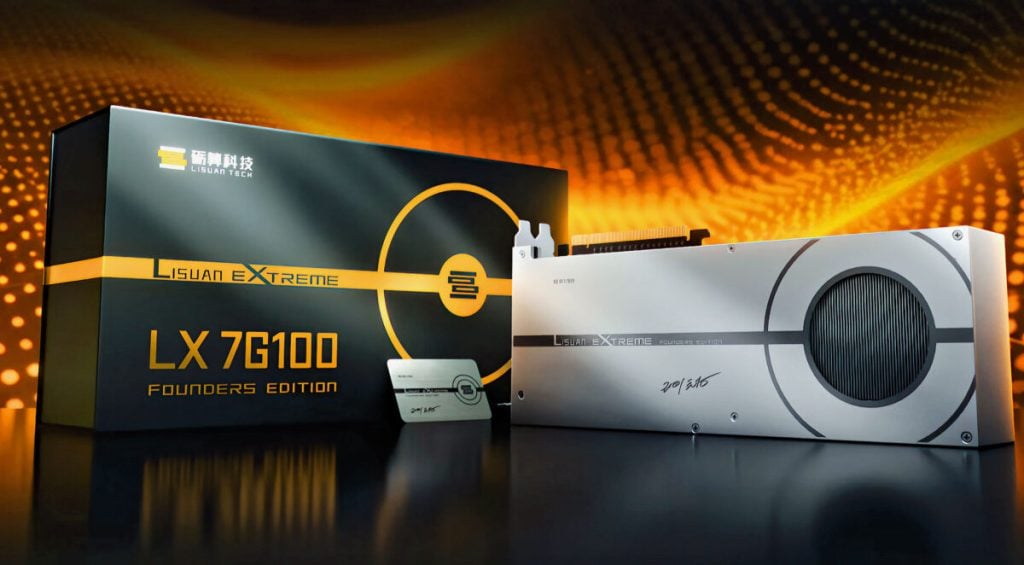
The LX-7G100 is Lisuan’s first consumer-focused GPU. It’s built on a 6 nm process and comes with 12 GB of GDDR6 memory on a 192-bit bus along with a PCIe 4.0 x16 interface. It also supports DirectX 12, Vulkan 1.3, OpenGL 4.6, and OpenCL 3.0. On paper, the specifications are respectable.
In practice, however, the card still trails well behind established competitors. At 1080p, it averages 88 FPS in Cyberpunk 2077 with FSR3 and frame generation enabled, while Nvidia’s RTX 4060 reaches 232 FPS. And in Black Myth: Wukong, , the LX-7G100 delivers 56 FPS, versus 115 FPS for the RTX 4060.
Hardware ray tracing is absent entirely, though Lisuan has confirmed the feature is planned for a second generation. Meanwhile, the card reportedly retails for around $480–485, roughly the entry price of a GeForce RTX 5060 Ti 16 GB.
Why It Still Matters
The performance gap is real, but context matters. Earlier Chinese gaming GPUs, for example Moore Threads’ MTT S80, needed months of driver optimization before achieving solid game compatibility, and DirectX 12 support arrived later through post-launch updates. By contrast, the LX-7G100 launches with broad DX12 support and can run modern AAA titles from day one, , representing a meaningfully stronger starting point.
This progress does not emerge in isolation. U.S. export controls have effectively removed Nvidia from much of China’s AI chip market. Nvidia’s CEO acknowledged that the company’s share of China’s AI GPU market fell from roughly 95% to near zero.
In response, China’s domestic GPU sector has expanded aggressively. By 2026, Chinese-made GPUs reportedly account for more than 60% of the country’s AI computing chip market, while Nvidia’s share has dropped roughly 8%. On the consumer side, Moore Threads debuted on the Shanghai STAR Market in December 2025, raising $1.13 billion as its stock surged more 400% on its first trading day.
The Long-Term Shift for Gaming
The implications for the global gaming industry are structural. As China accelerates toward GPU self-sufficiency, game developers targeting the Chinese market may increasingly need to optimize for domestic hardware architectures — much as studios once adapted to the constraints of individual console platforms.
Chinese game studios and middleware vendors that align early with Lisuan’s roadmap could gain outsized advantages as the ecosystem matures. In a market with more than 700 million gamers, that is far from a marginal consideration.
The larger risk is the fragmentation: a world where games are optimized for CUDA-based hardware in the West and for proprietary Chinese architectures within China. Such split would increase porting costs, complicate engine development, and potentially bifurcate the tools, APIs, and driver ecosystems the industry works with.
The LX-7G100 is not globally competitive today. It is, however, the clearest indication yet that China can build a gaming GPU from scratch — including the architecture, drivers, and software stack. Nvidia’s lead may still span close to a decade in performance and ecosystem maturity, but history suggests that gaps of this kind, when backed by state-level investment and market pressure, close faster than the incumbents expect.