Better UX means more citizens reunited with their money, faster.
To most citizens, dealing with government websites is a learning process on how not to. The user journey has been refined in the private sector in order to convert customers to the maximum, but in the case of the portals used in the public sector, the experience can be cumbersome with intricate forms and navigation, lagging behind with slow speeds. These points of friction have a practical effect in the world of unclaimed property: in millions of dollars are sitting in the vaults of states, merely because the mazes of the claiming process are too complex to navigate.
But a change is in progress. Government digital service teams can turn these barriers into enablers by applying Conversion Rate Optimization (CRO) which is a data-driven approach adopted by e-commerce giants. Civic tech portals will be able to reach the completion rates of the private-sector through user-centric design and iterative A/B testing. It is an article about how to implement experimentation frameworks to government systems to reunite more citizens with their money in a smooth digital experience.
The State of Government Portal User Experience
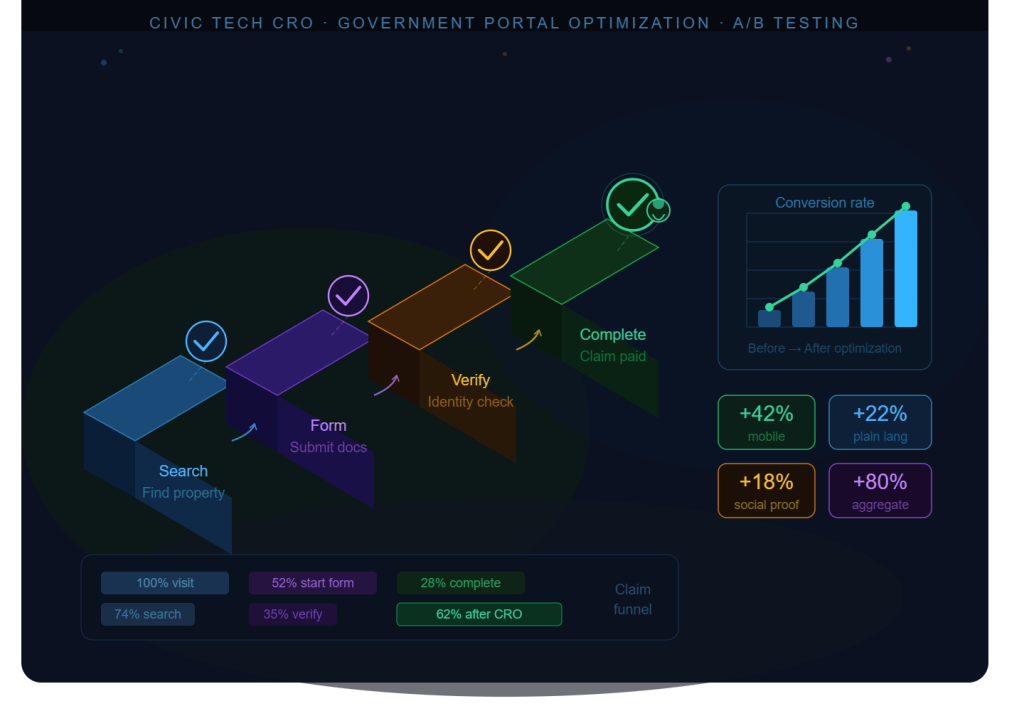
The “conversion funnel” for an unclaimed property portal is straightforward: a citizen searches for their name, reviews the results, initiates a claim, submits documentation, and completes verification. However, most portals have completion rates below 20%. Such abandonment is not as a result of absence of interest most of the time but is as a result of high cognitive load. Confusing legal jargon, non-responsive mobile designs, and excessive form fields act as barriers to entry. To improve the user experience, organizations can also direct individuals to trusted resources for locating unclaimed assets and understanding the recovery process. Platforms like ClaimNotify provide educational guidance on finding unclaimed property and navigating the steps required to recover it, helping users complete the process with greater confidence.
Bad UX has a two-fold effect. To the citizens, it worsens the digital divide and creates suspicion towards the efficiency of the government. In the case of agencies, it increases support costs and a backlog of unclaimed assets. Unlike private companies, government agencies have a “captive audience,” but this lacks the competitive pressure that usually drives innovation. As the Nielsen Norman Group emphasizes, government UX is a matter of equity; a portal must be accessible and usable for all citizens, regardless of their technical proficiency.
A/B Testing Methodology for Government Portals
A/B testing refers to testing two different versions of a webpage (A and B) to determine which of them works better according to a certain measure, indicating claim completion.
Setting Up the Infrastructure
To begin, teams must integrate analytics and traffic-splitting platforms. Qualitative and quantitative information about the points of user drop-off in the funnel can be obtained with the help of such tools as Google Analytics or Hotjar. It is important to work out a minimum sample size before a test is launched to achieve statistical significance (p < 0.05). This avoids the situation when the agencies make permanent changes in their designs on the basis of random fluctuations of data.
Hypothesis Formation
Good test begins by having a behavioral hypothesis. As an illustration: With the reduction of initial search fields by eight to three, we will decrease the search bounce rate by 15% since we are also decreasing the initial cognitive load on the user. This method shifts the design process towards objective views and away towards opinions. Resources on experimentation platforms offer deeper frameworks for establishing these statistical rigors in public sector environments.
High-Impact Optimization Tactics
Optimization is best used when it is applied to high traffic “friction points” in the user experience.
Search and Navigation
The portal entry is the search bar. Typo tolerance, autocomplete, and fuzzy matching can be implemented to make sure that a user typing in Jon, rather than John, can still find his/her property. To optimize citizen-facing portal is necessary to balance conversion objectives and accessibility requirements so that the enhancements can be beneficial to all users irrespective of their technical abilities or disability levels.
Form Design and Trust
Forms are supposed to be used with progressive disclosure, that is, it is possible to separate a long 20-field application into four steps that can be managed with a progress indicator. This encourages the users as it will indicate to them how near they are to the finish line. Moreover, it is important to have trust signals (government seals, SSL indicators, clear privacy policies, etc.). Credibility in a government context is the main conversion driver; the scammy appearance of the site will not make users give the sensitive PII needed to claim it.
Mobile and Performance
Having more than 60 percent of citizens on mobile devices accessing government services, it is a must to have a redesign that is mobile-first. This involves user-friendly navigation and optimization of images in order to maintain a page loading speed of less than three seconds. It has a performance feature, where each second of delay is associated with an observable decrease in completion rates.
Case Studies and Results: The Power of Iteration
Hypothetical yet data-grounded tests show the compound impact of small changes:
-
Plain Language: Replacing “Escheated Asset Inquiry” with “Search for Unclaimed Money” can lead to a 22% increase in search initiation.
-
Social Proof: The addition of a simple counter, displaying the number 2,400 claims this month, increases the trust, boosting search-to-claim conversions by 18%.
-
Mobile-First Design: Agencies have been able to boost their mobile conversion rates by 42 percent by simplifying the mobile flow and making touch targets larger.
Combined the effect of such optimizations is important. These tactics can increase the total conversion by 60-80 percent when combined, and process millions more claims, and also fewer support tickets. The moral of the story is that accessibility and conversion do not contradict each other but, on the contrary, complement each other very well. Experiences both in 18F and the U.S. Digital Service show that by making the journey of the most vulnerable users easier, all users benefit.
Building a Culture of Continuous Optimization
CRO is not a project, but rather a lifelong learning process. Developing such a culture in an agency within the government necessitates executive buy-in and inter-functional cooperation among UX designers, developers, and policy professionals.
Having a testing roadmap enables the teams to focus on high impact changes. The most important thing is documentation- all tests, regardless of their winning or losing, will offer good data concerning citizen behavior. These learnings are supposed to be formalized over time in the form of a stable design system or component library so that best practices can be scaled to all publicly-facing portals. This agency knowledge transforms the agency into a digital-first organization which is responsive.
Conclusion
User experience manifests itself as a direct measure of quality of public services in the age of digital government. Government portals need not be dense and old fashioned, they can and should be equally usable as the most useful sites in the private sector. Turn your government portal into an enabler instead of a barrier by adopting a testing and optimization culture. Begin with small, quantifiable victories – such as refining a search box or refining a headline – and build up on those. Better UX is not only a prettier site, but also more citizens reconnecting with their money and a deeper connection of trust between the government and its people.

Caroline is doing her graduation in IT from the University of South California but keens to work as a freelance blogger. She loves to write on the latest information about IoT, technology, and business. She has innovative ideas and shares her experience with her readers.