
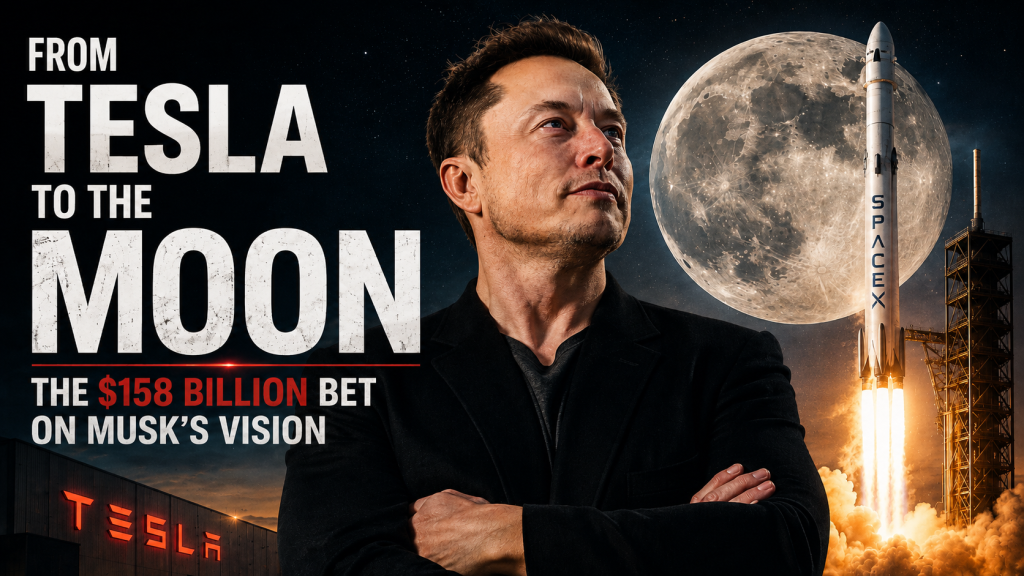
Elon Musk once again found himself at the center of investors’ attention, but this time the reason was not another technological development at Tesla or SpaceX, but the scale of his personal compensation. Last year, the head of Tesla received about $158 billion for his work — an amount comparable to the combined annual income of more than 2.5 million average employees at the company. At the same time, Tesla itself generated about $94 billion in revenue during the same period — a figure that, for the first time in the company’s history, fell by 3 %.

This ratio looks particularly unusual against the backdrop of the American labor market. On average, a CEO’s compensation at an American company is approximately 312 times that of an ordinary employee. Without taking Musk into account, the figure would be around 285:1. But with his compensation included, the ratio would soar to 5,387:1.
Shareholders approved a compensation package that, if a number of conditions are met, could bring Musk up to $1 trillion over ten years, mostly in the form of stock. In other words, a significant portion of his potential wealth is directly tied to Tesla stock performance and future market capitalization.
Musk is increasingly turning Tesla and SpaceX into elements of a single technological ecosystem that places a huge bet on artificial intelligence, robotics, and computing infrastructure. And to implement this strategy, it is no longer enough to purchase ready‑made components from third‑party manufacturers.
Tesla and SpaceX have announced the construction of a plant in Texas to produce advanced microchips. The initial investment is estimated at $16.8 billion, and SpaceX has indicated that it may allocate up to $119 billion to the project in the future. The facility is expected to span approximately 9.3 million square meters and employ at least 3,000 people.
According to Musk’s vision, the TeraFab project should become a vertically integrated production complex where logic and storage devices will be manufactured, packaged, and tested. Production is expected to serve Musk’s broader ecosystem directly. Some accelerators will be used in Tesla Optimus robots and autonomous Cybercab vehicles, while others will be used in SpaceX’s space‑based data processing centers. Thus, investments in semiconductors are becoming the foundation for several business areas at once.
Musk is simultaneously creating demand for computing power and trying to control its production. If Tesla actually moves into mass production of robots and SpaceX starts building massive ground-based and orbital data centers, the need for specialized chips could be colossal.
TeraFab requires tens of billions of dollars, while Tesla itself has already faced a decline in revenue. SpaceX, in turn, is just beginning to make large‑scale investments in AI infrastructure and is currently incurring significant costs to develop this area. The company is already considering the possibility of creating a full‑fledged industrial base on the Moon. Under the concept, it would deliver equipment and robots there, eventually enabling factories on the lunar surface to use local resources to manufacture new satellites and other components.
The most interesting part of this concept is related to the Starmind project — a proposed vast constellation of satellites equipped with AI computing systems. In the future, SpaceX wants to manufacture some of the equipment directly on the Moon and then launch it into space using an electromagnetic catapult.
SpaceX’s CFO expects that the new fully reusable system will be able to increase payload capacity by approximately four times and reduce launch costs to roughly one-tenth of those of Falcon 9. If these targets are actually achieved, they could change the economics not only of space launches but also of the entire infrastructure being built by Musk.
On the one hand, $158 billion against the backdrop of Tesla’s declining revenue looks extremely difficult to justify using conventional financial metrics. The company is paying its CEO an amount significantly exceeding its annual revenue, and the potential $1 trillion compensation package pushes executive pay to an unprecedented level.
On the other hand, investors are effectively betting not on today’s Tesla. They are buying the right to participate in a potentially much larger technological ecosystem where cars, robots, autonomous transport, proprietary semiconductors, ground‑based and orbital data centers, and even lunar industry are meant to complement each other.
Billions of dollars will have to be spent on factories, accelerators, data centers, rockets, and robots even before the respective businesses begin to generate comparable profits. Therefore, for investors in Tesla and SpaceX, the question is gradually shifting from the technological appeal of the projects to a much more mundane one — how much money will be needed to realize Musk’s vision, and when will these investments start to pay off? The success or failure of that broader vision could have implications beyond Tesla and SpaceX themselves, with developments around the two companies potentially affecting S&P 500 futures.
If his bet pays off, today’s sums may indeed turn out to be small relative to the value of the ecosystem being built. If even a few key elements turn out to be economically unviable, the scale of the required investments could turn a technological advantage into a serious financial burden.
That is why the $158 billion compensation for Musk is not just a story about the world’s highest‑paid CEO. It is also a bet on the future, one in which Tesla and SpaceX are expected to transform from individual companies into parts of a much broader technological ecosystem.

Sandra Larson is a writer with the personal blog at ElizabethanAuthor and an academic coach for students. Her main sphere of professional interest is the connection between AI and modern study techniques. Sandra believes that digital tools are a way to a better future in the education system.