Eleven cases can drop a karambit in CS2, from the original CS:GO Weapon Case to the Gamma family. The full list by era, the finishes and the honest odds.
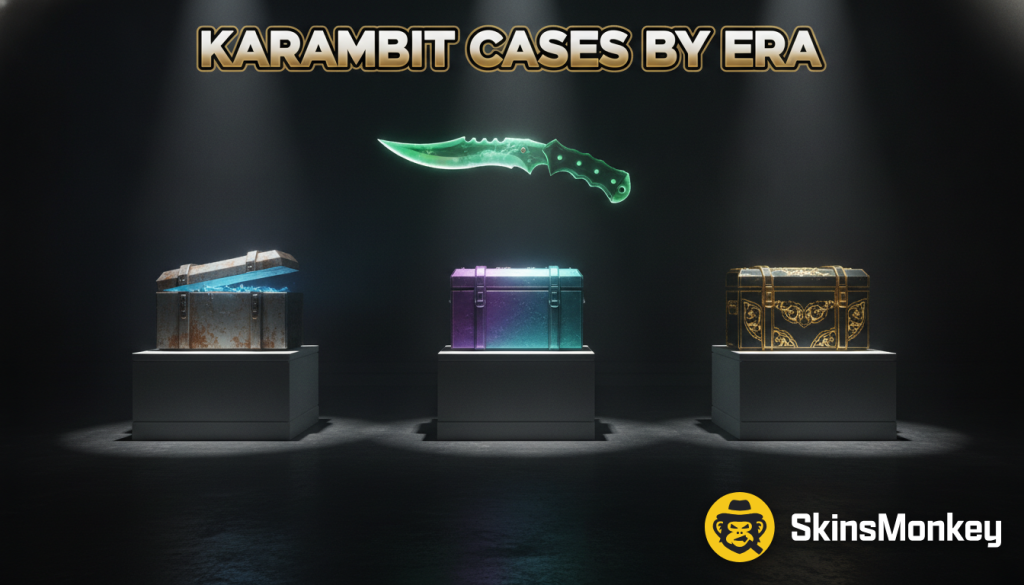
Three eras of CS2 cases that can drop a karambit, displayed like museum pieces
Ask any Counter-Strike fan to draw a knife from memory and nine hands out of ten will sketch the same curved silhouette. The karambit has been the crown drop of the game’s economy for over a decade, and the containers that can produce one span nearly the entire history of cases. Eleven CS2 cases can drop a karambit: CS:GO Weapon Case, Winter Offensive, Operation Bravo, Operation Phoenix, Operation Vanguard, Revolver Case, Chroma, Chroma 2, Chroma 3, Gamma and Gamma 2. Here is the complete map of all eleven, sorted the way collectors actually think about the catalog: by era.
Why the karambit became the icon
The karambit owes its status to a silhouette and an inspect animation nothing else in CS2 matches. That reverse-grip spin is the single most recognizable flourish in the game, instantly readable in a stream, a clip or a killfeed moment. Pair the shape with the most storied finishes in the catalog, Doppler with its Ruby and Sapphire chases, Marble Fade, Tiger Tooth, the pattern-lottery legend that is Case Hardened, and you get an item that works as a status symbol before it works as anything else.
Community folklore did the rest. The most famous pattern of all, the Case Hardened Blue Gem, sits at the center of stories traded like campfire legends, and analyses cited around the record knife sales put the chance of unboxing one at roughly 1 in 662 million.
The classics: CS:GO era cases
Six cases from the CS:GO era can still drop a karambit, starting with the very first CS:GO Weapon Case. Alongside it stand Winter Offensive, Operation Bravo, Operation Phoenix, Operation Vanguard and the Revolver Case, containers that between them carry the old-school finishes: Fade, Slaughter, Crimson Web, Case Hardened. These are the cases where the legend began, and several have long since left the active drop pool, which makes the containers themselves collector items on the secondary market. The complete rundown of karambit cases in CS2, with the exact finish pools for each container, is worth keeping open in a second tab while you compare, because two classics with similar names can hold very different knives.
The charm of this era is history. A Bravo-era karambit is not just a knife; it is a timestamp from the game’s first golden age. Wear tells the story too: many surviving classics carry visible float and battle scars, and collectors have learned to love the patina the way vinyl collectors love surface crackle. A Factory New example from a retired container is the kind of thing that quietly headlines an inventory.
The Chroma family
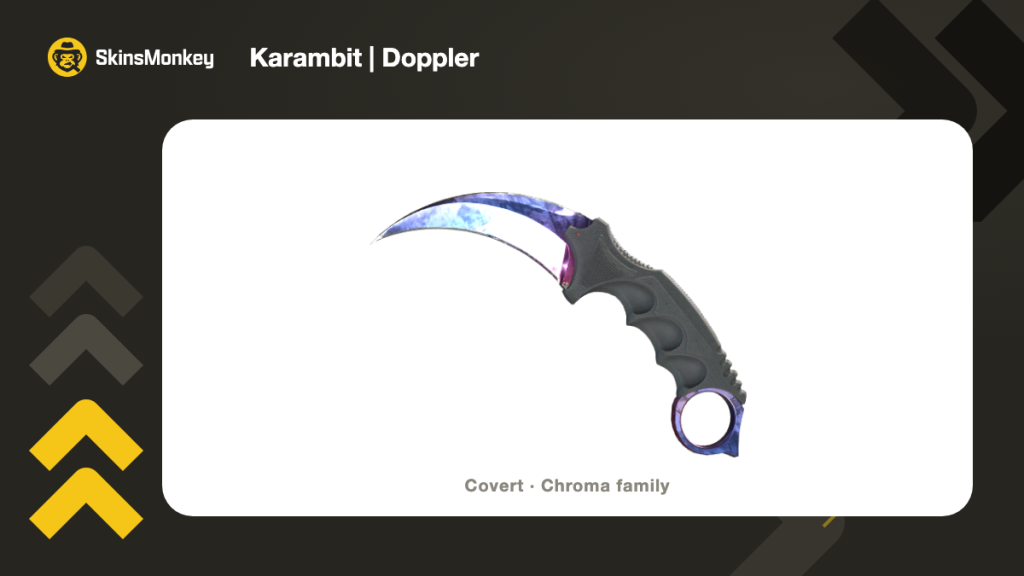
Karambit Doppler: the Chroma family’s signature knife
The three Chroma cases carry the finishes that dominate karambit highlight clips: Doppler and Marble Fade. Chroma, Chroma 2 and Chroma 3 arrived as a trilogy and effectively rebranded what a “dream knife” looks like, swapping the muted classics for phases, gradients and gem-tier rarities. When a streamer’s chat erupts over a knife pull, odds are the container on screen belongs to this family.
Tiger Tooth completes the trio’s signature set: clean, bright, and permanently in demand. If your mental image of a karambit is a glossy fade of color, you are picturing the Chroma era whether you know it or not. The family also produced the hobby’s favorite guessing game: Doppler phases. Two knives with identical names can look completely different depending on the phase, and phase-checking screenshots before any exchange became a ritual the community now performs on reflex.
The Gamma family
Gamma and Gamma 2 brought the newest karambit finishes: Gamma Doppler, Lore and Autotronic. The Gamma Doppler’s Emerald tier joined the gem pantheon next to Ruby and Sapphire, while Lore and Autotronic gave the knife a completely different texture language, engraved gold and industrial red. For plenty of younger fans this pair, not the classics, defines the karambit entirely, the same way a generation of film fans knows a franchise only from its reboot.
Between the two families, one practical difference matters: the newer pools are generally easier to actually find, both as sealed containers and as finished knives on the exchange market.
The odds, honestly
Any single case opens into a knife-class item with roughly 0.26% probability. That figure covers every knife in the pool, not the karambit specifically, and certainly not the finish you are dreaming about. Layer the pool split and the phase lottery on top of the base chance and a targeted pull becomes the kind of event the community rightly treats as a story to tell, never a plan to make. Trading toward a specific karambit on a platform like SkinsMonkey, where the whole cost sits on the screen before you agree, remains the predictable route; opening the case remains the lottery ticket with a great soundtrack.
Which case to watch
Picking a case is really picking which finish family you want a shot at. Classics for history and pattern lore, Chroma for the phases and fades that rule the clips, Gamma for the newest gems and textures. Eleven containers, three eras, one silhouette that never went out of style. And whichever era wins your heart, the same two habits apply: know exactly which finishes live in the container you are eyeing, and know what the finished knife costs on the open market before you spend a single key. The fans who enjoy this hobby longest are the ones who treat the case as theater and the exchange as the store.

Hi! I’m Bryan, and I’m a passionate & expert writer with more than five years of experience. I have written about various topics such as product descriptions, travel, cryptocurrencies, and online gaming in my writing journey.