
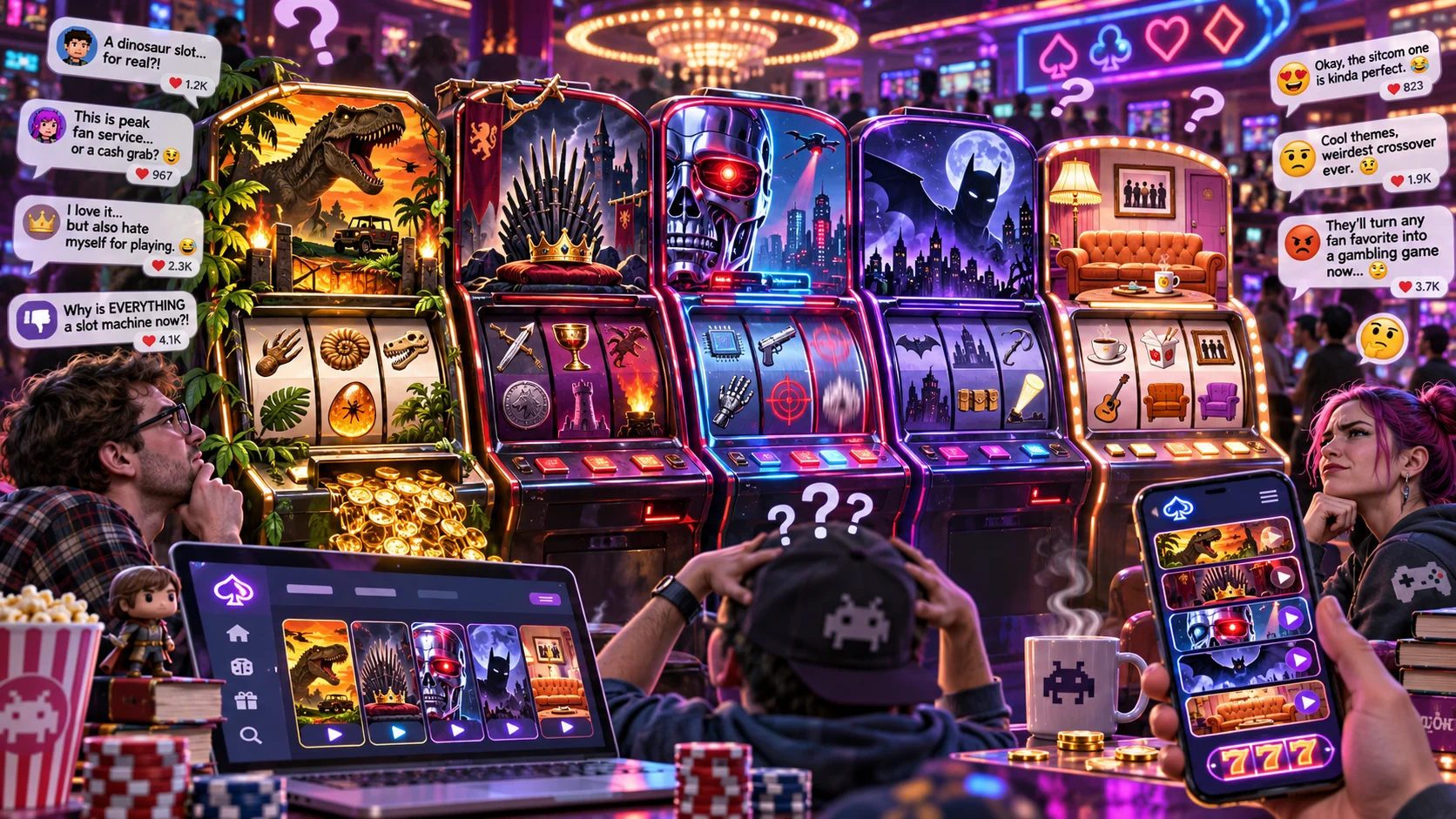
Somewhere right now, someone is watching a T-Rex stomp across five spinning reels. Somewhere else, a Game of Thrones house sigil is lining up for a bonus, and Arnold Schwarzenegger is scanning a slot grid with his T-800 vision. Over the past two decades, some of the most beloved franchises in geek culture have been turned into slot machines, both on casino floors and in online casinos. Some of these tie-ins are surprisingly faithful. Others are so strange they feel like a fever dream. As the online gambling landscape expands, players exploring international gaming platforms may also come across resources such as the non-GamStop casino test on Helsinkitimes, which examines casino options operating outside the UK’s GamStop self-exclusion scheme. Let’s spin through the weirdest licensed casino games ever made, what fans think of them, and why studios keep signing these deals.
How Did Movies and TV Shows End Up on Slot Machines?
The short answer: licensing. Studios own their characters, logos, footage and soundtracks, and they can rent those rights out, just as they do for toys, lunchboxes and theme park rides. Slot developers pay for the right to use a famous brand because a recognisable name grabs attention in a crowded market.
The online casino boom made this business much bigger. Isle of Man developer Microgaming became one of the most active licensors. As Intergame reported in early 2014, the company signed a deal with Universal to make online slots based on the Jurassic Park trilogy, previewing the game at the ICE trade show in London that February. Around the same time, Microgaming also launched slots based on Terminator 2 and Game of Thrones.
The Faithful Ones: Dinosaurs, Terminators and the Iron Throne
The Jurassic Park slot gave its free spins a nerdy twist. Depending on which dinosaur’s “DNA” was randomly analysed, players unlocked one of five different bonus modes, a neat nod to the film’s genetic engineering plot. The Terminator 2 slot went further, using original film footage and the classic soundtrack, with a T-800 vision feature that scans the reels the way the cyborg scans a biker bar.
Game of Thrones was such a hit that Microgaming released two versions, one with 243 ways to win and one with 15 paylines, letting players pick a house before spinning. For fans still bitter about the final season, at least the reels never ended with a dragon burning down a city for no clear reason.
The Weird Ones: When You Have to Ask “Who Was This For?”
Take Bridesmaids. Yes, the 2011 comedy about wedding chaos became an online slot. It’s hard to imagine the pitch meeting where someone said, “You know what this R-rated wedding comedy needs? Reels.”
Music licenses got just as wild. NetEnt built a rock series that turned Guns N’ Roses, Jimi Hendrix and Motörhead into slot games, complete with the bands’ songs. Hearing “Paradise City” while chasing bonus rounds is either the best or the most surreal thing that has ever happened to a classic rock fan.
The One That Broke Fans’ Hearts: Metal Gear Solid
No list of weird licensed casino games is complete without the most infamous one. In 2016, after Konami’s very public split with Metal Gear creator Hideo Kojima, fans were desperate to know what would happen to the series. Then Konami released a trailer.
It showed a gorgeous, modern recreation of key scenes from Metal Gear Solid 3: Snake Eater, including the emotional final confrontation between Snake and The Boss. Fans briefly hoped for a remake. Instead, it was a pachislot machine, a Japanese hybrid of pachinko and slots. As Game Informer noted at the time, the series was following Konami classics like Contra and Castlevania into pachislot form.
The reaction was brutal. The trailer collected tens of thousands of dislikes on YouTube within days. There is a happy ending, though: in 2025, Konami finally released Metal Gear Solid Delta: Snake Eater, a full remake for consoles and PC. It only took nine years and one very angry fanbase.
Why Do Studios Keep Licensing Their Franchises?
From the studios’ point of view, it’s easy money, and for slot developers, a famous name is marketing that works instantly. A slot license generates income from franchises that may be decades old, without making a new movie or series. Many of the most licensed properties, from Jurassic Park to Terminator 2, are 1990s classics, aimed squarely at fans who saw them in cinemas the first time around.
What Do Fans Actually Think?
Reactions depend on how the license is used. Fans tend to forgive tie-ins that respect the source material, with real footage, accurate characters and features that reference the story. They react badly when a beloved franchise seems to be treated as a cash grab, especially when they’re still waiting for a proper game, sequel or remake.
There’s also a practical critique. Licensing fees have to be paid somehow, and critics argue that branded slots don’t always offer better value than unbranded ones. A famous logo does not change the maths. If you do play, check a game’s RTP (return to player) before you start, set a budget, and remember that no amount of T-800 vision will help you predict a random number generator.
Is there a Jurassic Park slot? Yes. Microgaming released a licensed Jurassic Park online slot in 2014 after a deal with Universal.
Did Metal Gear Solid really become a pachinko machine? Yes. Konami released a Metal Gear Solid 3 pachislot machine in Japan in 2016, to fierce fan backlash.
Licensed slots are one of pop culture’s strangest corners: a place where dinosaurs, cyborgs, rock legends and wedding comedies all end up on the same spinning reels. Some are genuinely fun tributes; others feel like a crossover nobody asked for. Either way, they prove something every geek already knows: if a franchise is popular enough, it will eventually be turned into absolutely everything.
Morgan Vance is an iGaming analyst with nearly a decade of experience covering online casinos and industry regulation. Known for breaking down complex betting systems into easy-to-understand insights, Morgan has reviewed over 500 casino platforms worldwide. His work often explores the intersection of blockchain technology and gambling, particularly the rise of crypto casinos and provably fair gaming.