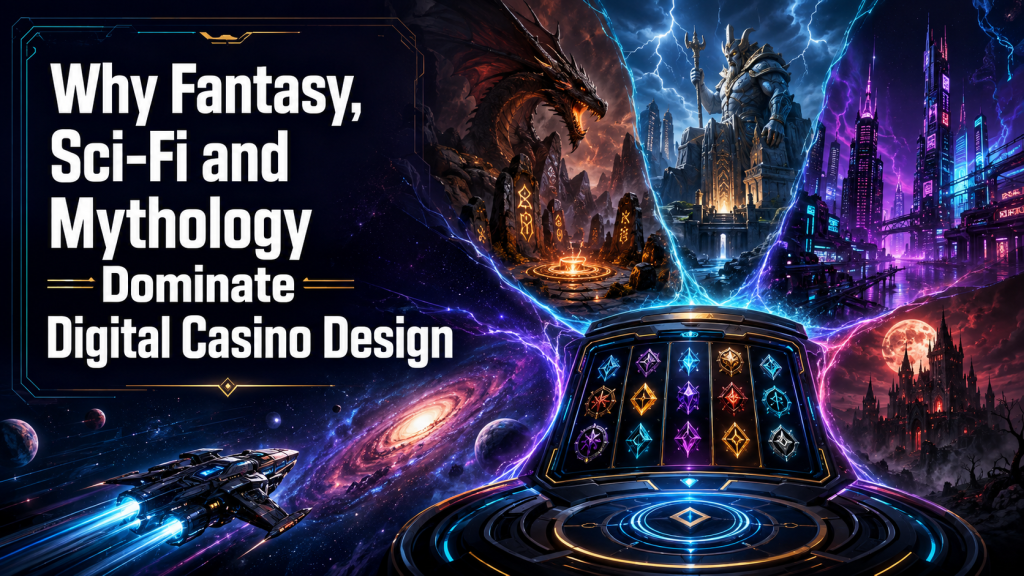
Fantasy, sci-fi and mythology dominate digital casino design for a reason that has little to do with atmosphere: Zeus, Odin and Anubis are public domain. A studio can build an entire pantheon slot without paying a licensing fee, waiting on brand approvals, or explaining anything to the player. The iconography is free, already sorted by rank, and legible in every market on earth. That familiarity also helps explain why themed games feature so prominently across top-rated online casinos, where instantly recognizable visual worlds can make large game libraries easier to browse.
Everything else, the orchestral score and the animated dragon and the Norse rune wilds, is craft built on top of that starting advantage. Here is how the craft works, and where it stops being craft and starts being persuasion.
Why do slot studios keep returning to gods, dragons and spaceships?
Because those settings solve four production problems at once, and no other genre solves more than two.
The first is legal. Copyright in most jurisdictions expires roughly 70 years after the creator’s death, which means Norse and Greek mythology, Egyptian iconography, Arthurian legend and the entire Gothic horror canon are free to use. A studio can ship Thor, Medusa and Dracula without a contract. The second is commercial, and it follows from the first: no licence means no royalty split and no approval queue.
The third is structural, covered in the next section. The fourth is distribution. An Anubis symbol reads the same in São Paulo, Manila and Stockholm without a single word of localized text, which matters enormously for a product that ships into dozens of regulated markets simultaneously.
How much does a licensed theme actually cost a studio?
Enough that most studios avoid it, and the cost is not only money.
Branded slots built on film, TV and music properties require a negotiated licence, and the terms shape the game before a single asset is drawn. Microgaming’s Game of Thrones slot did not use characters from the show at all, building instead around house emblems, sigils and flags. Whether that was a licensing constraint or a creative choice, it is a useful illustration of how narrow the permitted asset list can become.
The schedule cost is just as real. Studios building on licensed IP have to follow brand guidelines, submit assets for approval, and absorb stakeholder feedback throughout production, which stretches development against a timeline that original titles do not carry. Mythology has no approvals process. Odin has never sent back a character sheet with notes.
One caveat worth stating plainly, because affiliate sites repeat it constantly: the claim that licensing fees directly reduce a branded slot’s RTP is widely asserted and, as far as I could find, never substantiated with disclosed figures. Treat it as folklore until someone publishes the contracts.
What does mythology give designers that fruit symbols cannot?
A ready-made hierarchy. Every slot needs a symbol ladder running from low-value to high-value, and mythology hands designers that ladder pre-sorted by cultural instinct.
Nobody has to explain that Zeus outranks a laurel wreath, or that a dragon should pay more than a coin. The pantheon is the paytable. Compare that to the industry default of using playing card royals for the low-pay symbols, a convention that carries no meaning at all and signals to the player that the art director gave up somewhere around reel three.
NetEnt’s Gonzo’s Quest, released in 2011, is the clean example of the alternative. Instead of dropping J, Q, K and A onto an Incan backdrop, the studio carved every symbol as a stone glyph. The theme reaches all the way down the paytable rather than sitting behind it as wallpaper.
How does a theme turn a mechanic into a story?
By giving the mechanic a physical reason to exist inside its own world.
Gonzo’s Quest introduced the Avalanche mechanic, the first widely adopted cascading reel system in online slots. Instead of reels spinning on strips, stone blocks fall onto a 5×3 grid, winning combinations explode, and the blocks above drop into the gaps, chaining multiple wins from one paid spin. The theme is not decoration here. Falling stone blocks in a crumbling Incan temple explain the mechanic without a tutorial, which is why the game read as intuitive in 2011 when nothing else worked that way.
The mechanic outlived its wrapper. Pragmatic Play, Play’n GO, Push Gaming and Hacksaw Gaming all build tumble systems now, all descended from a design decision that was justified narratively before it was justified mathematically.
Can a slot actually tell a story, or is that marketing?
It can, and Immortal Romance is the case that proves it.
Microgaming released it in December 2011 as a 243-ways vampire romance built around four characters: Amber, a witch; Troy, a vampire; Michael, an 800-year-old vampire; and Sarah, the mortal at the center of it. Each character owns a separate free spins mode inside the Chamber of Spins bonus, and access unlocks progressively. Amber is available from the first trigger, Troy from the fifth, Michael from the tenth, Sarah from the fifteenth.
The design move that matters is that the story is the progression system. Players do not read the backstory, they earn it, and the unlock count persists across sessions rather than resetting each login. Gamified, progression-based bonus structures were not standard in 2011, and the game is still in casino lobbies fifteen years later, remastered in 2020 and sequelized by Stormcraft Studios. Gothic horror was the right genre for that structure because vampire fiction already runs on withheld secrets and slow revelation.
Why does sci-fi work when the theme has no mythology behind it?
Because abstraction travels even better than myth does, and Starburst is the proof.
NetEnt released it in June 2012 on a 5×3 grid with 10 paylines, an outer-space background, and colored gems as symbols. There is no protagonist, no lore, no cutscene. It went on to become the most widely distributed slot in online casino history and the default title attached to free-spin promotions across the industry, largely because its simplicity suited players with no prior slot experience and its visual design was attractive without being alienating to anyone.
That last point is the design lesson hiding inside the space theme. Cosmic and cyberpunk settings carry no religious sensitivity, no age-rating problem, no cultural ownership dispute, and no text. Sci-fi also licenses any mechanic a designer wants: a hologram justifies a sticky wild, a warp drive justifies a respin, a malfunctioning reactor justifies a random multiplier. Fantasy has to obey its own internal logic, and space does not.
What is the soundtrack actually doing?
More than atmosphere, and this is where the design stops being neutral.
Mike Dixon’s team at the University of Waterloo published a study in Addiction in 2010 examining what they called losses disguised as wins: outcomes on multiline slots where a player bets a dollar, wins back fifty cents, and the machine celebrates with the full winning jingle and animation. Measuring skin conductance and heart rate across 40 novice players, they found arousal responses to those disguised losses were similar to responses to genuine wins, and larger than responses to plain losses.
A follow-up study published in the Journal of Gambling Studies in 2014 ran 96 gamblers through two sessions, one with sound and one without. Sound raised arousal, players preferred the sessions with it, and the researchers found that players’ tendency to overestimate how often they had won was made worse by the audio accompanying those disguised losses.
Worth noting for a geek audience: one of the co-authors on both papers is Karen Collins, Canada Research Chair in Interactive Audio at Waterloo and author of Game Sound (MIT Press, 2008) and Playing with Sound (MIT Press, 2013). The person who wrote the standard academic texts on video game audio also helped run the experiments on slot machine audio, which tells you these are the same discipline with different stakes attached. The orchestral swell when Thor’s hammer lands is the same craft as a Zelda chest jingle, aimed at an outcome where money moves.
Why these five genres and almost nothing else?
Because a slot symbol has to be readable at roughly sixty pixels on a phone screen, and only a few genres produce silhouettes that survive it.
A hammer, a rune, a pyramid, a spaceship, a skull and a dragon all read instantly at thumbnail size. A courtroom drama, a workplace comedy and a period romance do not, because their imagery depends on faces, context and dialogue. This constraint quietly eliminates most of the genres that dominate film and television, and it explains why the survivors cluster around fantasy, myth, sci-fi, horror and adventure.
The same constraint explains the visual conventions that make slot art recognizable from across a room: heavy gold trim, deep saturation, hard rim lighting on every symbol. Those choices exist to hold contrast on a small backlit display in a bright room, not because someone thinks gods look best in gold.
None of this makes the genre work bad. Some of it is legitimately excellent, and Immortal Romance did character-gated progression before most mobile games did. It does mean that when a slot’s art direction feels lovingly made, the affection is real and the commercial logic underneath it was settled first. If you enjoy these games, enjoy them with the design mechanics visible rather than hidden, and set a budget before you open the lobby rather than after.
Which genre would you most want to see a studio actually commit to, instead of reskinning Norse mythology for the fortieth time?

Taylor Wynn is an esports betting columnist and digital wagering expert focused on emerging online gambling markets. Tracking esports odds across major leagues—from CS2 to League of Legends—Taylor offers insight into odds movement, bookmaker trends, and new player bonuses. Their work highlights the rapid evolution of online sportsbooks and the future of digital wagering experiences.