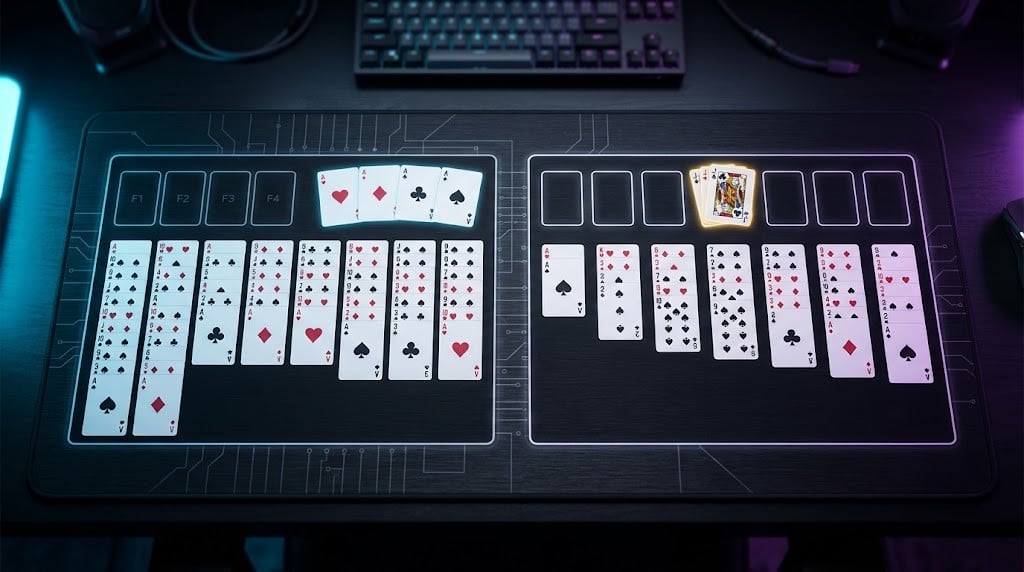
Let me be upfront about something: I have played a lot of solitaire in my life. Not casually – I mean years of it, across every major platform and variant, going back to the Windows 3.1 era when FreeCell shipped baked into the OS and became one of the most-played computer games in history without anyone really noticing. I’ve studied win-rate theory. I’ve read David Parlett’s A History of Card Games. When someone asks me which browser-based solitaire implementations are actually worth your time in 2026, I have opinions.
So when I spent a week seriously playing through freecell io and their penguin solitaire implementations, I wasn’t going in blind. Here’s my full breakdown.
Why These Two Games, Specifically?
If you’ve only ever played Klondike – the classic “draw from a stock, build descending tableau” format – you know maybe 20% of what solitaire actually is. Klondike is the genre’s pop single: accessible, fun, and built largely on luck. Depending on the deal, you can play a statistically perfect game and still lose.
FreeCell and Penguin are different animals entirely. They belong to a category where nearly every deal is winnable if you make the right moves. That shifts the dynamic completely. You’re not fighting the deck – you’re fighting your own logic. For anyone who considers themselves a strategic thinker, a puzzle solver, or just someone who doesn’t like losing to randomness, these are the games that matter.
FreeCell IO: The Strategic Benchmark
Skill ceiling: High Luck factor: Minimal Average session length: 10–25 minutes
FreeCell’s genius is architecture. You play with a standard 52-card deck dealt face-up across eight columns. The goal is to move all cards to four foundation piles, sorted by suit from Ace to King. Simple enough. The twist is four “free cells” – temporary holding spaces where you can park individual cards while you maneuver the tableau.
Those four cells sound generous until you realize they’re the only buffer you have. Every move you make affects every future move. There’s no blind draw from a stock pile, no mystery – all 52 cards are visible from the very first second. That means FreeCell is a pure information game. You can, in theory, calculate an entire winning solution before touching a single card. In practice, that’s brutally hard, and that gap between theoretically solvable and actually executing the solution is where all the fun lives.
The SolitaireX.io Implementation
The freecell io experience on SolitaireX.io is clean in a way that genuinely matters. The interface doesn’t fight you. Cards snap to valid positions without lag, the layout scales correctly across screen sizes (I tested on a 27-inch monitor and a mid-range Android phone – both worked well), and there’s no visual clutter pulling your attention away from the board.
A few specific things I appreciated after extended play:
Unlimited undo. This is huge for learning. FreeCell is a game where you might play 15 moves perfectly and then realize the 16th move, made three turns ago, boxed you in irreversibly. Being able to backtrack without restarting the entire game is the difference between a useful tool and a frustrating dead end. SolitaireX.io gives you unlimited undos with no penalty.
Hints that don’t hold your hand. The hint system shows a valid next move when you’re stuck, but it won’t chain-solve the puzzle for you. It nudges, it doesn’t carry you. That’s the right call.
100% winnable deals. This is the thing that makes or breaks a FreeCell implementation. Classic FreeCell has one infamously unsolvable deal – deal #11982 in Microsoft’s original numbered set – along with a small handful of others. SolitaireX.io filters those out entirely, so when you start a game, you know with certainty that it can be won. Whether you’ll win it is another question.
No intrusive ads. I played over thirty games across multiple sessions. The experience was never interrupted. For a free browser game, that’s notable.
Verdict on FreeCell IO: This is the implementation I’d recommend to anyone coming from desktop FreeCell who wants a browser version that doesn’t feel like a downgrade. The mechanics are faithful, the interface respects your intelligence, and the 100% winnable deal pool means your losses are always instructional. 8.5/10
Penguin Solitaire: The Geek’s Deep Cut
Skill ceiling: Very high Luck factor: Near zero Average session length: 20–40 minutes
Here’s where it gets interesting for the truly initiated.
Penguin Solitaire was designed by David Parlett – one of the foremost authorities on card game history and design – and it shows. The game is a FreeCell variant with some key structural changes that make it simultaneously more forgiving and more demanding.
How It Differs From Classic FreeCell
The deal starts by placing one card from each rank in a row to begin four foundation piles. That starter card – called the “beak card” – defines the rank you build from. If the beak card is a 7, all foundations start at 7, and you build up in suit (7, 8, 9, 10, J, Q, K, then wrap around to A, 2, 3, 4, 5, 6). Wrapping around the rank adds a layer of mental tracking that FreeCell doesn’t require.
The tableau uses seven columns instead of eight, and you get seven free cells instead of four. That expanded buffer seems generous, but the seven-column layout packs the tableau more tightly and the wrap-around sequencing means you’ll misread available moves constantly until you internalize the pattern.
Win rate data puts Penguin at approximately 99% of deals being theoretically winnable – slightly lower than standard FreeCell but still overwhelmingly in the player’s favor. Every loss, once again, is on you.
What Makes the SolitaireX.io Version Worth Playing
The Penguin Solitaire implementation here handles the wrap-around foundation mechanic clearly, which is not trivial to communicate visually. The beak card is highlighted at game start, and the foundation ordering is always visible. Newer players will still need a few games to internalize the rotation logic – that’s inherent to the game design, not a UI failure.
The same clean interface principles from the FreeCell implementation carry over: responsive layout, unlimited undo, and no ads ruining your concentration mid-move. Session resumption worked reliably across my test devices, which matters for a game where you might want to think over a position overnight.
Where Penguin earns its difficulty rating isn’t from complexity of rules but from the density of decision trees. With seven free cells and a rotating foundation, players are managing more simultaneous constraints than classic FreeCell. It’s the kind of puzzle that rewards a systematic approach – geeks who enjoy optimization problems, logic puzzles, or roguelike strategy will find a lot to like here.
Verdict on Penguin Solitaire: A genuinely rare find in the browser solitaire space. Most sites don’t bother implementing Penguin because the average casual player doesn’t know it exists. SolitaireX.io’s version is faithful to the original design, well-executed, and appropriately challenging. If you’ve mastered FreeCell and want the next level, this is it. 8.0/10
Head-to-Head Comparison
|
FreeCell |
Penguin Solitaire |
|
|
Difficulty |
Medium-High |
High |
|
Luck Factor |
Minimal |
Near Zero |
|
Win Rate (theoretical) |
~99.999% |
~99% |
|
Free Cells |
4 |
7 |
|
Foundation Wrap-Around |
No |
Yes |
|
Best For |
Strategic thinkers new to pure FreeCell |
Veterans wanting a design-forward challenge |
Final Thoughts
If you’ve ever found yourself bored with Klondike but unsure where to go next, FreeCell and Penguin Solitaire are the answers. They reward deliberate thinking over luck, they scale with your experience, and they’re the kind of games that you genuinely get better at over time – which is more than most browser games can claim.
SolitaireX.io’s implementations of both are among the cleanest available online. No friction, no ads, no nonsense – just the game, working correctly, on whatever device you’re using.
Reviewed across desktop (Chrome, Firefox) and mobile (Android). All games tested without accounts or paid features.

Amanda Dudley is a lecturer and writer with a Ph.D. in History from Stanford University. After earning her doctorate in 2001, she decided to pursue a fulfilling career in the educational sector. So far, she has made giant strides by working as an essay writer for EssayUSA, where she delivers high-quality academic papers to students who need them.