

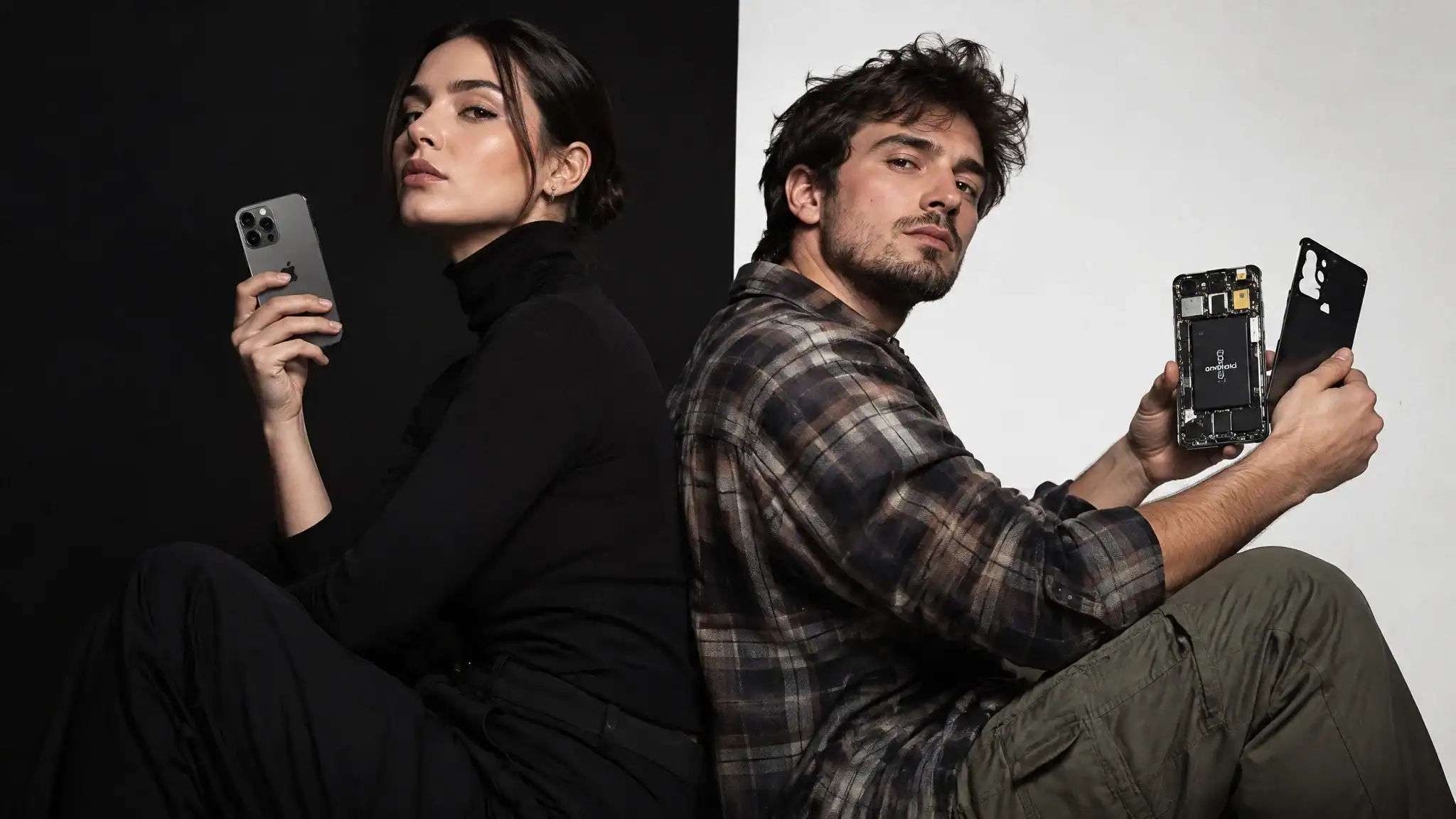
Here at Geek Vibes Nation, we’ve been friends with the geek-culture site GeekExtreme since 2000, and our latest head-to-head debate over geeks and nerds started during a casual chat with them after watching both labels shift in real usage for more than two decades. Both words have been shouted across crowded playgrounds as insults and printed on convention lanyards as badges of honor, leaving people to use them interchangeably and contradictorily.
Even official dictionaries hedge between put-down and compliment, which doesn’t help when you just want to know which camp you belong to without feeling insulted by the answer. Instead of sorting people by hobby lists, you can separate the two cleanly using three defining personality traits, a 2.6-million-tweet language dataset, and a handful of observable everyday habits ranging from convention attendance to smartphone choices and wardrobe.
Key takeaways
- In comedian Don McMillan’s three-trait Venn diagram taxonomy, a nerd combines intelligence, obsession, and social awkwardness, while a geek is smart and obsessed without the social awkwardness.
- Researcher Burr Settles’ co-occurrence analysis of 2.6 million tweets found that geeks act as fans who collect trivia and memorabilia around words like Apple, Linux, and box set, whereas nerds act as practitioners tied to history, mathematics, and neuroscience.
- Survey figures show just over 41% of people are happy being called a geek (almost double the share unoffended by nerd), rising to nearly 66% among people under 30 who view geek as a compliment.
Nerd vs geek vs dork: the trait taxonomy
Nerd, geek, and dork are defined by which combination of three traits a person holds (smart, socially awkward, and obsessed), while dweeb is a common search label with no established trait definition. Popular consensus usually splits geeks and nerds by subject matter, pairing nerds with deep academic, intellectual, or technical mastery like science and math while linking geeks to encyclopedic pop-culture and fandom enthusiasm. According to a Geek Extreme guide, however, “Today, being a “nerd” or “geek” simply means you’re passionate, knowledgeable, and dedicated to your interests.” In his stand-up routines *Geek v.
A nerd is someone who holds all three core traits, smart, socially awkward, and obsessed, often paired with the stereotype of an IQ bigger than body weight and a single-minded focus on a non-social pursuit. In his stand-up routines Geek v. Nerd v. Dork and Geeks vs Nerds vs Engineers, comedian Don McMillan maps these archetypes onto a three-circle Venn diagram: while a nerd requires all three traits, a geek is smart and obsessed while remaining very social, and a dork is smart and socially awkward without any obsession (though dorks can move into the nerd region by becoming obsessed).
The four-quadrant Venn diagram
Social awkwardness, rather than intelligence or passion, is the real dividing axis between a nerd and a geek. Audiences call McMillan the Venn diagram comic, and he also invented the binary high five (101), which he wants to sweep the nation. He built this four-part chart to honor the 190th birthday of John Venn, who was born on August 4, 1834, joking that a Venn diagram of people who are 190 years old and people who are still alive barely overlaps. He even performed the routine on America’s Got Talent, where he believes judge Simon Cowell disliked him because Cowell didn’t understand the Venn diagram joke. In the routine’s fourth quadrant, combining social awkwardness and obsession without intelligence lands on the stalker punchline, prompting McMillan’s warning that it’s a short walk between those four things.
| Archetype | Smart | Socially Awkward | Obsessed |
|---|---|---|---|
| Nerd | Yes (all three traits required) | Yes | Yes |
| Geek | Yes | No (very social) | Yes |
| Dork | Yes | Yes | No (can move to nerd via obsession) |
| Fourth quadrant (stalker joke) | No | Yes | Yes (comedic punchline only) |
Where dork and dweeb fit
Nobody wants to be a dork in McMillan’s chart, because a dork has the intelligence and the social friction without a driving passion to show for it. Still, he jokes that a dork has an easy upgrade path and can move right into the nerd region just by getting obsessed with something. People frequently search for dweeb alongside nerd, geek, and dork, hoping for a fourth circle on the chart, but dweeb has no established definition in any trait taxonomy.
What the dictionary actually says
Dictionary.com defines nerd and geek asymmetrically, giving nerd two numbered definitions and geek three, while attaching an explicit term-of-pride usage note only to geek. Looking past Urban Dictionary to the official entries that describe how we label ourselves every day, the asymmetry stands out immediately. Dictionary.com defines a nerd first as an insult for a stupid, irritating, ineffectual, or unattractive person, and second as an intelligent, single-minded person who is obsessed with a non-social hobby or pursuit, such as a computer nerd. Its geek entry starts similarly, defining the word first as a peculiar or dislikable person, especially someone perceived as overly intellectual.
The second geek definition shifts to a computer expert or enthusiast, adding a crucial boundary: it’s used as a self-reference and a term of pride among insiders, though it’s often considered offensive when used by outsiders. The third geek definition drops tech entirely for a carnival performer who carries out sensational acts like biting the head off a live chicken.
Where the words came from
The word geek has a documented origin in 19th-century circus slang, whereas the two competing origin stories for nerd are both unverified folklore. According to the first piece of nerd folklore, students at MIT spelled the word drunk backward as knurd to describe their sober, studious classmates who skipped parties to study. The second unverified claim argues that nerd began as an acronym for Northern Electric Research and Development, named after the laboratory’s staff. Neither story has ever been proven.
Geek, by contrast, started as a 19th-century term for bizarre freak-show performers in circuses before softening over the decades into the clean-cut pop-culture image of Justin Timberlake in a short-sleeve shirt and braces. Regardless of which nerd legend you prefer, the historical trajectories flipped completely: nerd has always described the dull, boring, and hopelessly conventional square, while geek described the outlandish and bizarre, making today’s mainstream adoption of geek as a casual compliment a total inversion of where it started.
Geeks are fans, nerds are practitioners: the 2.6-million-tweet test
In a statistical analysis of 2.6 million tweets measuring which words co-occur in sentences with geek and nerd, researcher Burr Settles found that geeks are fans who collect trivia and memorabilia at the cutting edge of a subject, whereas nerds are achievement-oriented practitioners who live, breathe, and understand the subject itself. Settles’ data ranked history, mathematics, neuroscience, data, analytics, education, and intellectual on the nerdy side, while Apple, Linux, box set, shiny, and trendy clustered on the geeky side. Both camps shared Star Wars, glasses, and computer, and neither group claimed vegetables, chores, or boobies.
Everyday behavior: conventions, premieres, and staying home
In everyday behavior, geeks show up for their fandoms as a shared social event, whereas nerds engage their interests in private or through solitary commitment. Hand both groups a ticket to a Harry Potter movie premiere and a geek queues for 4 hours, while a nerd camps out overnight dressed as a wizard. At convention time, geeks cosplay and intermingle with other fans at Star Trek and comic book conventions, while nerds avoid the crowds, stay home, and stick to text and email.
Conventions and cosplay
That public-versus-private split runs right through convention season. Geeks attend Star Trek and comic book conventions to cosplay, dress up, and intermingle with thousands of other fans. Nerds skip conventions entirely because there are people there, preferring to stay home and communicate strictly by text and email.
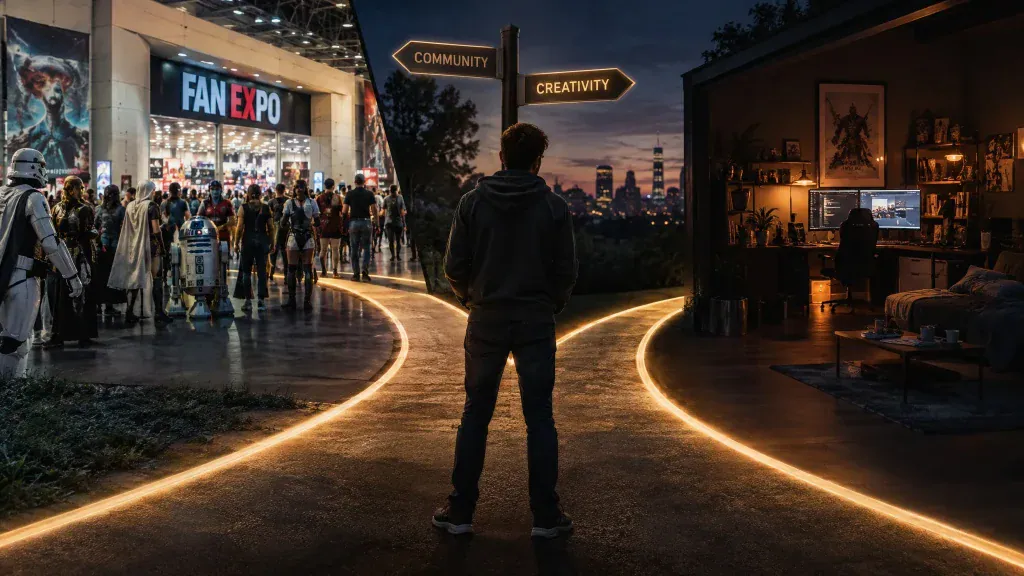
Run your weekend plans and gear through the three filters and the label picks itself.
The queue vs the overnight campout
McMillan’s stand-up comedy extends that social comfort gap into a joke about dating and contraception. Because geeks are out mingling and having sex, he jokes, they use all forms of contraception. Nerds in his routine had one girlfriend until age 25, never expected sex to happen, and relied on the pill, while really big nerds rely on their personality, which he jokes stays 100% effective until that very moment.
Vacations: Hogwarts vs CERN
Even family holidays split along the fan-versus-practitioner line. In McMillan’s family, his wife read Harry Potter to their son and turned him into a geek, and his geek nieces and nephews take vacations to Hogwarts. McMillan, who calls himself a physics nerd, spent his vacation visiting CERN’s super collider in France, adding that engineers just go to work for vacation, even if they still leave at 5:00.
Tech and style habits
In McMillan’s comedy bit satirizing tech and wardrobe habits, geeks buy into polished ecosystems and visible geek chic, while nerds strip hardware down for customization and dress strictly for utility. You can spot the difference across five everyday setups.
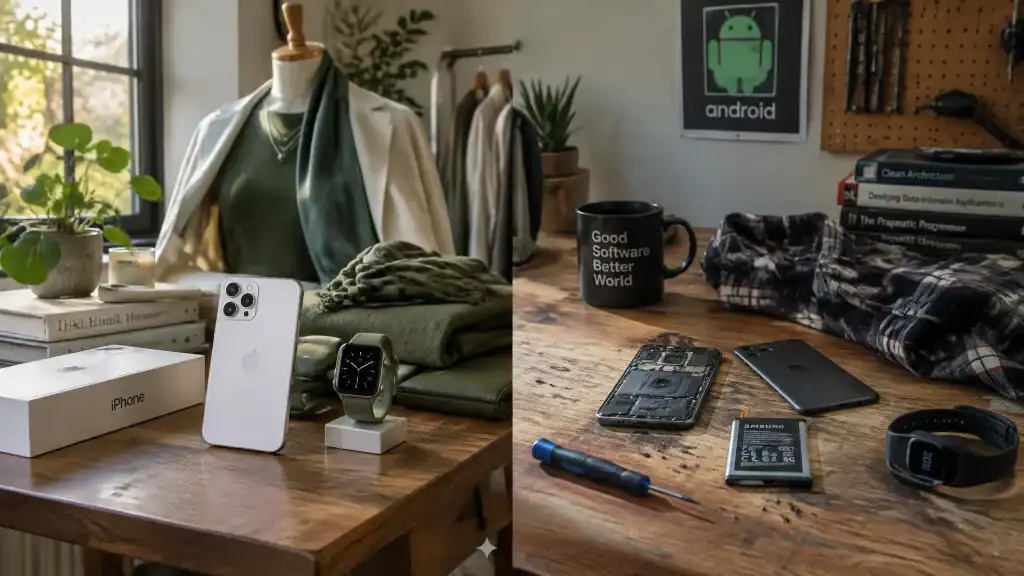
McMillan’s five everyday setups make the labels visible in your pockets, your wrists, and your closet.
Phones: iPhone evangelists vs Android tinkerers
- Geeks: Carry iPhones and act as what McMillan calls the Jehovah’s Witnesses of the 21st century, asking strangers if they’re ready to accept Steven Jobs as their lord and savior. He pairs that evangelism with an Apple Store afterlife joke about AT&T’s spotty coverage: Jobs only has two bars in heaven, because if he got a third bar, he’d be here.
- Nerds: Prefer Android devices so they can rewrite the software and BIOS, swap cards, pop the back cover off, void the warranty, and brag that the phone came with a Kirkland battery. Really big nerds and engineers strap several of both phones to their belts because they think they’re Batman.
Watches, social media, and second languages
- Wearables: Geeks wear an Apple Watch, nerds wear a Fitbit, and really big nerds or engineers (McMillan’s attribution varies between performances) skip fitness routines completely, figuring that if their fingers work, they’re in shape.
- Communication: Geeks post across Facebook, Instagram, and TikTok. Nerds stick to email only, typing the entire message into the subject line, while really big nerds operate like a radio telescope and only want to talk to intelligent life.
- Second languages: Geeks learn Java, nerds learn English so they can talk to humans, and engineers learn Klingon.
Clothes: the turtleneck vs the cargo pants analysis
- Geeks: Dress to stand out in geek chic, modeled on Steve Jobs’ black turtleneck, hats, and sweaters. Their signature color is green, matching Green Lantern, Green Arrow, Green Hornet, and the Hulk.
- Nerds: Stay hopelessly conventional, wanting nothing more than 16 GB of RAM and a Klingon dictionary. They wear any color as long as it’s plaid, which hides spills and doubles as graph paper, while engineers escalate to plaid on plaid. In McMillan’s cargo pants analysis, the lower half of regular trousers is totally useless, whereas cargo pockets let you carry an extra pair of pants inside your pants. He champions cargo shorts in midwinter and cargo underwear with pockets, claims Colorado invented them, jokes that Dell should sell them, and once wore a suit jacket with cargo pants to a wedding as engineering formal.
Engineers: the escalation beyond nerd
Stereotypes within both camps branch into familiar sub-tribes, from comic book and Star Trek geeks to computer and physics nerds, and McMillan’s routine Geeks vs Nerds vs Engineers places engineers at the extreme outer edge of the nerd spectrum. Rather than treating engineering as a separate third peer group, his bit frames an engineer as what happens when you take core nerd traits and dial utility and social avoidance all the way up.
On the escalated engineer tier, fitness trackers disappear completely, communication shrinks to subject-line-only emails, outfits lock into plaid-on-plaid shirts over cargo shorts, Klingon becomes the default second language, and the workday ends promptly at 5:00. Even their pop-culture heroes prioritize pure problem-solving over social banter.
In McMillan’s icon rankings, engineers look up to Star Trek’s Scotty as the original pioneer, MacGyver, and the Alexa voice assistant, whom he praises because she never asks him any questions and calls every prompt a great question. Elon Musk used to hold a spot on that engineer pedestal too, before quickly dropping off the map and prompting McMillan to nominate himself as the replacement.
Pop-culture icons and the rap battle
Media icons split between geek charisma and nerd redemption arcs. In McMillan’s rankings, geek icons project sex appeal and swagger through Captain Kirk (since Star Trek started geekdom), Wonder Woman, and Gabrielle, whereas nerds pick Scooby-Doo’s Velma over Daphne and trace a rocky lineage: Gilligan’s Island’s the Professor (who built a coconut taxi and record player yet couldn’t patch a 6-foot boat hole), Revenge of the Nerds’ Robert Carradine, Urkel (who set nerds back 5 years), and Jim Parsons’ Sheldon (who saved their reputation). Rhett & Link’s comedic viral video Epic Rap Battle: Nerd vs. Geek (which closed with promos for an iTunes download, a tigerdirect.com/rl sweepstakes, and Good Mythical Morning) captures that rivalry as the geek boasts about wearing glasses sincerely and t-shirts ironically as the early 2013 cool form of uncool, trading jabs over kindergarten versus college entrance exams, a retainer wired to a back brace, Renaissance Fair cosplay, dying of boredom after touching dragons, Assassin’s Creed versus Mario Party, an infographic tweet, and knowing what URL means.
Geek pride: the perception shift in numbers
Geek is the more welcome label in public polling: just over 41% of people are happy being called a geek, almost double the share who aren’t offended by being labeled a nerd. Both words have evolved into modern badges of pride, so whether either label feels like a compliment or an insult depends on whether it’s claimed by an insider as a self-reference or thrown by an outsider as a put-down. Among people under 30, almost 66% consider geek a direct compliment, viewing geeks as smarter, more knowledgeable, and operating at the cutting edge of their subjects.
Those figures come from survey stats cited in analytical video commentary without a named polling organization attached, and they reflect how thoroughly geek aesthetics went mainstream. Black-rimmed glasses, Hello Kitty t-shirts, and Hot Topic turned geek into high-street fashion, making people far more eager to call themselves geeks than nerds and spawning color-coordinated pseudo geeks who imitate the look, much like Red Dwarf’s Dwayne Dibi. Still, McMillan points to the world’s four richest men at the time of his routine to argue that being a nerd is cool now, even if billionaire wealth can’t buy hair, style, or vision: Elon Musk (around $28 billion before buying Twitter and 17billionafter,citedasthesecondrichestmanintheworld),JeffBezos(177 billion, who still can’t cure baldness and looks like Willy Wonka), Bill Gates (131billion,whowearsglasseswhenhecouldbuyaLasikmachine),andMarkZuckerberg(108 billion, who still can’t get a good haircut).
Same word or different? The equivalence argument
Nerd and geek act like two different labels in the language data and the trait charts, though a vocal reclamation camp argues they ultimately mean the same thing. While Don McMillan’s Venn diagram separates the two by social awkwardness and Burr Settles’ 2.6-million-tweet study separates them into fans versus practitioners, the host of the channel Answerly (answering viewer Orange hat tweets) contends that the distinction disappears once insiders claim both words as terms of pride.
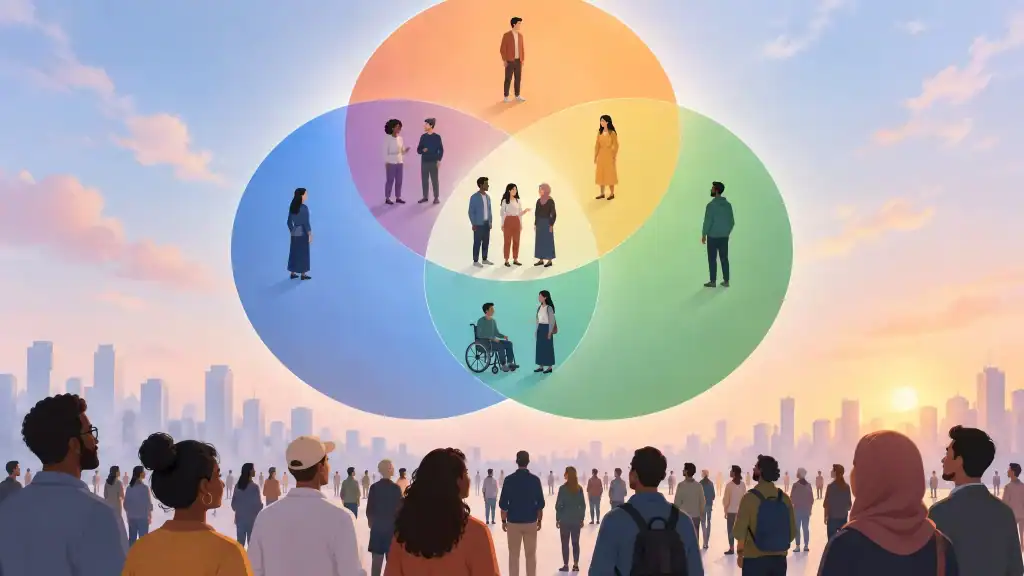
The equivalence camp says the circles collapse once insiders reclaim both words; the data says otherwise.
Both sides of that debate carry real limits. The distinction camp brings clever, concrete structures to the table, pairing a stand-up comedian’s behavioral observations with a massive Twitter word-co-occurrence model, yet neither one is actual sociology. The equivalence camp captures how the words feel when outsiders use them interchangeably as playground put-downs, arguing that reclaiming them (“these words are ours”) strips away the sting. Even so, treating the labels as identical ignores why mainstream fashion eagerly adopted geek chic while leaving nerd behind.
So which one are you?
You can sort yourself as a geek or a nerd with three quick tests: the three-trait Venn count, the fans-versus-practitioners check, and an everyday device-and-social habit audit, while the opposite of a nerd is someone who sits outside all three circles as socially comfortable and unobsessed. If you want to locate yourself without relying on a rigid hobby list, run your daily habits through all three filters in order:
- Count your traits: On McMillan’s Venn diagram, being smart, obsessed, and socially comfortable makes you a geek; adding social awkwardness makes you a nerd; dropping the obsession leaves you a dork; and sitting outside the traits entirely as a socially comfortable non-obsessive makes you the exact opposite of a nerd.
- Check how you engage: Using Settles’ tweet benchmark, ask whether you engage your favorite subject publicly as a fan who collects box sets, trivia, and memorabilia, or privately as an achievement-oriented practitioner focused on data, mathematics, and how the system works.
- Audit your gear and weekend plans: Check whether you queue 4 hours for a premiere in a black turtleneck with an iPhone, an Apple Watch, and active TikTok and Instagram feeds, or camp overnight in wizard robes with a warranty-voided Android running a Kirkland battery, a Fitbit, plaid and cargo pants, and subject-line-only emails.
The three-question self-sort
Anyone can buy black-rimmed glasses and a Hello Kitty shirt at Hot Topic to fake being a geek for an afternoon. By the analytical commentary’s standard, you can’t fake being an authentic nerd: it requires an IQ bigger than your body weight, single-minded passion and commitment to a pursuit, and a genuine refusal to care about societal rules for fitting in with peers. And if you were hoping to dodge both labels by calling yourself a dweeb, that fourth search term still sits outside every available trait chart without a definition.
Why self-labels drift
Watch people sort themselves in the wild and a funny pattern emerges: people routinely claim the label they prefer while describing daily habits that belong to the other camp. A self-described nerd will spend every weekend organizing group cosplay meetups on Instagram, while a self-proclaimed geek will stay home flashing custom BIOS firmware onto an Android phone to avoid a crowded room. Having watched these words collide, invert, and drift across our friendship with GeekExtreme since 2000 here at Geek Vibes Nation, we’ve learned that the debate refuses to stay settled for one simple reason: self-labels track which badge people aspire to wear at the moment far more closely than how they actually behave.
Frequently Asked Questions
What is the difference between a nerd and a dork?
Obsession is the only separator between the two. Both nerds and dorks share high intelligence and social awkwardness, but a dork lacks a driving passion to focus that brainpower. As Don McMillan points out in his stand-up taxonomy, a dork has an easy upgrade path and can cross straight into nerd territory just by getting deeply obsessed with a subject.
What does geek mean vs nerd in the dictionary?
Dictionary.com treats the two words unevenly, giving nerd two definitions and geek three while explicitly noting insider pride only under geek. Both entries open with insults, framing a nerd as a stupid, irritating, or unattractive person and a geek as a peculiar, overly intellectual person, before shifting to technical or hobbyist descriptions. However, the second definition of geek highlights its use as a badge of pride among computer enthusiasts (even if offensive from outsiders), and its third definition reaches back to 19th-century circus performers who bit the heads off live chickens.
Is it better to be a geek or a nerd?
In public perception polling, geek wins easily: just over 41% of people are happy to be called a geek, nearly double the share who aren’t offended by nerd, and almost 66% of people under 30 view geek as a straight compliment. Mainstream fashion embraced geek chic, turning the label into an aspirational badge associated with being smart and trendy. Still, Don McMillan argues that nerds have plenty of clout too, pointing out that billionaire tech titans like Jeff Bezos, Bill Gates, Mark Zuckerberg, and Elon Musk made being a nerd cool on a massive financial scale.
Are geek and nerd the same thing or actually different?
It depends on whether you look at behavioral data or cultural reclamation. Language models like Burr Settles’ 2.6-million-tweet study and trait frameworks clearly separate geeks into socially engaged fans and nerds into solitary, technical practitioners. However, the equivalence camp, including the GeekExtreme guide and the host of Answerly, argues that once insiders reclaim both former playground insults as badges of honor, both words simply describe someone who is passionate, knowledgeable, and dedicated to their interests.

Amanda Lancaster is a PR manager who works with 1resumewritingservice. She is also known as a content creator. Amanda has been providing resume writing services since 2014.