

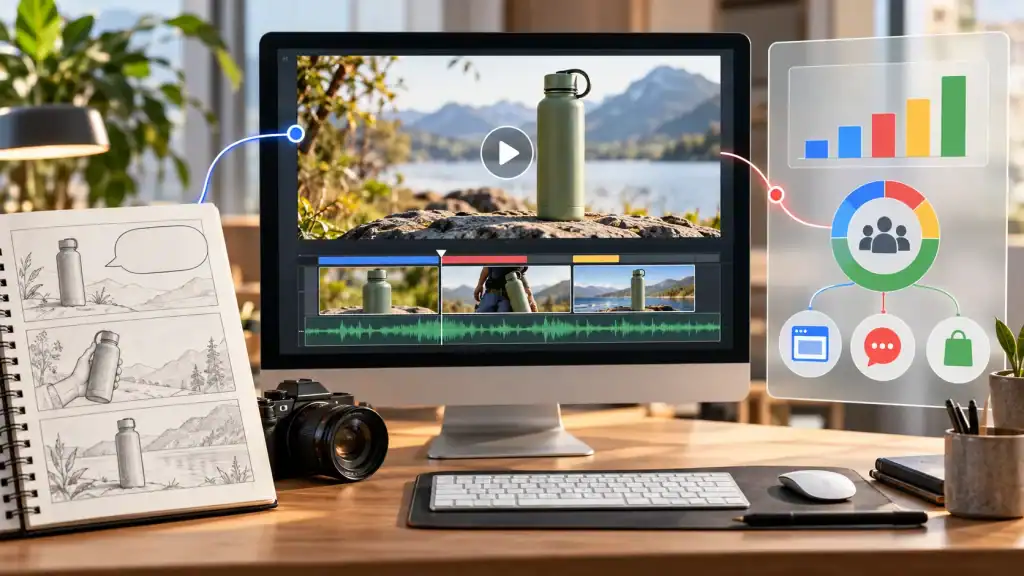
A video can earn attention and still leave viewers unsure what to do next. Someone might enjoy a demonstration, remember a joke or watch a customer story without understanding the offer. For a business paying to distribute that video, the planning question is specific: what should this person understand or do after seeing it?
Google Ads provides several ways to put video in front of an audience. Choosing a campaign is only part of the work. The message, destination page and measurement plan need to support the same objective. A practical approach connects those decisions before production consumes the budget.
Choose an outcome before writing the script
Write a short statement describing the audience, the offer and the intended outcome. For example, an equipment supplier might want maintenance managers to request a demonstration of a particular machine. That brief gives the writer a person to address and a reason for the video to exist.
Distinguish a business outcome from an advertising metric. A video view shows a form of interaction with an ad; it does not establish that the viewer is a suitable prospect. If the aim is lead generation, define what a useful inquiry looks like. If the aim is awareness, decide which delivery and attention measures will help you assess it.
For broader context on placing video within a digital strategy, My Digital Marketing Help’s discussion is a relevant starting point for planning video marketing using google ads alongside other content. Use that wider perspective to decide which question paid video should answer, rather than expecting one advertisement to explain the whole business.
Match the campaign to its intended job
Google distinguishes among campaign approaches for different goals. Video View campaigns focus on generating views, while Video Reach campaigns address reach objectives. Demand Gen is an option for advertisers pursuing action across Google’s visual environments. Select the approach that fits the brief, then examine its available settings and reporting.
Older tutorials need particular care. Google has replaced Video Action campaigns with Demand Gen, so instructions that tell an advertiser to create a new Video Action campaign are outdated. Check current documentation and the options in the account before treating a sequence of screenshots as a reliable setup guide.
A campaign type does not remove the need to make editorial choices. A prospect who has never encountered the business may need a clear explanation of the problem. Someone comparing suppliers may need a demonstration or an answer to a specific concern. Draft for that situation instead of giving every audience the same introduction.
Give the opening a concrete purpose
Begin with something the intended viewer can recognize: a task, a problem or a result worth investigating. An equipment video might show the maintenance step it simplifies before introducing the company’s history. Write the opening so that a viewer can understand why the subject matters without waiting through a long preamble.
Google’s guidance on effective video ads groups creative decisions under attention, branding, connection and direction. That offers a useful review structure. Does the opening make sense quickly? Can viewers identify the business? Does the example relate to their situation? Is the requested next step clear?
Keep proof close to the claim it supports. Show the relevant feature when discussing how something works. If a customer describes a benefit, give enough context to understand the experience without presenting it as a promise for everyone. Remove lines that repeat the same idea without adding an example or useful detail.
Prepare for the actual viewing environment
Google’s video formats include in-stream placements, in-feed placements and ads within the Shorts experience. These settings involve different ways of encountering a message. Review Google’s current video ad format guidance before deciding which versions to produce and how the assets will be used.
Preview each version rather than assuming that a single edit will work everywhere. Check whether a product remains visible, text is readable and the framing preserves the action. Watch with sound, then check whether captions and on-screen information still communicate the essential point when audio is unavailable.
Build a production brief around the versions you actually need. Record alternate openings and leave room in the composition for different crops. Keep captions away from important visual details. These choices are easier to address during production than after a finished shot has become the only available option.
Make the landing page continue the conversation
If the advertisement invites a demonstration request, send viewers to a page that explains that demonstration and provides a clear way to request it. A general homepage can make the visitor search again for the offer. Compare the spoken promise with the destination headline and ask whether they describe the same next step.
Review the page on a phone as well as a desktop. Read the form labels, submit a test inquiry and check the confirmation. Decide who will receive new inquiries and how they will respond. An advertising test becomes difficult to interpret when the destination is confusing or the follow-up process is uncertain.
Plan a test that answers a useful question
Choose a question narrow enough to investigate. You might compare two openings that explain the same offer differently, while keeping the rest of the message consistent. Write down the reason for the comparison and the evidence that would make one version more useful. Avoid treating a collection of unrelated edits as a single creative test.
A compact launch checklist helps keep the brief and implementation connected:
- State the intended audience, offer and primary outcome in one short brief.
- Check that the campaign approach and geographic settings match the plan.
- Preview every video version and confirm that the destination URL is correct.
- Test the inquiry or purchase path and verify that the intended event is recorded.
- Set a budget boundary, a review date and a clear owner for follow-up.
Choose a spending level the business can justify as a learning exercise. There is no universal budget that guarantees a useful result. Consider how quickly the audience makes decisions and how much evidence the test could realistically collect before interpreting a small number of inquiries.
Read conversion reports with their definitions attached
Google Ads can attribute conversions after different kinds of ad interactions. Engaged-view conversions, for example, can be recorded when someone watches a qualifying portion of an ad and later converts within the applicable window without first clicking the video. That is different from a conversion following an ad click.
Keep those definitions visible during reporting. Check which events count toward the campaign’s goal and which attribution windows apply. A reported conversion is an attributed event under the selected measurement rules. It does not by itself prove that the advertisement caused an additional sale.
For lead generation, compare advertising reports with inquiry quality and subsequent outcomes. Record whether contacts were relevant, reachable and interested in the advertised service. If views look strong but useful inquiries remain scarce, review the offer and destination before assuming that more distribution will resolve the problem.
Use the findings to improve the next message
Finish the review with a decision tied to evidence: keep the clearer opening, revise the offer explanation or repair a weak point in the inquiry path. Preserve what was tested and what changed so the next round has a useful starting point.
A workable Google Ads video plan connects an audience question to a clear message, an appropriate campaign and a measurable next step. Production quality helps communicate that plan, but it cannot supply a missing purpose. Start with the intended outcome, make the promise easy to understand and judge results in the context of the business receiving them.

Caroline is doing her graduation in IT from the University of South California but keens to work as a freelance blogger. She loves to write on the latest information about IoT, technology, and business. She has innovative ideas and shares her experience with her readers.