

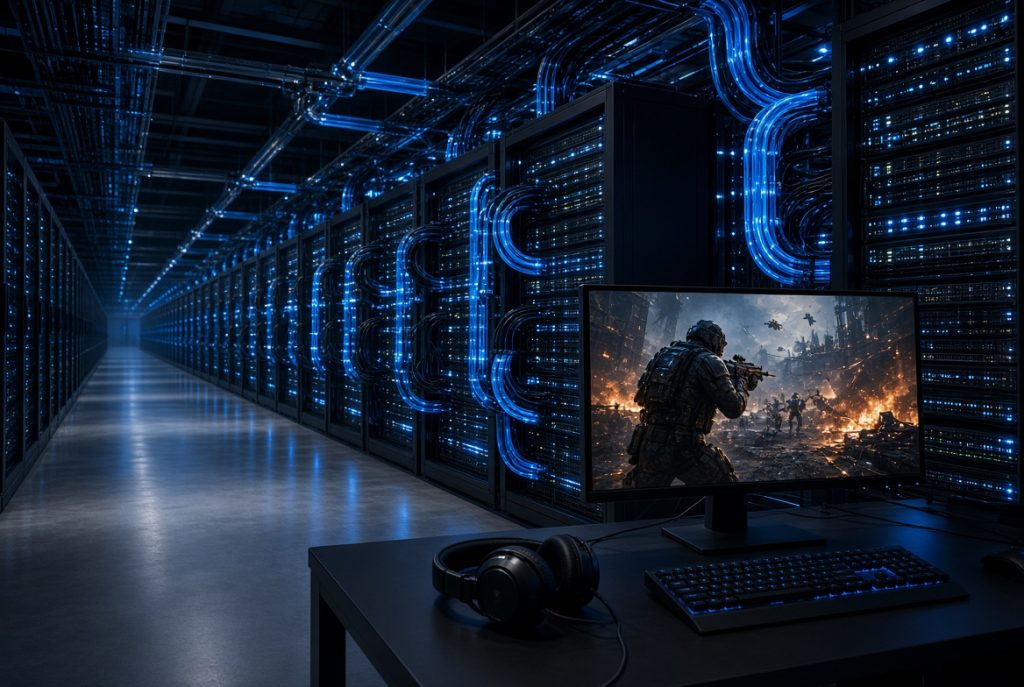
Every time you queue up for ranked, stream a raid boss kill, or watch your favorite esports team clinch a championship, there’s a data center somewhere working overtime. We obsess over frame rates, patch notes, and meta shifts. Nobody talks about the humming rooms full of servers that make any of it possible in the first place.
That’s a shame, honestly, because the infrastructure behind gaming is its own kind of geeky rabbit hole. The same instincts that make you want to know how a game engine renders lighting should make you curious about how the physical machines survive. Turns out, keeping a server room alive is a battle against invisible forces most players never think about.
Why Data Center Reliability Matters More Than Ever
Cloud gaming isn’t a novelty anymore. Services like Xbox Cloud Gaming, GeForce Now, and Amazon Luna depend entirely on remote servers doing the heavy lifting your console or PC used to handle. Esports tournaments stream to millions in real time, with zero room for a server hiccup mid-match.
That shift means data centers can’t just be powerful. They have to be stable, every hour of every day, in ways that go beyond processing speed. A single environmental failure can take down the exact infrastructure an entire tournament, MMO, or live-service game depends on.
What’s Actually Threatening the Hardware
Here’s the part most gamers never consider: the biggest threats to a data center aren’t hackers or bad code. They’re humidity swings.
Air that’s too dry builds up static electricity fast. Air that’s too wet invites corrosion. Both extremes are quietly dangerous, and both are entirely about the physical environment around the servers, not anything happening in software.
The Static Electricity Problem
When humidity drops too low, electrostatic discharge becomes a real risk. A tiny static spark, the kind you’d barely notice on a doorknob, can fry sensitive server components in an instant. Motherboards, RAM, network cards. Gone.
That’s a nightmare for any facility running thousands of servers around the clock. One discharge event can knock a rack offline, and depending on the setup, that rack might be handling matchmaking for an entire game region. Suddenly your queue times make a lot more sense.
The Corrosion Problem
Too much humidity swings the danger the other direction. Moisture in the air can lead to condensation, corrosion, and slow degradation of the same equipment ESD threatens from the dry side. It’s a narrow window facilities have to hit, and hitting it consistently is harder than it sounds.
This is why precision matters so much in these environments. Engineered systems designed for industrial spaces are built to hold humidity within a tight, controlled range rather than just roughly in the ballpark. A properly specified server room humidifier is one piece of that puzzle, helping facilities avoid both the static-discharge risk of dry air and the corrosion risk of overly wet conditions.
What This Means for Gamers and Streamers
None of this is abstract for anyone who plays online or streams for a living. Every dropped connection, every unexpected server maintenance window, every “servers are currently unstable” tweet traces back to physical infrastructure somewhere. Environmental failures are part of that picture, even if they rarely make headlines.
For streamers and content creators specifically, uptime is the whole business model. A platform outage during a big tournament or a viral moment costs more than just embarrassment. It costs revenue and momentum that don’t come back easily.
Understanding this stuff doesn’t make you a sysadmin overnight. But it does make you a sharper observer of why some platforms feel rock solid while others seem to buckle under pressure during peak events.
How Facilities Choose the Right Environmental Setup
Data center operators don’t pick environmental systems at random. They look at server density, airflow patterns, and regional climate before settling on a humidity control approach. A facility in a dry desert climate faces very different baseline conditions than one in a humid coastal city.
Precision also matters more than raw output. A system that swings humidity wildly between too dry and too wet can be worse than no control at all, since it stresses hardware in both directions over time. The goal is steady, consistent conditions that don’t wet surfaces or leave standing moisture anywhere near the equipment.
Scalability matters too. A system built for a single server closet won’t hold up in a facility running thousands of racks. Operators generally look for solutions engineered specifically for industrial-scale deployment rather than adapted from consumer-grade equipment never meant for that kind of load.
Final Thoughts
As gaming keeps shifting toward cloud-based and always-online models, the physical infrastructure behind it matters more, not less. The next time your favorite game handles a massive concurrent player spike without breaking a sweat, some credit belongs to the unglamorous environmental engineering happening in a server room nobody sees. That invisible layer of reliability is quietly becoming as important to the gaming experience as the code itself.

Caroline is doing her graduation in IT from the University of South California but keens to work as a freelance blogger. She loves to write on the latest information about IoT, technology, and business. She has innovative ideas and shares her experience with her readers.