Introduction
In the high-stakes world of automotive manufacturing, engineers are under immense pressure to reconcile two often conflicting goals: relentless cost reduction and uncompromising part consistency. A minor design flaw or material deviation in a high-volume stamping project can cascade into massive scrap, production line stoppages, and costly die rework, jeopardizing both budget and launch timelines.
The root cause frequently lies in siloed decision-making during the project’s critical early phases. Material selection is often based on handbook data rather than real-world stamping performance, and die design may overlook long-term wear impacts. This article provides a systematic framework — spanning materials science, die engineering, quality systems, and total lifecycle cost — to help slash costs by 15% or more while ensuring zero-defect production.
How Can Automotive Engineers Scientifically Select Stamping Steels for High-Load Components Based on Authoritative Standards?
Selecting the right material is the foundational decision that dictates the success of a stamped automotive part. Beyond basic mild steel, the industry leverages High-Strength Low-Alloy (HSLA) and Advanced High-Strength Steels (AHSS) to achieve the critical balance of lightweighting, safety, and durability required for chassis and structural components.
l Moving Beyond Yield Strength: A Holistic Property Evaluation: A common pitfall is selecting materials based solely on yield strength. A truly scientific approach must evaluate a holistic property matrix. Formability determines how the material will behave in the die without cracking, while weldability and fatigue performance are critical for the part’s performance in the assembled vehicle. Engineers must model the entire forming process to ensure the chosen grade can achieve the desired geometry without failure.
l The Critical Role of Standardization and SAE J404: To ensure batch-to-batch consistency across millions of parts, adherence to standardized material specifications is non-negotiable. Standards like SAE J404 provide the definitive framework for the chemical composition of alloy steels. Sourcing materials that strictly comply with such standards guarantees material traceability and predictable mechanical properties, forming the bedrock of reliable high-volume car part stamping.
l The Cost of Inconsistency in Material Selection: Deviating from standardized, well-understood materials for marginal initial cost savings carries significant hidden risk. Inconsistent material grain structure or fluctuating mechanical properties from non-standard grades can lead to unpredictable springback, increased scrap rates, and accelerated die wear. Investing in the right, standardized material from the start prevents exponentially higher costs during production.
Progressive Die vs. Transfer Die: Which Design Philosophy Best Optimizes Efficiency and Consistency for Million-Unit Runs?
The choice between a progressive die and a transfer die is a strategic decision that defines the manufacturing efficiency of a high-volume stamping service. Each system offers distinct advantages tailored to part complexity, throughput requirements, and long-term consistency goals, directly impacting the per-part cost equation.
1. Progressive Die: The Champion of Speed for Simpler Geometries
A progressive die is the engine of ultra-high-volume production for parts with relatively simpler, flatter geometries. The strip metal feeds through a single die with multiple stations, performing a different operation at each step until a finished part is severed. This continuous process enables extraordinary production speeds and is ideal for components like brackets, clips, and electrical contacts where cycle time minimization is paramount.
2. Transfer Die: Mastering Complexity for Deep-Drawn Parts
For complex, deep-drawn components like transmission oil pans or structural cross-members, a transfer die system is superior. Here, a mechanical system lifts and transfers the part between separate, standalone dies. This allows for more complex forming sequences, better material flow control, and access to all sides of the part. While slightly slower, it provides the geometric freedom needed for challenging parts that a progressive die cannot form.
3. Engineering Die Longevity for Per-Part Cost Reduction
The true cost advantage in stamping die design comes from maximizing tool life. Utilizing carbide inserts for high-wear areas, implementing precision guiding systems, and applying advanced surface coatings like PVD (Physical Vapor Deposition) can increase die life by 30% or more. This upfront investment dramatically reduces the per-part tooling cost amortized over a multi-million-unit production run, making it a key lever for long-term stamping cost analysis.
Why is IATF 16949 Certification the Gold Standard for Evaluating a Stamping Supplier’s Quality System?
For an automotive stamping supplier, IATF 16949 is far more than a certificate on the wall; it is the operational blueprint for preventive quality management. This framework mandates a systematic, data-driven approach to eliminate variation and prevent defects before they occur, which is the only way to guarantee consistency from the first prototype to the millionth production part.
1. The Pillars of Prevention: APQP, PPAP, and FMEA
IATF 16949 is built on core preventive tools. Advanced Product Quality Planning (APQP) structures the entire development process from design to launch. The Production Part Approval Process (PPAP) provides documented evidence that the production process can consistently make parts that meet all requirements. Failure Mode and Effects Analysis (FMEA) proactively identifies and mitigates potential failure risks in both design and process.
2. Statistical Process Control (SPC) as the Real-Time Nerve Center
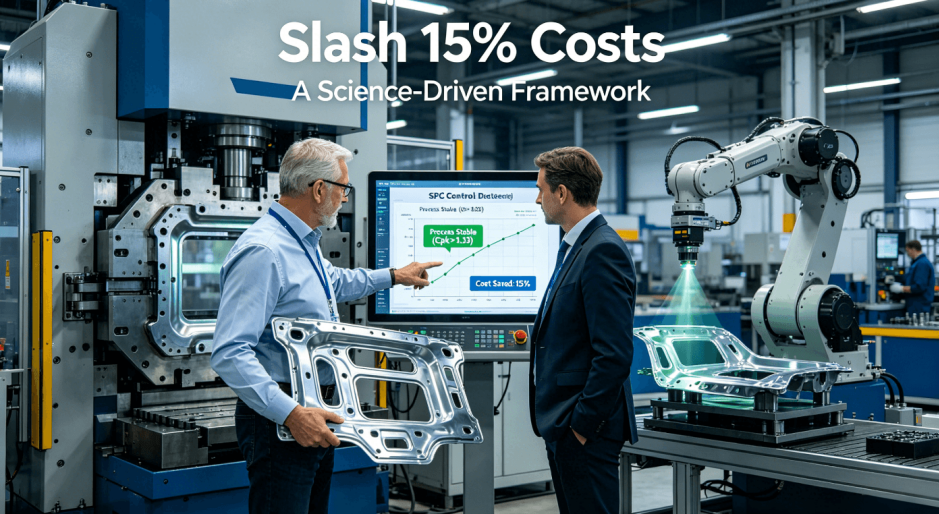
A certified supplier implements Statistical Process Control (SPC) not as an afterthought, but as a real-time monitoring system. Critical process parameters — like press tonnage, feed length, and punch depth — are continuously measured and plotted on control charts. This allows for immediate correction of any process drift long before it results in non-conforming parts, ensuring dimensional stability is maintained 24/7.
3. Beyond IATF 16949: The Assurance of Multi-Industry Certification
While IATF 16949 is the automotive mandate, the most capable suppliers often hold complementary certifications like AS9100D for aerospace and ISO 13485 for medical devices. This multi-standard compliance demonstrates a foundational quality culture that transcends any single industry checklist, offering OEMs a fundamentally de-risked partnership for their most critical precision auto stamping service needs.
What Are the Most Commonly Underestimated “Hidden Costs” in a Stamping Project Budget?
A savvy stamping cost analysis looks beyond the obvious line items of “tooling cost” and “material cost per kilogram.” True cost optimization requires a deep dive into often-overlooked factors that silently erode profitability over a high-volume production run, from ongoing tool maintenance to the true price of material waste.
1. The True Cost of Tooling: Maintenance and Downtime
The initial die cost is just the entry fee. The significant, ongoing expenses are preventive maintenance, spare part inventories, and unplanned downtime for repairs. A robust, data-driven predictive maintenance program based on stroke counts and wear monitoring is essential to schedule maintenance during planned pauses, avoiding catastrophic failure and costly production stoppages.
2. The Silent Drain: Scrap Cost from Poor Material Utilization
Material is often the single largest cost driver. A suboptimal strip layout design can waste 5-15% of expensive coil stock as scrap. Value Engineering collaboration with the stamping partner during the Design for Manufacturability (DFM) phase is critical to nest parts more efficiently, potentially saving hundreds of thousands of dollars over the project’s lifecycle. This is a core consideration for any automotive metal stamping services provider focused on true partnership.
3. The Ripple Effects of Inconsistency: Inspection and Supply Chain Risk
Inconsistent part quality creates a cascade of hidden costs. It necessitates 100% inspection and sorting, increases rework labor, and leads to line-side inventory buffers to hedge against quality issues. At worst, it can cause a supply chain disruption, halting an assembly line with penalties measured in tens of thousands of dollars per minute. Investing in a supplier with a robust quality system is ultimately the cheapest insurance against these risks.
How Can Finite Element Analysis (FEA) Simulation Predict and Solve Cracking and Wrinkling Before Die Manufacturing?
Modern stamping defect prevention is increasingly digital. Advanced Finite Element Analysis (FEA) software like AutoForm simulates the complex physics of metal forming, allowing engineers to digitally prototype the stamping process, identify potential failures, and optimize parameters long before a single piece of tool steel is cut.
1. Simulating Material Flow and Failure Modes in a Virtual Environment
FEA software creates a digital twin of the forming process. It models how the metal blank flows into the die, predicting areas of excessive thinning that could lead to splits, and zones of compressive stress that cause wrinkles. By visualizing these potential stamping defects in advance, engineers can modify part geometry, blank shape, or draw bead configuration to ensure a safe, robust forming window.
2. The Critical Battle Against Springback
One of the most costly challenges in precision auto stamping service is springback — the elastic recovery of the metal after forming, which distorts the final part shape. FEA accurately predicts the magnitude and direction of springback. This allows engineers to proactively “over-bend” the tooling geometry in the digital model, so the part springs back to the perfect net shape, eliminating costly manual die tryouts and rework.
3. Quantifying the ROI: Fewer Tryouts and Faster Time-to-Market
The return on investment for FEA simulation is substantial. By resolving 80-90% of potential forming issues digitally, the number of physical die tryouts can be reduced by 50% or more. This slashes development time, conserves expensive tool steel, and gets a production-ready die to the press line faster. This digital validation is a cornerstone of modern, efficient prototype to production stamping.
What Critical Technical and Management Gaps Must Be Bridged from Prototype Validation to Stable Mass Production?
The journey from a successful prototype to stable, high-volume stamping service production is fraught with challenges. It requires a disciplined shift from a project-based, engineering-focused mindset to a process-oriented, operations-driven system capable of relentless repetition and statistical control.
1. Process Freezing and Standardization: The successful parameters from prototyping — lubricant type, press speed, binder force — must be rigorously documented and frozen into standardized work instructions. This “recipe” becomes the bible for production, ensuring every operator and every shift produces identical parts. Any deviation requires a formal engineering change process to maintain control.
2. Scaling Supply Chain and Secondary Operations: A prototype may use hand-loaded blanks, but volume production requires a reliable, high-speed coil feed line. Scaling also impacts secondary operations like welding, cleaning, and plating. The entire supply chain for these processes must be validated and scaled in parallel. Failure to coordinate this can create a bottleneck that halts a fully validated stamping line.
3. The Handoff: From Lab Validation to In-Line SPC: Quality control must evolve from lab-based, sample-based checking of first articles to a real-time, in-line system. This means deploying automated vision systems for 100% surface inspection and integrating SPC stations directly into the production line to monitor critical dimensions on every Nth part. This transition is where a partner with deep custom stamped metal manufacturing experience proves invaluable, ensuring a seamless scale-up.
Conclusion
Achieving the dual victory of significant cost reduction and flawless part consistency in high-volume automotive stamping is a multidimensional challenge. It demands moving beyond isolated decisions to embrace a synergistic approach that integrates materials science, precision die engineering, and a systemic quality culture from the very first design review. Partnering with a manufacturer that embodies this integrated philosophy, backed by rigorous certifications and deep technical expertise, is the definitive strategy to transform theoretical cost savings into a sustainable, competitive market advantage.
FAQs
Q1: For new energy vehicle battery pack stampings, which material properties should be prioritized?
A: Beyond high strength and lightweighting, electrical conductivity and corrosion resistance are paramount. Aluminum alloys (e.g., 6000 series) are common for their favorable strength-to-weight ratio and conductivity. However, their different formability requires careful die design and lubrication. Compatibility with battery chemistry to prevent galvanic corrosion is also critical, guided by relevant SAE and OEM standards.
Q2: How to assess if a stamping supplier can truly handle million-unit volume challenges?
A: Look beyond their machine list. Audit their die maintenance schedules, real-time SPC monitoring capabilities, and SMED (Single-Minute Exchange of Die) performance. Scrutinize their IATF 16949 implementation, especially APQP/PPAP documentation. A capable supplier’s shop floor will exhibit excellent 5S organization and low work-in-process inventory, signaling a lean, responsive production system.
Q3: For Class A exterior panels with strict cosmetic requirements, what are the key stamping process control points?
A: Control focuses on eliminating surface defects (slip lines, orange peel) and springback. This requires ultra-precise, mirror-polished dies, stringent blank cleanliness, and optimized press parameters (slide parallelism, cushion pressure). Often, a secondary finishing or restrike station is needed. Production should occur in a cleanroom-like environment with 100% automated optical surface scanning.
Q4: What should be considered in the design phase for stampings requiring subsequent welding or painting?
A: Early manufacturing collaboration is key. Design appropriate flanges and contact surfaces for welding; avoid stress-concentrating sharp corners in weld zones. For painting, ensure design allows for proper electrophoretic coating penetration, avoiding enclosed cavities. Material selection must consider its suitability for phosphating and e-coating processes, which is best validated through early supplier DFM analysis.
Q5: What strategies can mitigate material cost volatility risks in stamping projects?
A: First, maximize material yield through expert DFM and nesting optimization. Second, establish long-term price agreements with material suppliers. Third, evaluate alternative material grades or gauges. Fourth, invest in die technology to enable the use of thinner or lower-cost materials. Finally, consider strategic inventory buffers to smooth short-term price fluctuations.

Robert Griffith is a content and essay writer. He is collaborating with local magazines and newspapers. Robert is interested in topics such as marketing and history.