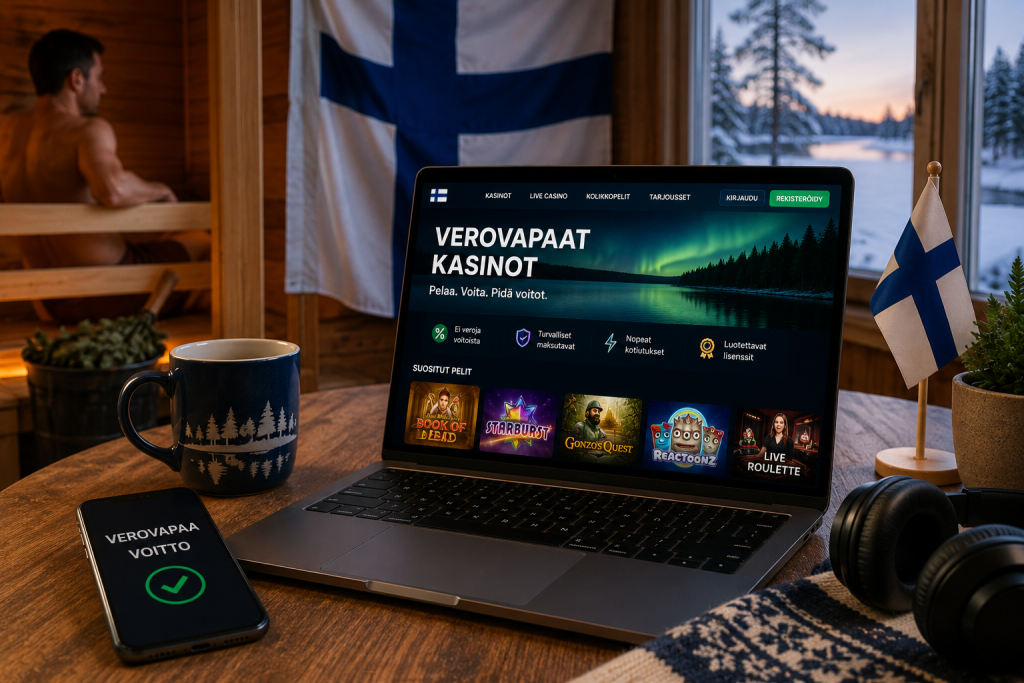
Every few years a niche word escapes its corner of the internet and turns into everyday Finnish slang. It happened with streaming, it happened with crypto, and over the last couple of years it has quietly happened with “verovapaat kasinot,” the Finnish phrase for tax-free online casinos. Search interest climbs, forum threads multiply, and suddenly a phrase that used to belong to accountants and gambling-law hobbyists is showing up in ordinary conversations about weekend plans and payday routines.
What makes this interesting is not the gambling itself, which is old news, but the shape of the trend. Finland has spent decades with a single state operator, and the pull toward EU-licensed alternatives has moved with the rhythm of a genuine cultural migration rather than a marketing push. Finnish affiliate guides such as Kasinoilmanveroja, which catalogs these EU and EEA licensed sites under the plain-spoken banner of kasinoilmanveroja, have played the role that fan wikis once played for television, turning a dry tax technicality into a shared vocabulary that regular players actually use.
This piece is a trend story, not a how-to and not a legal brief. The aim is to explain why the tax-free casino conversation caught fire among Finnish players right now, what real mechanics sit underneath the hype, and where the whole thing seems to be heading as Finland rewrites its gambling rulebook. Anyone playing does so at their own risk, real-money play is 18 and over, and none of what follows is advice to gamble.
The word that outgrew its niche
For a long time, “verovapaat kasinot” was a technical label used by a small circle of players who read gambling forums the way collectors read grading guides. The idea was simple but easy to get wrong: winnings from a casino licensed inside the EU or EEA are treated as tax-free income for a Finnish resident, because the operator has already paid gaming tax in its home jurisdiction under the logic of Finland’s income tax law. Winnings from an operator licensed outside that zone, a Curacao site for example, can land on the player as taxable income.
That distinction used to be inside baseball. What changed is the audience. As more Finns grew comfortable running their financial lives from a phone, the tax angle stopped being a footnote and became a headline feature. “Tax-free” is a phrase that needs no explanation to anyone who has ever filed a return, and once affiliate sites started leading with it, the term did what good pop-culture shorthand always does. It gave a large, loose group of people a single word for something they were all circling anyway.
Why the timing lined up
Trends need a trigger, and this one had a big one. Finland is in the middle of rewriting how gambling works. The government proposal known as HE 16/2025 sets up a licensing system that would open online casino and betting to private operators, moving the country away from the long-running monopoly held by Veikkaus. Under the proposed timetable, licence handling runs through 2026 and the competitive market is expected to open around the start of 2027, though the exact rollout is still settling and no single launch day should be treated as a fixed promise.
That backdrop reframed the entire conversation. When a national system is visibly about to change, people start paying attention to the version of the change that already exists in practice. EU-licensed casinos were the preview reel: they showed Finnish players what a competitive, choice-heavy market feels like before the domestic reform formally arrives. The reform gave the trend a why-now, and the why-now gave the phrase its cultural lift.
What “tax-free” actually means, minus the myth
The single most misread part of this whole story is the word “free.” Tax-free does not mean the operator pays no tax, and it does not mean the activity floats outside the rules. It means the tax is settled upstream, in the licensing country, so it never reaches the Finnish player as personal income. The consumer-facing benefit is real, but it is a consequence of where the licence sits, not a magic exemption.
That is why the licence badge matters more than any promotional banner. A Malta Gaming Authority licence, for instance, places an operator inside the EU regulatory zone, which is what makes winnings tax-free for a Finnish resident, and it also signals EU-level consumer protections such as segregated player funds, a formal dispute process, and tested random number generation. It is not a Finnish licence and it does not lift the operator out of Finnish law. Finnish players who understand this one point tend to make far calmer decisions than those who read “verovapaat” as a slogan.
| Milestone in the trend | What shifted | Why Finnish players noticed |
|---|---|---|
| Everyday mobile banking | Bank-verified identity became normal on a phone | Made registration-free play feel familiar, not sketchy |
| “Tax-free” as plain language | A legal nuance got a memorable name | Turned a niche term into shared vocabulary |
| Reform proposal HE 16/2025 | A monopoly market moving toward licensing | Gave the whole topic a why-now urgency |
| Affiliate guides going mainstream | Curated lists replaced word-of-mouth | Lowered the effort of finding EU-licensed sites |
| Expected 2027 market opening | Domestic competition on the horizon | Framed EU sites as a preview of what is coming |
The payment flow that made it feel effortless
A cultural trend rarely spreads on legal nuance alone. It needs a moment of “oh, that was easy,” and here the payment layer supplied it. The Pay-N-Play model, pioneered by the Swedish fintech Trustly and echoed by peers such as Zimpler and Brite, lets a player deposit using online bank credentials and start playing without building a separate account. Swedish colloquial branding aside, Finns often call these fast, no-registration sites by the affiliate nickname “viljo” casinos.
The important honesty here is that “registration-free” is a user-experience claim, not an anonymity claim. The bank authentication carries the identity check, so the player skips a sign-up form but the bank still knows exactly who is playing. Because the verified account is already on file, withdrawals tend to clear quickly, which removes the classic friction point that used to sour online gambling. For an audience raised on one-tap logins and instant transfers, that flow felt native, and native experiences are the ones that turn into habits.
The honest pop-culture parallel
There is a tempting analogy floating around that says gamer instincts or strategy-game skills give someone an edge at the casino. That is worth resisting, because slots and casino games are chance-based, RTP is a long-run average rather than a session promise, and the house edge is built in no matter how sharp the player. Skill does not beat math here, full stop.
A more honest parallel is the one this audience already lived through with television. Finnish viewers spent years with a small set of national channels, then migrated to a fragmented world of EU and global streaming services because the choice, the catalog, and the on-demand convenience were simply better. The move toward EU-licensed casinos rhymes with that migration, and it also fits a wider blurring of gaming and casino culture that Geek Vibes Nation has tracked in its look at the intersection of gaming culture and entertainment. It is the same behavior of an audience leaving a single-provider default for a competitive, cross-border market, driven by convenience and variety rather than by any belief that the new option can be outsmarted. The cultural mechanics are familiar even when the product is not.
Where the trend goes from here
The next chapter is being written in Parliament and in licensing offices, not in casino lobbies. Once Finland’s new system takes effect, expected around 2027 under the current plan, the phrase “verovapaat kasinot” may lose some of its punch, because domestically licensed operators would change the reference point entirely. A trend built partly on the gap between a monopoly and an open EU market naturally softens once that gap closes at home.
For readers who track how industries evolve, the details of the reform are the part worth following. The Finnish Ministry of the Interior maintains a public overview of the gambling system reform that lays out the goals and the moving parts in plain terms, and it is a far more reliable compass than any operator’s promotional page. Watching that process is the closest thing this topic has to a season finale, and the ending is not yet on the page.
Reading the trend without getting swept up
Trends are fun to watch and easy to overrate. The sensible way to read the tax-free casino wave is as a story about licensing, payments, and consumer behavior, not as a shortcut to money. The tax treatment is genuine but conditional on where the licence sits. The fast withdrawals are real but come from bank verification, not anonymity. And the reform is progress in motion, not a finished product with a guaranteed date.
Anyone who decides to play should keep it firmly in the entertainment column, treat any winnings as a bonus rather than a plan, and lean on the support that exists when it stops being fun. Finland’s peluuri.fi and the Peli poikki service are there for exactly that, and using them is a sign of reading the trend clearly rather than falling for it.
Frequently asked questions
Why did “verovapaat kasinot” become so popular in Finland now?
The phrase caught on because a legal nuance got a memorable name at the same moment Finland began reforming its gambling system. The visible move away from the Veikkaus monopoly gave people a reason to pay attention, and everyday mobile banking made EU-licensed sites feel familiar. Those forces together turned a niche term into common vocabulary.
Does tax-free mean nobody pays any tax?
No. It means the gaming tax is paid upstream in the operator’s EU or EEA licensing country, so it never reaches the Finnish player as personal income under current Finnish tax rules. Winnings from operators licensed outside the EU or EEA can still be taxable for the player. The benefit depends entirely on where the licence sits.
Is a registration-free Pay-N-Play casino anonymous?
No, and this is a common misunderstanding. Pay-N-Play skips the sign-up form, but the deposit runs through bank authentication, so the bank verifies the player’s identity. It is a convenience feature, not a privacy shield, and the verified account is what makes withdrawals fast.
Will the 2027 reform change all of this?
It is likely to change the reference point. Once Finland’s licensing system takes effect, expected around the start of 2027 under the current proposal, domestically licensed operators would reshape the market and the tax-free framing may matter less. The timetable is still settling, so treat any specific date as provisional rather than fixed.
Do gaming or strategy skills help someone win at these casinos?
No. Casino games are chance-based, the house edge is built in, and RTP is only a long-run average rather than a per-session outcome. No amount of gamer instinct changes the underlying math, which is why the honest framing is about licensing and payments, not about any transferable skill. Real-money play is strictly 18 and over.
Article Disclaimer:
This article is for informational purposes only and should not be interpreted as legal, tax, financial, or gambling advice. Gambling laws and tax rules vary by jurisdiction and may change over time. Readers should consult official government guidance or a qualified professional regarding their specific circumstances and should always gamble responsibly where legally permitted.
Morgan Vance is an iGaming analyst with nearly a decade of experience covering online casinos and industry regulation. Known for breaking down complex betting systems into easy-to-understand insights, Morgan has reviewed over 500 casino platforms worldwide. His work often explores the intersection of blockchain technology and gambling, particularly the rise of crypto casinos and provably fair gaming.