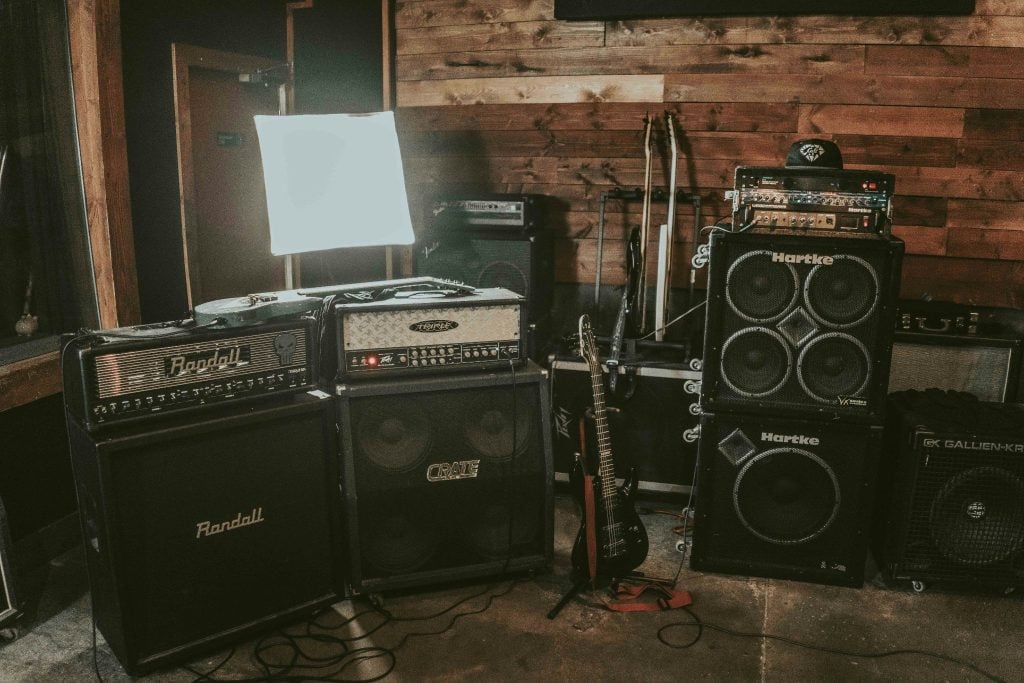
When two guitarists play the same instruments with different amplifiers, ahe sounds will differ. Tone is personal in a sense that transcends preference, becoming more akin to identity, and that identity can be heard most clearly through the guitar amp. The amplifier does not merely amplify the guitar. It interprets the signal, shapes the character, and ultimately becomes the dominant voice in what the audience hears.
Valve Amplifiers and Their Particular Character
Valve amplifiers distort because of the inherent saturation of vacuum tubes when pushed to their operating limits. The harmonic complexity of this saturation can be reproduced by solid-state circuits, but not with the same accuracy. What happens is a sort of propelled sound that is alive and responsive, compressed dynamically when played hard and opened up when the hand doing the picking relaxes. This interactive nature usually attracts those players who tend to be attracted to valve amplifiers, the feeling that the amp is listening to them instead of merely processing their signal.
Solid State Reliability and Tonal Honesty
Solid state amplifiers possess a personality of their own, which is appropriate to certain playing styles and sonic objectives. Their clean headroom is generally greater than that of similar valve designs; that is, they do not become coloured at volumes where a similar valve would start to become saturated. Jazz musicians, country guitarists, and those whose sound is based on complete, clean transparency will find that solid-state designs are more reliable than valve designs. Working musicians also appreciate the consistency and predictability across various settings, which they cannot afford to risk due to the variability introduced by valve amplifiers.
Clean Tone as a Creative Foundation
A guitarist whose main sound is constructed on a clean amplifier platform is making a statement on control and accuracy. Clean tone requires phrasing, dynamics and note choice to bear the musical load, since the amplifier contributes nothing to mask imprecision. Players who cultivate their identity via clean platforms are likely to develop extraordinary touch and an extremely sensitive sense of timing, since the amp will hold them accountable for each decision in a way that motivated tones will somewhat obscure.
Natural Overdrive and the Pushed Amp Sound
Operating a valve amplifier at the limit of its clean operation, when the tubes are just starting to saturate, but the sound has not yet entered the realm of full distortion, creates one of the most desirable sounds in guitar playing. This pushed-amp personality is warm, squashed, and blooms on long notes that pedals and digital processing strive to reproduce. Guitarists who base their identity on this sound often develop a specific association with volume and dynamics, and learn to treat the amp’s threshold as an expressive variable rather than a fixed setting.
Speaker Cabinets and Their Underestimated Role
The speaker cabinet does not passively figure in the tonal equation. The frequency response of all the amplifiers produced depends on the speaker size, the material used, and the speaker’s efficiency. A different combined character of the same head, achieved through a more open, extended cabinet, results from a bright, detailed amplifier paired with a warm, compressed speaker. It is not uncommon to find that changing speakers can bring more tonal change than anything they could do with the amplifier, and this realisation can be both eye-opening and lead to a great deal of further experimentation.
Headroom, Power, and Playing Context
The amplifier’s wattage not only influences volume but also its behaviour during dynamic playing. An amplifier with high wattage, when driven at moderate volume, has a large, clean headroom and behaves differently from a lower-wattage design driven to the same volume. Musicians in smaller spaces, recording at home, or with a particular, focused character at manageable levels frequently find that lower-wattage designs can be more effective at meeting their creative requirements than the specification sheet may indicate. Adjusting the wattage to the actual playing situation, rather than the peak theoretical demand, yields more musically pleasing results.
Effects Loops and Signal Chain Identity
The placement of effects relative to the preamp and power stages of an amplifier affects how they interact with the amp. Effects such as reverb and delay, which are time-based, are not only retained but also retain clarity and definition that are not always possible when placed before the amp. When guitarists develop an advanced understanding of their signal chain, they are conscious of how each component relates to the others, and these choices are central to creating a unique, deliberate sound.
The Amp as a Long-Term Creative Partner
The connection between a guitarist and their main amplifier deepens over time, and the choice of instrument truly shapes that connection. Knowing the specific behaviour of a given amplifier, its sweet spots, its behaviour to various pickup choices, and how it reacts to various pedals influences playing habits and creative decisions throughout the years of usage. This experience is stored as the player’s musical identity in a way that switching among a series of amplifiers never does. Selecting an amp, in this sense, is choosing a long-term creative partner.

Hi! I’m Bryan, and I’m a passionate & expert writer with more than five years of experience. I have written about various topics such as product descriptions, travel, cryptocurrencies, and online gaming in my writing journey.