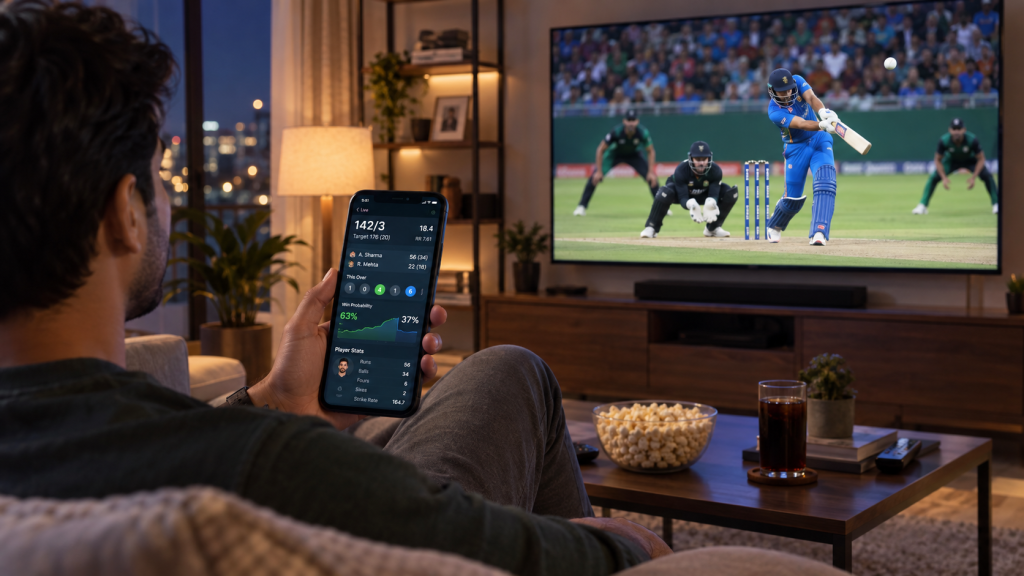
Cricket once asked viewers to keep one eye on the match and another on a paper scorecard. Now a phone can carry the score, commentary, replays, camera choices, alerts, and predictions at once. The match still happens on the field, but much of the fan experience now happens in the hand.
The Scorecard Became a Control Panel
A modern cricket app rarely stops at runs, wickets, and overs. During the 2026 Men’s T20 World Cup, JioHotstar offered multiple camera options, including stump, field, and player views, while official coverage also included vertical video designed for phone screens. The scorecard has become only the first layer.
That shift changes how people read a match. Someone following an online cricket betting app may watch live odds move beside the score, while another fan checks ball by ball commentary or a batter’s recent numbers. Both react to the same delivery, but the screen gives each person a different route through it.
The range of possible actions is easy to see during a single over:
-
A wicket alert can pull someone back into a match they were only half watching.
-
Ball by ball text fills the gap when video is unavailable or inconvenient.
-
Camera selection lets viewers choose an angle instead of accepting one broadcast feed.
-
Live statistics add context before the next delivery arrives.
Cricket gives these features room to breathe because the pauses between deliveries leave time for interpretation. A fan can check the required run rate, compare bowlers, or revisit a dismissal before play resumes. There is time to build a theory, then the next ball arrives and ruins it. Very cricket.
Big Matches Now Live on Small Screens
Mobile viewing has moved far beyond its old role as a backup option. The 2026 T20 World Cup final reached 72.5 million concurrent digital viewers on JioHotstar in India. Three days earlier, the India versus England semifinal had reached 65.2 million. That streaming record survived for roughly one match.
For the individual viewer, the change feels less dramatic. A phone simply becomes the quickest place to check what happened, then often the easiest place to keep following it. The Melbet app sits within that broader mobile habit by combining match information with betting functions, while other cricket services may concentrate on commentary, scores, streaming, or statistics.
Every extra function competes for the same few seconds between deliveries. Does the viewer open a replay, inspect a partnership, change the camera, read commentary, or put the phone down and watch the bowler run in? App design now shapes that decision almost as much as the available data.
Prediction Adds Another Layer
Cricket has always invited prediction. Spectators guess whether a spinner will come on, whether a chase is slipping away, or whether a batter will attack before the field changes. Digital services formalise some of those habits by placing statistics, fantasy scoring, polls, probabilities, and betting markets beside the live action.
Not every interactive feature asks the same thing from the user:
-
Fantasy scoring can make an individual performance matter even after the match result looks increasingly clear.
-
A poll turns a tactical question into a quick crowd response.
-
Win probability graphics give viewers a model based estimate, though models can still get a match spectacularly wrong.
-
Betting markets attach changing prices to possible outcomes, adding a financial decision that ordinary score tracking does not.
The distinction matters. A probability graphic can remain a piece of information that nobody acts on. A betting choice involves money. Both may sit beside the same score, but they represent different kinds of participation.
Watching Has Become Participation
The scale of digital use keeps growing. Before the semifinals of the 2026 T20 World Cup had even started, ICC.tv had already exceeded the entire 2024 tournament for both users and minutes watched. At the same stage of competition, unique users were up 28 percent and total playtime had risen 56 percent.
Those numbers say more than “people watch cricket online.” Viewers increasingly stay inside a digital match environment where they can move between video, commentary, statistics, alerts, and other layers without treating each as a separate activity.
Still, an app does not need to turn every delivery into a button to press. Sometimes the useful feature is the quiet one, a clean scorecard, a replay, or a notification that arrives at the right moment. The phone works best when it adds context without constantly asking for attention.
That is the real change from the old scorecard. Fans once used it mainly to record what had happened. A modern screen lets them inspect the action, replay it, test predictions, and choose how closely they want to follow. The match remains the main event. The app has simply moved much closer to the seat.

Frankie Wilde – is a content writer at various gambling sites. Also, he is a passionate traveler and a great cook. Frankie shares informative articles with the world.