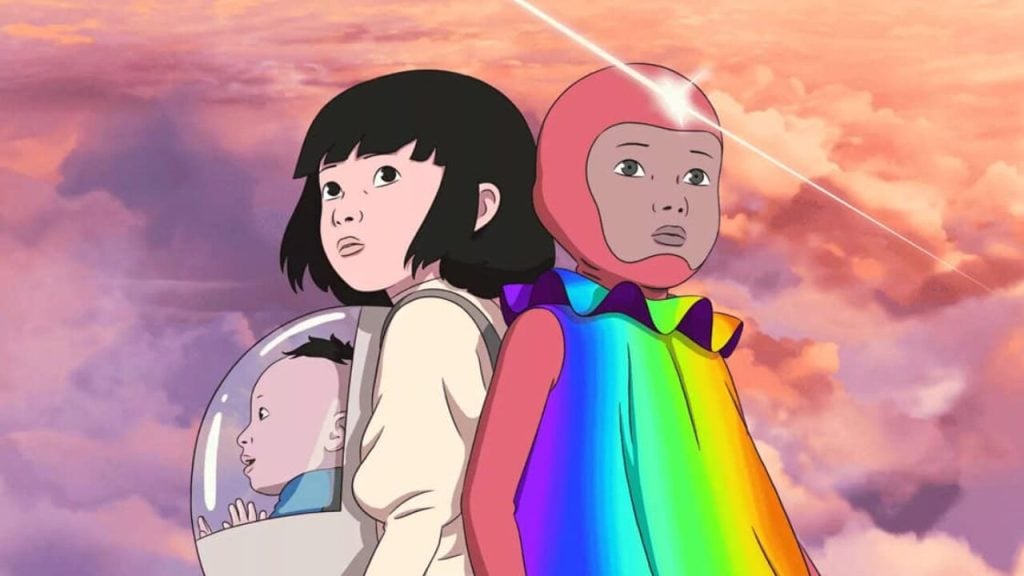
Ugo Bienvenu looked at the state of the world and decided the world needed a hug. “I believe science fiction produces the world that we are living in now,” he says. “I was thinking about what I wanted to see in the world, and I needed energy. I needed hugs. I needed good vibes. I needed that, and if I needed this, then I figured everybody needed it.”
Him and his producer, acclaimed actress Natalie Portman, are sitting with me in the Elevation Pictures interview studio shortly before Arco‘s premiere at the Toronto International Film Festival in September of last year. Much has happened in just four months, yet the film, an animated sci-fi adventure set in the near and distant future, feels more essential than ever. From its premiere at the Cannes Film Festival to its recent Oscar nomination for Best Animated Feature, Arco has proven to resonate with audiences and the industry as a beacon of hope in a deeply uncertain time. Portman, who aspired to make a film her children could enjoy, knew this optimistic story was the right project.
“After having children, I saw that kids see their favorite movies over and over and over and over,” she explains. “You realize how formative it can be. It’s such an amazing opportunity to give people light and hope and a new way to see the world. To see Ugo’s gorgeous artwork paired with a really hopeful vision of the world while acknowledging all of the challenges we face was an incredible opportunity.”
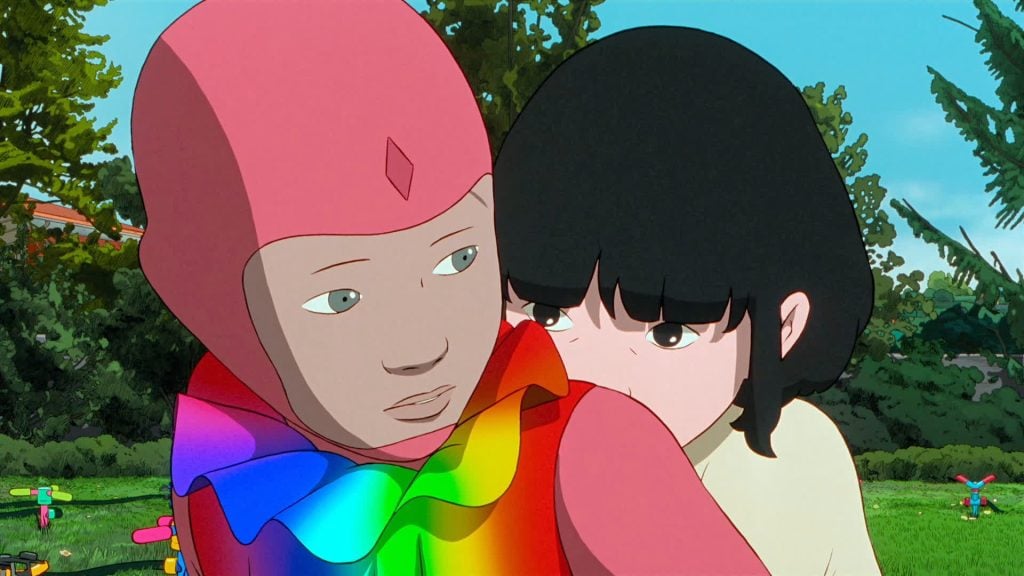
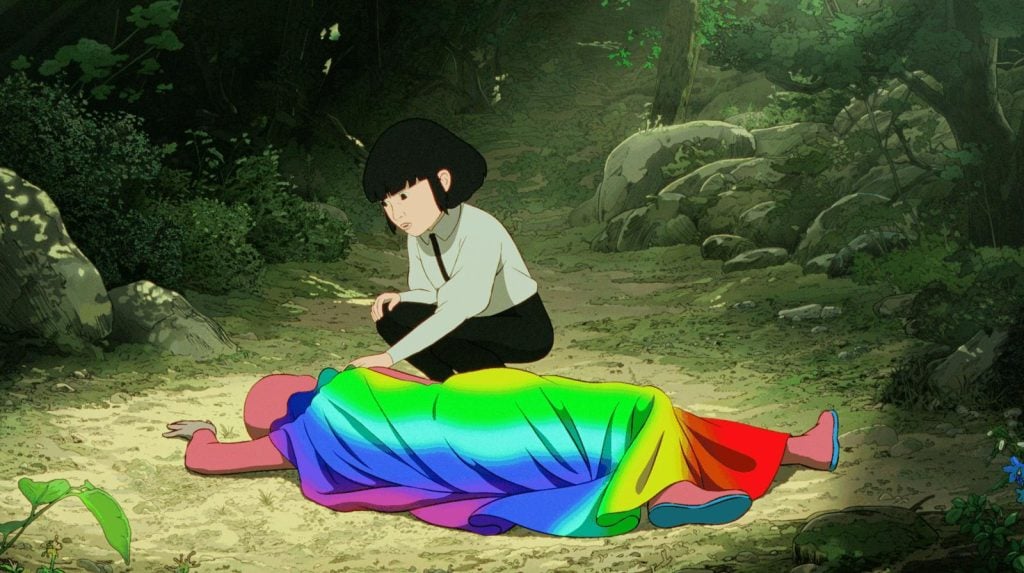
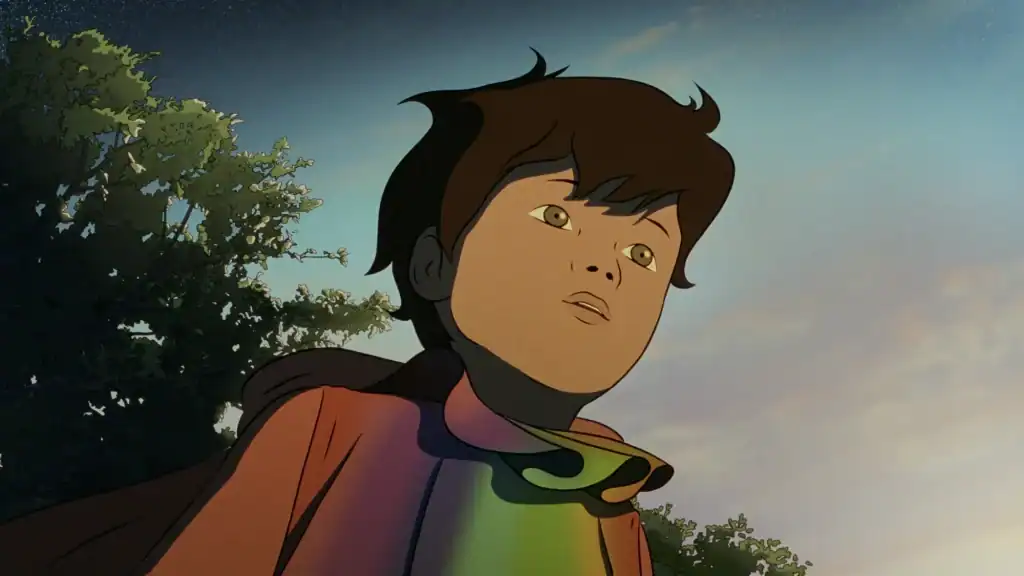
Arco follows its titular protagonist, a young boy from the year 2932 where ecologically-evolved humans can time travel using rainbow-trailed flight suits, as he inadvertently travels back to 2075 and destroys his suit in the process. There, he meets Iris, a young girl determined to help Arco return to his time and outrun three conspiracy theorist brothers determined to capture Arco and reveal him as a time traveler.
Though originally produced in French, the film will be released in the United States with a star-studded English dub featuring Portman along with the voice talents of Mark Ruffalo, Will Ferrell, Andy Samberg, and America Ferrera. Bienvenu, making his feature directorial debut, is excited for audiences to experience Arco in the theater.
“The experience is crazy in cinemas, to me,” expressed Bienvenu. “We worked hard on every detail of the movie, even in the sound [design]. The experience is not the same as when you’re on your sofa in your home without good sound. I hope it will be pleasant on your sofa, too, but let’s try it in cinemas too.”
Here is our full conversation with Arco filmmakers Bienvenu and Portman, edited for length and clarity.
Let me start off the interview by saying, normally, I go into an interview like this having seen the film, but I haven’t actually gotten a chance to see it yet because I want to conserve my first experience for the theater.
Natalie Portman: Oh cool!
Ugo, how important is it for you that this film is going to be seen by audiences in a theatrical setting?
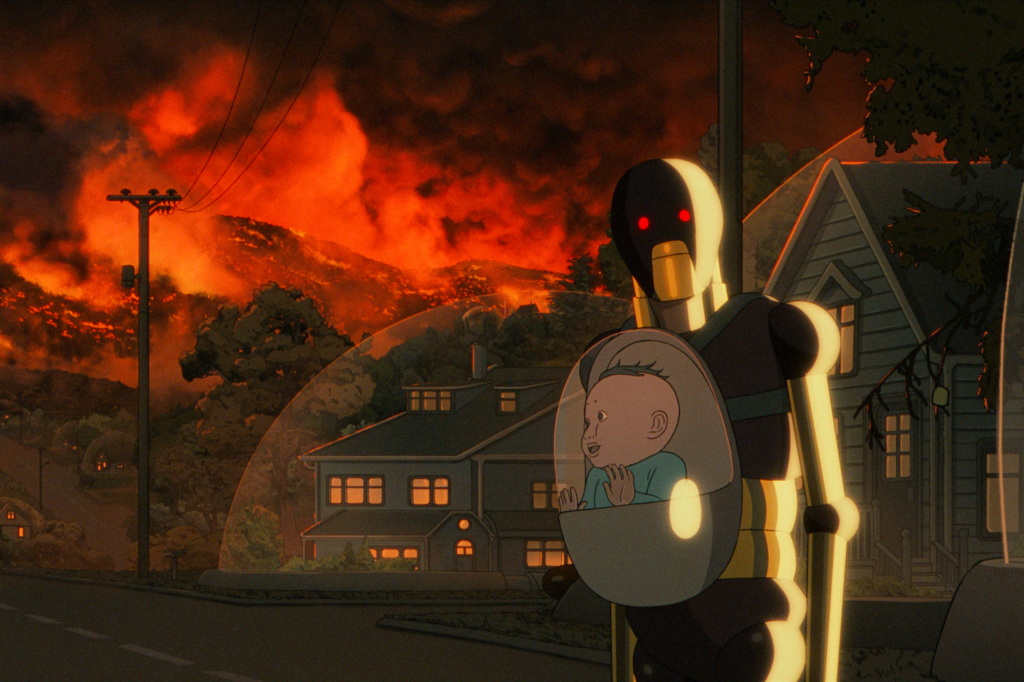
Ugo Bienvenu: We put a lot of effort into the details. We worked hard on every detail of the movie, even in the sound [design]. The experience is not the same as when you’re on your sofa in your home without good sound. Also, you react to the animation very differently when it’s big than when it’s on a computer or on a phone. We added a lot of details so you could pause it everywhere and be delighted. The experience is crazy in cinemas, to me, so I hope it will be for the audience. I hope it will be pleasant on your sofa, too, but let’s try it in cinemas too.
Portman: Yeah, maybe the first five times in the cinema, then the next 20 times at home. [laughs]
Bienvenu: Yeah, exactly. When you’re a kid, you like to watch animated movies over and over again, so that was super important, even in the writing. I wrote it so that you could watch and rewatch and find something new every time you wanted to watch it. As you grow up, you can find new themes, new ways of watching it, because it’s an adventure movie but it’s also a sci-fi movie. It’s also a rom com, in a way. There’s a lot to it and I like playing with genres. I think you can watch it as a romance one time and as an adventure in another.
Natalie, you’ve never worked on an animation before this, correct?
Portman: Mm-hmm. I mean, apart from an episode of The Simpsons, you know?
Bienvenu: Which is badass.
Portman: Thanks. [laughs]
You’ve done so many projects in live action, but for you to get behind this particular film – an independent French animated film – as your first real foray into animation sets a really beautiful precedent.
Portman: Thank you.
How have you watched animation over the years and was there a time when you particularly got to discover the beauty of international animation?
Portman: I loved animation as a kid, like most people do. The Lion King was very important to me as a kid. As I got older, I discovered the Miyazaki films and was opened up to a whole different look for animation. After having children, I saw, as Ugo was talking about, that kids see their favorite movies over and over and over and over, similarly to a favorite book you read every night. As a parent, that information gets in you the same way it gets in your kid, and it really builds a concept of the world. It really builds a mythology, understanding, and an ethical structure of the world. You realize how formative it can be. It feels so influential and such an amazing opportunity to give people light and hope and a new way to see the world. To see Ugo’s gorgeous artwork paired with a really hopeful vision of the world while acknowledging all of the challenges we face was an incredible opportunity.
Had you always wanted to work behind-the-scenes in animation?
Portman: It was definitely a goal of mine to do a voice in animation. While my kids are young, I want love to make something that they can watch that I am part of. Even when I was a kid, I never made movies for kids, except Star Wars; it’s kind of a kid movie but not purely a kid movie. I was actively looking to do a voice, but to produce Arco – that was kind of surprising and was a whole new world for Sophia [Mas], my producing partner, and I, to learn because neither of us had experience in that.
Arco debuted at Cannes in French and went on to premiere an English dub at TIFF, which is what folks in the US are going to see. Ugo, was an English dub for this film ever in your imagination when you were first working on it? Was that something that you ever thought was going to happen?
Bienvenu: We thought we would do it in English first, actually, but, for a lot of reasons, we did the French first. When we decided to do the English version, we wanted to control it and to make it as good as the French version, which we liked a lot. There was a lot of energy in the English dub because we had to do it fast but very well. MountainA’s teams and Remembers’s teams [production companies] were working on it all summer. We wanted the version to not be a copy of the French because it’s not the same culture, but we tried to keep the essence and the philosophy of it intact. We have slightly different cultural ways of saying things.
Were you guys feeling confident that you were going to make an English version prior to NEON getting on board as a distributor?
Bienvenu: I think we knew there would be an English version, no?
Portman: We definitely wanted one. I think when NEON came on, it was certain. It was always the goal, but I think it depended on the film succeeding the way it did. We’re so grateful to have had the French version be embraced at Cannes and then at Annecy. The embrace of the film in French allowed the English version to be 100% possible.
Ugo, so many of your works prior to this – your graphic novels (Sukkwan Island and System Preference) and your shorts – have ranged from dark stories to even dystopian ones. They deal with difficult subject matter. Arco does too, but there’s a far more hopeful spin. You describe it as giving the world a hug. Was it always your intention to work on a project that was more positive from the ground up?
Bienvenu: Yes, and there are two or three reasons for that. The first is that I wanted kids and [I was afraid that] my kids were going to see my work and say it was depressing stuff or too analytical and too cynical. The second is that I was thinking about what I wanted to see in the world, and I needed energy. I needed hugs. I needed good vibes. I needed that, and if I needed this, then I figured everybody needed it. The third is that I believe science fiction produces the world that we are living in now, because [the genre presents] appealing ideas to everybody, like technology. However, we forget that technology is made to allow us time for us, for our inside, to get in our poetic being. Now, technology is, to me, doing the opposite because we’re talking and the phone rings and we’re getting out of our thoughts. It reminds me of something. [In the original French,] the word “imbecile” means one who isn’t able to support himself with a stick. So, at first, technology is a stick. If you don’t use the stick, you’re an imbecile. In Arco, I tried to ask questions. Including, “are we okay with following that path?” I’m not the one to answer, I just let the audience decide, but I think these are important questions to ask.
Arco is now playing in select theaters and will expand nationwide Friday, January 30, courtesy of NEON.
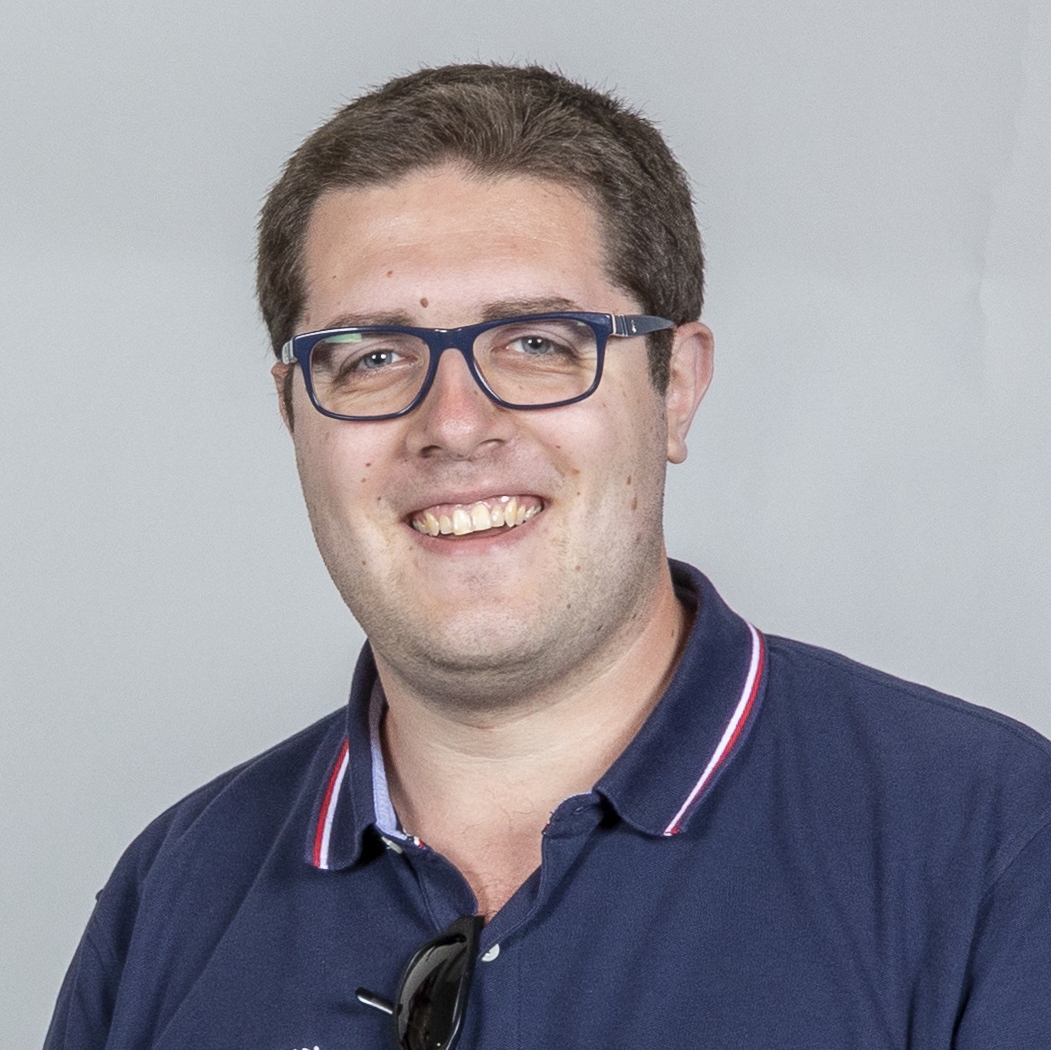
Larry Fried is a filmmaker, writer, and podcaster based in New Jersey. He is the host and creator of the podcast “My Favorite Movie is…,” a podcast dedicated to helping filmmakers make somebody’s next favorite movie. He is also the Visual Content Manager for Special Olympics New Jersey, an organization dedicated to competition and training opportunities for athletes with intellectual disabilities across the Garden State.